Why Sidi Harazem matters
A spring with a public history.
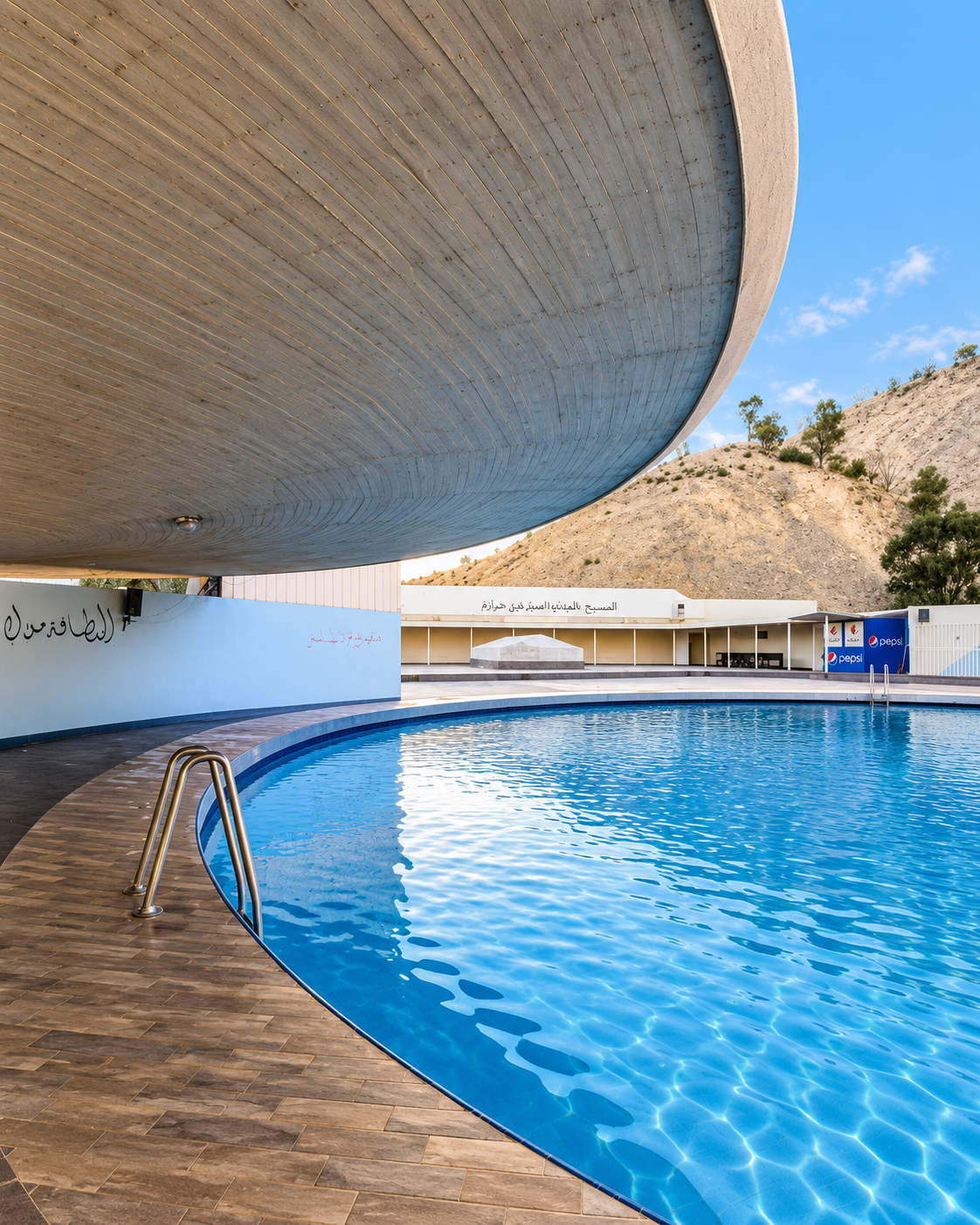
Sidi Harazem brings together two histories that are often separated in travel accounts: the long attraction of mineral springs and the ambitions of modern Morocco. Its setting near Fez became the site of a thermal station designed by Jean-François Zevaco, where leisure was organised through gardens, paths, pavilions and places to gather.
The architecture belongs to the period following Moroccan independence. It broadens the familiar image of the region beyond medina walls and decorated interiors. Here, concrete takes on a different role: forming broad roofs, sculptural supports and open spaces that place the visitor between shelter and landscape. The Archnet site record describes the station as a complex of gardens, walkways, open-air pavilions and accommodation.
The springs are the reason this landscape drew people before the modern buildings appeared. They also help explain why a bath complex cannot be understood through a single pool photograph. Approaching, waiting, resting and meeting are part of the place’s social purpose. Its heritage includes the everyday use of outdoor space alongside the architect’s most recognisable forms.
For a visitor based in Fez, this adds a valuable change of scale. The city’s dense streets give way to a more open composition, where the gaps between structures matter as much as the structures themselves. Looking across a terrace or beneath a canopy reveals how the station connects people with water, shade and the surrounding hills.
For the project’s modern heritage context, see the University of Toronto’s account of the conservation initiative. The station is a useful starting point for exploring Morocco’s twentieth-century architecture.