Visit / Place · Marrakech medina · Palace architecture
Bahia Palace Courtyards, zellige, painted cedar ceilings and Marrakech light
Bahia Palace is a 19th-century Marrakech palace where power becomes interior architecture: white arcades, carved plaster, painted wood, tiled floors, garden rooms and the quiet discipline of craft.
Enter slowly. The palace is strongest when it is read as a sequence of courtyards and thresholds: open light, shaded galleries, decorated ceilings, cool tilework and rooms that reveal their detail one layer at a time.
Bahia Palace matters because it teaches visitors how Moroccan palace architecture works from the inside out. Its beauty is not carried by one facade or one famous room. It comes through movement: courtyard after courtyard, passage after passage, then sudden moments of wood, plaster, marble, zellige and garden shade.
The palace is usually connected with Si Moussa and, especially, with his son Ba Ahmed, the powerful grand vizier who expanded the residence in the late 19th century. That political context is important, but it should not flatten the place into biography. Bahia Palace is also a record of workshop intelligence, urban enclosure and the way elite domestic space was organised around privacy, ceremony and controlled access.
Official Marrakech tourism material describes the name Bahia as meaning the marvelous or the brilliant, and links the palace to Ba Ahmed, the Marrakchi architect Si Mohamed El Mekki El Mesfioui and Moroccan and Andalusian artisans. The craft story is visible everywhere: cedar ceilings, carved and painted wood, plaster surfaces, zellige panels, marble paving and the disciplined geometry of rooms around open air.
For visitors, the palace matters because it makes decoration legible as structure. The tiles are not just pattern; they organise the floor and lower walls. The ceilings are not just colour; they pull the eye upward and change the feeling of scale. The courtyards are not just pretty pauses; they regulate light, air, movement and the social rhythm of the building.
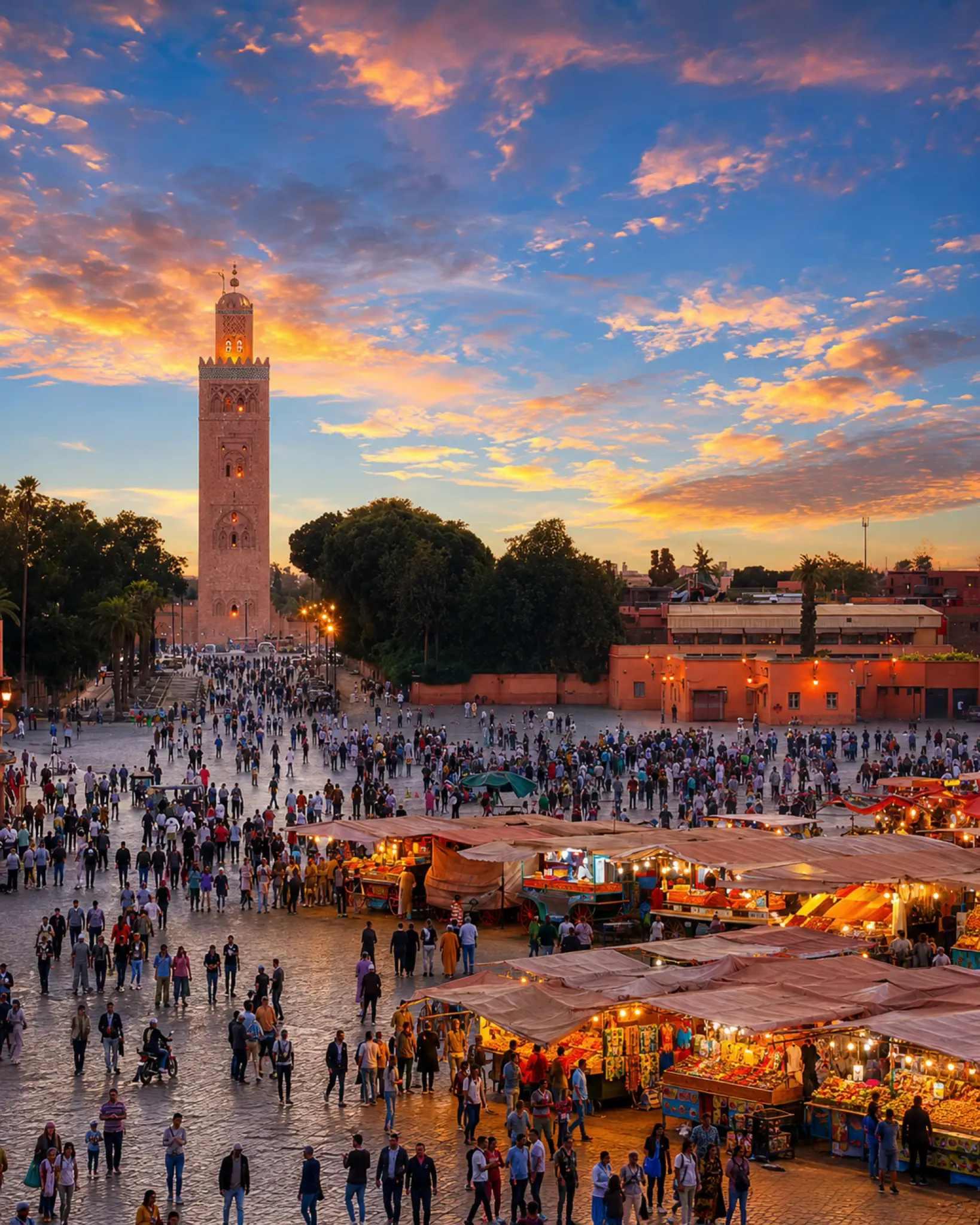
Bahia Palace also gives Marrakech a softer register than the noise of the souks or the open theatre of Jemaa el-Fna. It is still a busy visitor site, but the architecture asks for another pace: stand under the gallery, look across the courtyard, read the edge of a door, then let the painted ceiling answer the tiled floor.
Core orientation is grounded in Visit Marrakech and Visit Morocco. Practical details such as prices, opening hours, access arrangements and transport times should be checked close to travel.
Bahia PalaceMarrakech medinaHistoric palace
Map orientation
Use the map to place Bahia Palace inside the historic Marrakech fabric, close to the palace quarter, Dar Si Said context, Mellah-side streets and the wider medina walking rhythm.
Editorial reading
Its luxury is measured in patience.
Bahia Palace does not reveal itself like a monument seen from a square. Its grammar is interior. The visitor moves from bright courtyard to shaded gallery, from white plaster to blue tile, from carved doorway to painted ceiling, and the building keeps changing scale without announcing each change loudly.
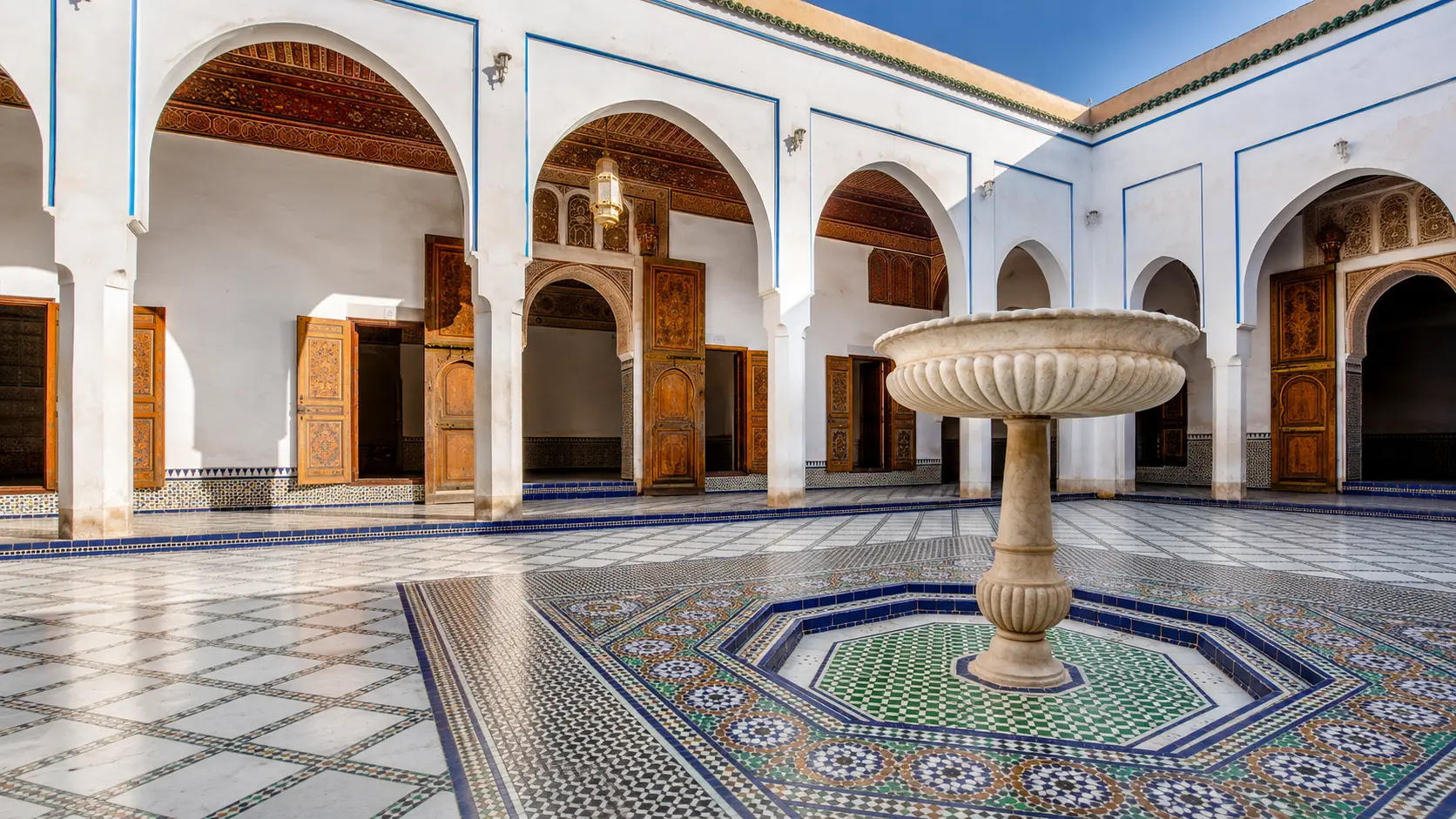
The strongest reading begins with the courtyard. Open sky brings heat and clarity; the surrounding galleries soften both. The fountain is not only an ornament in the middle of a photograph. It fixes the room of air, gives the courtyard a centre, and lets the tiled floor feel deliberate rather than merely decorative.
Then the eye should move to the edges. Door leaves, painted lintels, stucco panels and carved wooden canopies tell visitors that the palace is built through thresholds. Each threshold changes the visitor's attention: public to private, bright to shaded, wide to narrow, movement to pause.
The ceilings are a second architecture above the body. Painted cedar and carved wood draw colour into the upper register, while zellige and marble hold the lower register close to the hand and foot. Bahia Palace is beautiful because these levels speak to one another.
That is why a fast visit can feel strangely incomplete. The palace rewards looking sideways, upward and back across a courtyard after crossing it. It rewards the moment when the visitor realises that the route itself is part of the design.
Respectful looking matters here. Painted wood, plaster and tile can survive many visitors only when the building is treated as heritage rather than scenery. The best photographs come after the eye has understood the room; the best memory comes after the visitor has stopped trying to consume every detail at once.
Leave with one clear idea: Bahia Palace is not simply a display of Moroccan ornament. It is an argument for proportion, privacy, water, light, craft and controlled movement inside a dense city.
Historical and heritage orientation
Read the palace through patronage, workshops and urban enclosure.
Bahia Palace belongs to late 19th-century Marrakech and to the political world of grand viziers, royal proximity and elite domestic architecture. Its visitor value today comes from reading that history together with the craft system that made the building memorable: tiled surfaces, marble floors, carved plaster, painted cedar ceilings, courtyards and gardens organised around privacy and display.
01Place type
A medina palace
This is not a city gate, mosque or standalone museum building. It is a palace complex inside Marrakech's historic fabric, organised through courtyards, interior rooms, gardens, galleries and controlled transitions.
0219th century
Si Moussa and Ba Ahmed
The palace is associated with Si Moussa and was expanded under Ba Ahmed, whose late 19th-century role as grand vizier shaped the scale, ambition and ceremonial character of the residence.
03Craft network
Materials from across Morocco
Visit Marrakech links the palace to Moroccan and Andalusian artisans, with tilework from Tetouan, marble from Meknes and cedar wood from the Middle Atlas used for painted and illuminated ceilings.
04Visitor reading
Empty rooms, full surfaces
Much of the power today comes from architecture rather than furnishings. Visitors read the palace through proportion, floor patterns, courtyard edges, painted timber, carved plaster and the way rooms hold light.
A visual bridge
Three readings between courtyard, craft and city
Before Bahia Palace becomes a set of details, it is a spatial lesson. These three readings help visitors slow down and connect the palace to Marrakech: the open courtyard, the crafted surface and the quiet route through a dense medina world.
01
Courtyard
Open sky as architecture
The courtyard is not a pause between important rooms. It is one of the main rooms. White walls, tile borders, marble paving, shadow lines and the central fountain turn open air into a composed architectural space.
Stand back before crossing the floor.
Read the fountain as a centre, not a prop.
Notice how shade changes the galleries.
02
Craft
Surfaces that organise attention
Zellige, marble, plaster and painted cedar do more than decorate. They separate zones, mark thresholds, cool the lower wall, lift the ceiling and make movement through the palace feel measured.
Compare floor patterns with wall panels.
Look upward before leaving each room.
Read colour as structure, not noise.
03
City
A quiet interior inside Marrakech
The palace makes most sense when connected to the surrounding medina. Outside, the city is movement, trade and street rhythm. Inside, the palace compresses that energy into sequence, privacy and carefully managed light.
Connect the visit to Marrakech's historic core.
Move slowly between bright and shaded areas.
Let the route explain the building.
Quick orientation
Type of place
A 19th-century palace complex in Marrakech, best read through courtyards, riad gardens, carved plaster, painted cedar ceilings, marble, zellige and interior route logic.
Urban context
The palace sits within Marrakech's historic medina fabric, close to other heritage stops and best approached as part of a slower walking sequence through the old city.
Best for
Architecture lovers, craft detail, zellige, painted wood, courtyard photography, material reading, garden atmosphere and visitors who want Marrakech beyond the obvious viewpoint.
Closest city context
Marrakech is the essential frame: Bahia Palace belongs to the city's palace, medina, craft and courtyard traditions rather than to a detached monument experience.
What visitors experience here
A palace that unfolds through rooms of light.
Bahia Palace works in stages. First comes the brightness of the courtyard and the confidence of the white arcades. Then the eye starts to collect smaller signals: blue edges, painted doors, carved plaster, cedar ceilings, marble floors and the coolness created by shade, tile and enclosed gardens.
Arrival
The courtyard as first lesson
The main courtyard teaches the rhythm immediately: open sky, strong geometry, a central fountain and surrounding rooms that hold their detail at the edges. It is an architectural pause with real authority.
Light
White walls, blue lines, warm wood
The palace is not visually heavy. Sunlight makes the plaster bright, blue tile borders sharpen the arcades, and painted wooden ceilings bring warmth into shaded areas without making the rooms feel dark.
Movement
Threshold after threshold
The visit is a sequence rather than a straight line. Each doorway changes the scale: wide courtyard, narrower passage, decorated chamber, garden edge, then another turn back toward light.
Craft
Ceilings that reward looking up
Painted cedar ceilings are among the palace's clearest pleasures. Their colour and geometry complete the rooms from above, balancing the tilework and marble that hold attention near the floor.
Gardens
Riad calm inside the city
Garden spaces soften the building's ceremonial side. Trees, shade, water and enclosed air remind visitors that palace architecture also managed comfort, privacy and retreat.
Pace
A slower kind of richness
The palace can feel busy, but the architecture still asks for patience. The better visit returns to details after seeing the whole room: a carved edge, a painted beam, a tile border, a shadow line.
Place details and orientation
Read Bahia Palace through six defining elements
No single room explains the palace. Its meaning comes from the relationship between courtyard planning, water, craft surfaces, painted ceilings, garden spaces and the way privacy is built through movement.
1
Courtyard composition
Arcades, paving, fountain and open sky create the palace's clearest spatial statement: architecture arranged around light, symmetry and pause.
2
Zellige tilework
Tile patterns give colour and order to floors and lower walls, making geometry part of the visitor's physical movement through the building.
3
Painted cedar ceilings
The decorated timber ceilings change the emotional temperature of the rooms, lifting colour above the body and giving shaded interiors depth.
4
Carved plaster and wood
Stucco, doors, lintels and carved wooden details turn thresholds into moments of attention rather than simple openings.
5
Riad garden logic
Garden spaces connect architecture to water, shade, planting and privacy, giving the palace a softer rhythm beyond the ceremonial courtyards.
6
Marrakech medina setting
The palace should be read with the surrounding city: dense streets outside, controlled interior space inside, and heritage routes nearby.
Palace, not backdrop
The place asks for a careful eye.
Begin with the whole courtyard before chasing individual details. The first lesson is spatial: floor, fountain, arches, galleries and sky all work together. That composition explains why the palace feels calm even when many visitors are moving through it.
Then move closer. Door paintings, plaster relief, zellige edges and ceiling beams make the building intimate. Bahia Palace becomes more powerful when the visitor understands that every surface has a role in guiding the eye and slowing the body.
Finally, connect the palace back to Marrakech. Outside is the medina's compressed urban energy; inside is an architecture of privacy, ceremony and controlled light. The contrast is part of the experience.
Architecture and material intelligence
Craft here is spatial intelligence.
At Bahia Palace, ornament is not an extra layer pasted onto architecture. The materials help organise the building. Zellige cools and defines the lower surfaces, marble gives courtyards brightness and weight, plaster softens walls into relief, and painted cedar ceilings complete rooms from above.
This is why the palace should be read slowly. A visitor who only collects patterns misses the deeper lesson: craft can guide movement, regulate attention, mark private and ceremonial spaces, and turn enclosed rooms into places of changing light.
What to notice slowly
Look across each courtyard before photographing the fountain or door details.
Compare the lower zellige bands with the painted wood above.
Notice how white plaster reflects light into shaded galleries.
Read doors and thresholds as part of the palace route, not isolated decoration.
Give attention to garden spaces, where water, shade and privacy soften the architecture.
Avoid touching fragile surfaces, leaning into carved work or blocking narrow passages.
Architectural reading
Three architectural languages to notice
Court and centre
The fountain and courtyard floor create an ordered centre. The surrounding arcades then turn that centre into a room of air, light and measured movement.
Threshold and privacy
Bahia Palace is built through transitions. Doorways, passages and chamber entrances make privacy architectural, guiding visitors from bright public-feeling spaces into more intimate decorated rooms.
Surface and scale
Zellige, plaster, marble and painted cedar each operate at a different height and distance. Together they make the palace readable from floor level, eye level and ceiling level.
Visual atmosphere
Light, colour and interior calm
From courtyard to ceiling
Start with the open courtyard, then let the eye climb. The palace is arranged so that ground pattern, wall border, arch, carved panel and painted ceiling form a complete vertical reading.
From white plaster to colour
The strongest colours work because they are held by restraint. White walls, blue lines, warm cedar, green tile and marble brightness keep the palace vivid without making it visually chaotic.
From photograph to memory
The lasting memory is not only the fountain or the ceiling. It is the shift from Marrakech street energy into enclosed quiet, then the repeated discovery of detail inside light, shade and crafted edges.
Nearby places and onward links
Connect Bahia Palace to the wider Marrakech map
Bahia Palace belongs to a broader Marrakech heritage route. Use the city guide, imperial region, architecture theme and planning pages to place the palace inside a richer medina and craft journey.
Marrakech
The essential city context for Bahia Palace: medina streets, palace quarters, gardens, craft traditions, food culture and layered historic routes.
Bahia Palace is a delicate place to move through because the surfaces are the experience. Walk carefully through narrow thresholds, avoid touching carved plaster or painted wood, keep bags and shoulders away from fragile edges, and leave space for other visitors to look without pressure.
Respect also means slowing down the camera. The palace is photogenic, but not every doorway, staff member, guide, visitor or private-feeling corner should become a frame. Ask before photographing people, keep voices low in enclosed rooms, and let the building remain more than a backdrop.
Keep hands away from carved plaster, painted timber, doors and tile edges.
Move through thresholds without blocking circulation or crowding doorways.
Ask clearly before photographing people, guides, staff or small working moments.
Respect closed, roped or fragile areas even when details are visible from outside.
Check current access, restoration conditions and practical arrangements close to travel.
A strong first visit
Begin with the main courtyard and give it time. Stand where you can see the fountain, paving, arcades and room openings together. This first view gives the palace a structure in your mind before the smaller details begin to compete for attention.
After that, move by layers. Look down at the floor patterns, across at the zellige and plaster, then up to the painted cedar ceilings. Repeat that rhythm in each major space. Bahia Palace becomes clearer when the eye understands how lower, middle and upper surfaces work together.
Use pauses rather than speed. Wait for crowded rooms to thin where possible, step aside in narrow passages, and return to a courtyard after visiting adjoining rooms. Looking back often reveals the building better than looking forward.
Afterward, connect the visit to Marrakech rather than treating it as an isolated attraction. The medina, Dar Si Said context, palace-side streets, craft traditions and garden culture all help Bahia Palace feel like part of a living urban fabric.
Start with the courtyard, where the full composition is easiest to read.
Follow the sequence of floor, wall, doorway and ceiling in each room.
Pause in shaded galleries to see how light changes the plaster and tilework.
Leave space for local staff, guides, groups and visitors moving through tight areas.
Finish by reconnecting the palace to Marrakech's medina and craft context.
Careful planning note: opening hours, prices and exact travel times can change. Verify practical arrangements locally before travelling.
Go deeper through the nearest city context
Marrakech - the city gateway to Bahia Palace
Bahia Palace belongs naturally inside a wider Marrakech journey. The city gives visitors the right frame for reading medina movement, palace architecture, garden culture, painted wood, zellige, craft workshops and the relationship between public streets and private interiors.
Use Marrakech to widen the context after the palace itself. Jemaa el-Fna, medina lanes, historic quarters, gardens, museums and craft streets all help explain why Bahia Palace feels both enclosed and deeply connected to the city around it.
Marrakech city orientationMedina walking contextPalace and garden cultureArchitecture and heritage readingZellige and painted woodPractical travel structure
Read the palace slowly, then connect it to Marrakech's medina, craft traditions, palace architecture, garden spaces and the wider heritage map of Morocco.