
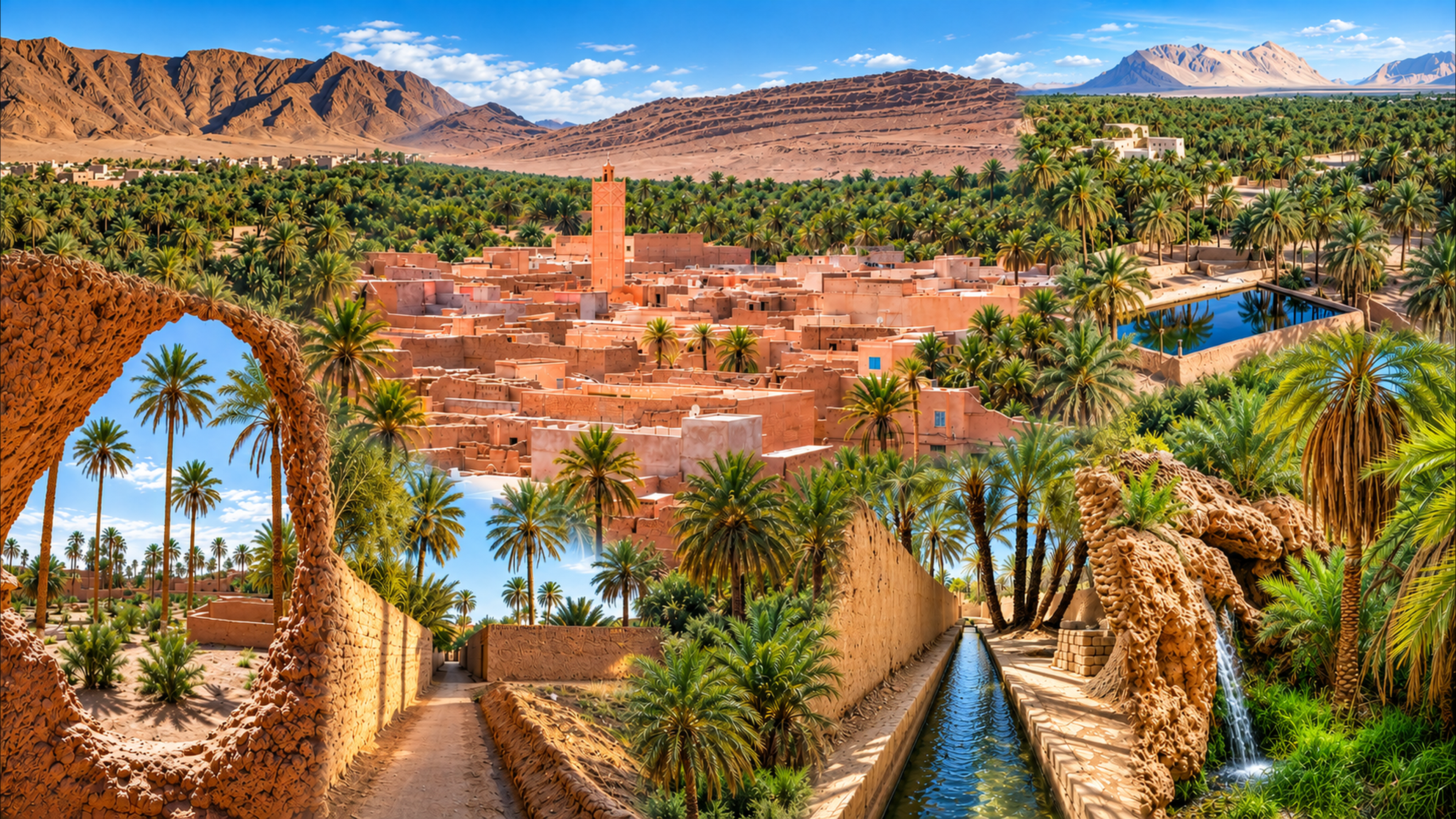
Figuig Oasis with palm groves, earthen settlement, irrigation water and surrounding mountains in eastern Morocco

Visit / Place · Oriental region · Eastern Morocco

Figuig Oasis A water-shaped landscape of palm gardens, earthen ksour and desert-edge settlement

Figuig Oasis is a historic cultural landscape where seven ksour, cultivated palm gardens and carefully managed water form one coherent settlement system at Morocco’s far eastern edge.

Begin with the grove as a whole. The oasis becomes clearer when palms, earthen walls, shaded lanes, irrigation lines and surrounding dry country are read together before attention turns to individual buildings.

Why Figuig Oasis matters

An oasis before it is a postcard.

Figuig matters because the palm grove, the ksour and the water system are not separate attractions. They are parts of one lived oasis landscape. Settlement took shape around scarce water, cultivated gardens and compact earthen neighbourhoods, creating a human geography adapted to an arid environment.

Morocco’s UNESCO Tentative List dossier describes seven ksour forming a coherent whole, linked to a palm-grove landscape of irrigated gardens. It also records monumental and everyday heritage across the oasis: walls, watchtowers, religious buildings, gates, public spaces and water infrastructure. The value lies in the relationship between these elements rather than in one dominant monument.

Water is the organising principle. Springs and traditional distribution systems support gardens and settlement, while shade from palms and walls moderates the experience of the cultivated landscape. The oasis therefore reads as environmental knowledge made visible: where water can move, where plants can grow, where walls create enclosure and where daily life can continue under dry conditions.

The built fabric adds another layer. Earthen construction, palm wood and lime are among the local materials identified in the UNESCO nomination dossier. Their presence connects architecture directly to place, but also to maintenance: earthen buildings and traditional systems survive through ongoing knowledge, repair and use.

For visitors, the strongest experience is not simply “seeing palm trees.” It is understanding how grove, garden, lane, water channel, wall and ksar depend on one another. Figuig rewards a slow reading because its intelligence is distributed across the landscape.

Heritage orientation is grounded in the UNESCO World Heritage Centre Tentative List entry for Oasis de Figuig. Morocco submitted the property in 2011; Tentative List status is not the same as World Heritage inscription. Practical access details should be checked close to travel.
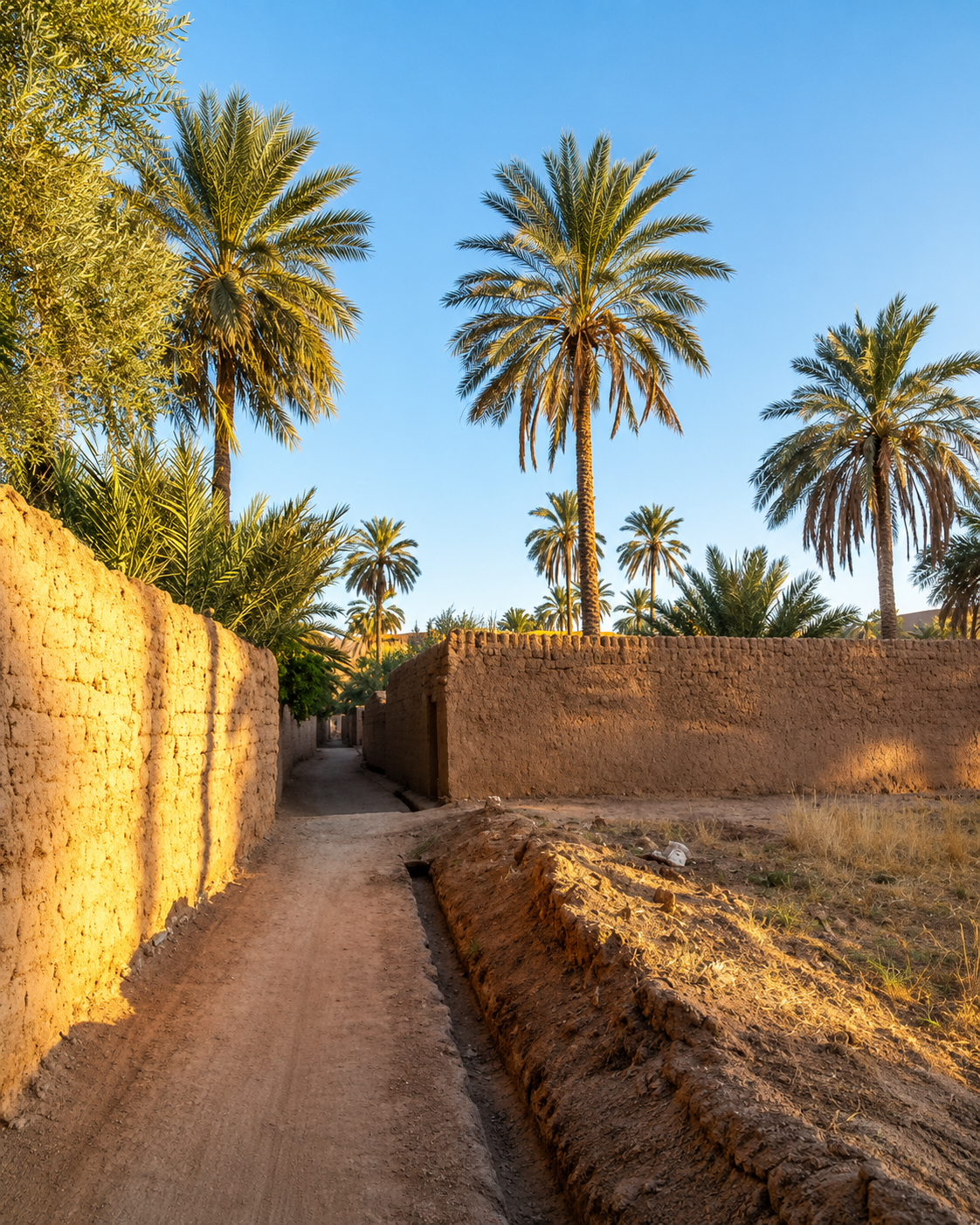
Palm-lined earthen lane within the cultivated landscape of Figuig Oasis

Map orientation

Use the map to place the oasis at Morocco’s far eastern edge and to understand how the cultivated grove sits within a much drier regional landscape.

Editorial reading

Its beauty is structural, not decorative.

Figuig’s visual character comes from organisation: water moving through channels, gardens arranged around access to irrigation, palm crowns building shade above lower crops, and earthen walls creating protected lanes at ground level.

The grove is therefore not background scenery for the ksour. It is part of the same system. Built fabric defines settlement and enclosure; water defines possibility; cultivation fills the space between them with productive life.

Look for changes in scale. From outside, the oasis appears as a green body against dry land. Within it, the view narrows to walls, trunks, channels and paths. That compression is essential to understanding why oasis landscapes feel different from open desert-edge terrain.

Shade is another form of structure. Palm canopies, fruit trees and walls reduce exposure and create a sequence of cooler and hotter spaces. The visitor experiences climate not as an abstract fact but as a series of transitions between sun, shadow and moving air.

Earthen surfaces should be read with the same care. Their colour belongs to local material and light, while cracks, repairs and weathering reveal that this architecture is maintained rather than frozen. Monumentality here can be visually strong and materially vulnerable at the same time.

Water infrastructure deserves special attention without intrusion. Channels, basins and distribution points explain the oasis more clearly than a decorative viewpoint can. Observe how water crosses or parallels paths, how gardens sit beside built edges, and how the entire settlement depends on controlled flow.

The deeper memory of Figuig comes from this interdependence. Palms, ksour, gardens and water form a cultural landscape in which beauty is the visible result of adaptation, organisation and continuity.

Historical and heritage orientation

Read the oasis through settlement, water and continuity.

Figuig is not a single historic quarter placed beside a palm grove. Its heritage value comes from the cohesion of seven ksour, irrigated gardens, earthen architecture and social practices around water. Morocco placed the oasis on its UNESCO World Heritage Tentative List in 2011, recognising this combined cultural landscape while also documenting pressures on traditional fabric and cultivation.

01Settlement

Seven ksour, one oasis

The UNESCO nomination dossier describes seven ksour that remain spatially distinct yet form a coherent oasis system. Their significance comes from the network they create with gardens, water and shared cultural practices.

02Water

Irrigation as heritage

Springs, foggaras, basins and canals are part of the cultural landscape, not merely utilities. They show how scarce water has been organised and distributed to sustain gardens and settlement.

03UNESCO 2011

Tentative List status

Morocco submitted Oasis de Figuig to UNESCO’s World Heritage Tentative List in 2011 under cultural criteria. It is important to describe this accurately: the oasis is a candidate property, not an inscribed World Heritage Site.

04Continuity

A landscape that requires care

The nomination dossier identifies vulnerability in old earthen fabric and parts of the cultivated landscape. Figuig should therefore be read as heritage sustained through use, knowledge and maintenance rather than as a preserved museum set.

A visual bridge

Three readings between palm grove, ksar and desert edge

Figuig becomes clearer when the visitor stops separating nature from settlement. Water, cultivation and earthen architecture form one visual system, and each reading below reveals a different part of that relationship.

01

Water

Flow as landscape

Water is the hidden geometry of the oasis. Channels and basins organise cultivation, connect gardens and help explain why dense green growth can exist within a dry regional setting.

  • Watch where channels meet paths and walls.
  • Notice how cultivated plots follow access to water.
  • Read irrigation as infrastructure and heritage together.
02

Settlement

Earth beside cultivation

The ksour belong visually to the grove because their earthen walls, shaded passages and compact organisation answer the same climate. Built form and cultivated land reinforce one another.

  • Compare wall colour with surrounding soil.
  • Notice how lanes create shade and enclosure.
  • Look for the boundary between garden and built fabric.
03

Looking

Distance before detail

From outside, Figuig reads as a green oasis body set against dry land. Inside, trunks, walls and water narrow the field of view. Moving between those scales is central to the visit.

  • Start with the full grove and settlement edge.
  • Move slowly into narrower palm and wall corridors.
  • Return to a wider view to reconnect the parts.

Quick orientation

Type of place

A historic oasis cultural landscape made up of seven ksour, irrigated palm gardens, earthen architecture and traditional water infrastructure.

Region

Figuig lies in Morocco’s Oriental region at the country’s far eastern edge, where cultivated oasis land meets dry mountain and desert-edge terrain.

Best for

Oasis landscapes, earthen architecture, water systems, slow walking, cultural-landscape reading, responsible photography and travellers interested in how settlement adapts to aridity.

Closest city context

Figuig itself is the urban and cultural gateway. Use the city context to understand the ksour, local services, settlement history and the wider eastern Moroccan setting.

What visitors experience here

A place that changes as you walk it.

Figuig shifts constantly between wide and narrow space. A distant view gives palms and settlement one outline; inside the oasis, earthen walls, garden edges, trunks, irrigation channels and patches of shade break that whole into a sequence of close observations.

Arrival

The oasis from outside

From drier surrounding ground, the palm grove appears as a concentrated green mass. That first contrast explains the oasis before any individual monument does: water and cultivation have created a distinct inhabited landscape.

Light

Shade, glare and leaf pattern

Sunlight is filtered by palm crowns, fruit trees and walls. The strongest visual moments often come from transitions: bright openings, cool lanes, patterned shade and the sudden return to exposed sky.

Movement

Palm paths and narrow lanes

Walking compresses the landscape. Paths pass between gardens and earthen edges, and turns reveal small changes in elevation, shade and access. The experience is spatial rather than spectacular.

Material

Earth, palm wood and lime

The UNESCO nomination dossier identifies dried earth brick, palm wood and lime among Figuig’s local building materials. Their tones and textures connect architecture to soil, vegetation and climate.

Water

Channels inside daily space

Irrigation is visible in the relationship between channels, basins, garden plots and paths. Look at how water infrastructure is embedded in ordinary space rather than isolated as a separate attraction.

Pace

A slower kind of visit

Figuig reveals itself through accumulated details. A measured pace allows the eye to connect water, shade, cultivation and settlement without turning private or working spaces into scenery.

Place details and orientation

Read Figuig Oasis through six defining elements

The oasis makes sense as a network. Each element below explains one part of the system, but the strongest reading comes from seeing how settlement, cultivation and water reinforce one another.

1
Seven ksour

The historic ksour form the settlement backbone of Figuig. Their value lies not only in individual structures but in the way distinct fortified neighbourhoods belong to one oasis landscape.

2
Earthen walls and local materials

Dried earth brick, palm wood and lime connect the built environment to locally available resources. Thick walls and shaded passages also help make climate response visible in everyday architecture.

3
Palm-grove gardens

The cultivated landscape is more than a ring of palms. Terraced and layered gardens create productive ground beneath and between trees, linking agriculture directly to the identity of the oasis.

4
Foggaras, basins and canals

Traditional water infrastructure distributes scarce water through the oasis. These systems are central to understanding how gardens survive and why water management is part of the heritage itself.

5
Civic and sacred landmarks

The UNESCO dossier records mosques, mausoleums, gates, squares and other communal features within the wider cultural landscape. Their significance is strongest when read within settlement life, not as isolated objects.

6
Desert-edge geography

Figuig’s green cultivated core is intensified by surrounding dry terrain. The contrast makes the oasis visible as an environmental achievement rather than simply a picturesque pocket of vegetation.

Oasis, not scenery

The place asks for a connected eye.

Start by locating the green mass of the grove against the dry setting. That distance reveals the basic fact of Figuig: water has made a concentrated cultivated and inhabited landscape possible where the regional environment is far less forgiving.

Then move into the oasis and let the scale contract. Palm trunks, earthen walls, garden edges and water lines become more important than panoramas. This is where environmental structure becomes visible at human height.

Finally, connect the ksour back to the grove. The built fabric is not an architectural display inserted into nature; it is part of a settlement system whose materials, shade, access and organisation respond to the same conditions that shape cultivation.

Landscape and material intelligence

The oasis is infrastructure before scenery.

Figuig’s beauty is inseparable from systems that work. Irrigation brings water to cultivated ground; palms and other trees create shade; earthen walls define lanes and gardens; compact settlement reduces exposure and organises community space. The visible landscape is the outcome of practical relationships.

The UNESCO Tentative List dossier describes the oasis as a coherent cultural landscape where ksour, palm-grove gardens and irrigation are closely interwoven. That framing is useful because it prevents the visitor from treating “nature” and “architecture” as two separate experiences.

What to notice slowly

  • Look for the line between cultivated garden, irrigation edge and settlement wall.
  • Notice how palm shade changes temperature, colour and the rhythm of walking.
  • Read earthen walls as climate-responsive construction, not simply visual texture.
  • Watch how channels and basins organise space without becoming dominant objects.
  • Compare wide views of the grove with the compressed scale of lanes inside it.
  • Respect private gardens, homes and working water infrastructure as lived spaces.

Architectural and landscape reading

Three languages that hold the oasis together

Built edge and grove

Earthen walls do more than enclose buildings. They mark transitions between lanes, gardens and neighbourhoods, giving the oasis a readable structure at ground level while palms create a second, higher canopy above.

Water as hidden structure

The most important lines may be the least monumental. Irrigation routes explain where cultivation can persist and how gardens relate to one another. Water turns the oasis from a collection of sites into a functioning landscape.

Repair and continuity

Earthen construction, garden walls and water systems depend on maintenance. Weathering and repair should be read as part of living heritage, reminding visitors that continuity comes through care rather than architectural permanence.

Visual atmosphere

Light, shade and quiet transitions

From grove to lane

Begin with palms reading as one green mass, then move inward until the view breaks into trunks, earthen walls, small openings and cultivated edges. That shift from landscape scale to human scale is one of Figuig’s most distinctive visual experiences.

From shade to sun

Much of the atmosphere comes from contrast rather than colour. Filtered shade under palms, cooler wall-lined passages and sudden areas of hard light make the oasis feel spatially varied even when the materials remain simple.

From photograph to memory

The strongest memory is rarely one object. It is the sequence of dry approach, green canopy, earthen enclosure, water movement and quieter interior paths. Figuig stays coherent because each of those impressions belongs to the same system.

Nearby places and onward links

Connect Figuig Oasis to the wider eastern Morocco map

Figuig is both the immediate city context and the best starting point for understanding the oasis. From there, widen the journey through the Oriental region, architecture-focused themes and Exotic Morocco’s broader place network.

Figuig

The city gateway to the oasis, bringing together local orientation, settlement context and the human side of this remote eastern landscape.

Open Figuig city guide

Oriental Region

Place Figuig within Morocco’s broader east, where mountain, steppe, oasis and Mediterranean-facing landscapes create a very different regional rhythm.

Explore Morocco’s regions

Architecture & Heritage

Use the theme to connect Figuig’s ksour and earthen construction with wider Moroccan traditions of material, settlement and preservation.

Read the theme

Visit Morocco places

Continue through oases, valleys, caves, monuments, coasts and cultural landscapes beyond the city guides.

Browse Visit places

Plan your journey

Use the planning section to structure a longer eastern Morocco route and to verify current transport, access and practical conditions close to travel.

Plan your journey

Stories from Morocco

Go beyond orientation through deeper editorial reading about landscape, memory, materials, communities and the cultural logic behind places.

Read stories

How to visit respectfully

Good behaviour protects the experience.

Figuig is a lived oasis, not an open-air exhibit. Paths can pass close to homes, cultivated plots and working water infrastructure. Keep a measured pace, use clearly public routes, and avoid treating garden edges or residential thresholds as unrestricted access.

Respect for the oasis also means respecting its physical systems. Do not step into irrigation channels, climb on earthen walls, damage palm or garden growth, leave litter or block narrow lanes. A careful visitor sees more because attention replaces intrusion.

  • Ask before photographing people, private homes, courtyards or working agricultural spaces.
  • Stay on appropriate paths and keep irrigation channels, basins and garden boundaries clear.
  • Avoid climbing, leaning on or scratching earthen walls and other vulnerable fabric.
  • Carry water and sun protection, and plan for exposed dry conditions outside shaded areas.
  • Check current local access and route guidance close to travel rather than relying on old reports.

A strong first visit

Start with a broad view of the oasis so the green cultivated zone can be read against the surrounding dry terrain. This first contrast gives the rest of the visit a framework: water has concentrated agriculture and settlement into a clearly defined landscape.

Then move into public lanes at walking pace. Pay attention to where walls create shade, where palms rise above garden plots, and where water infrastructure appears beside or beneath paths. These small relationships explain more than a sequence of isolated monuments.

When earthen architecture comes into focus, look for material intelligence rather than perfection. Wall thickness, patched surfaces, palm-wood elements and narrow passages show how building responds to climate and maintenance over time.

Finish by returning mentally to the whole system. The ksour, gardens and irrigation network are most meaningful when seen as interdependent. The city of Figuig then becomes the natural context for understanding local routes, services and the social geography around the oasis.

  • Begin with the oasis as a whole before entering narrow lanes.
  • Follow public paths and observe water systems without interfering with them.
  • Use shade and material changes to read how the oasis manages climate.
  • Leave private gardens, homes and working spaces their proper distance.
  • Continue through Figuig city context to deepen the settlement story.

Careful planning note: access conditions, transport arrangements and local services can change. Verify current information locally before travelling.

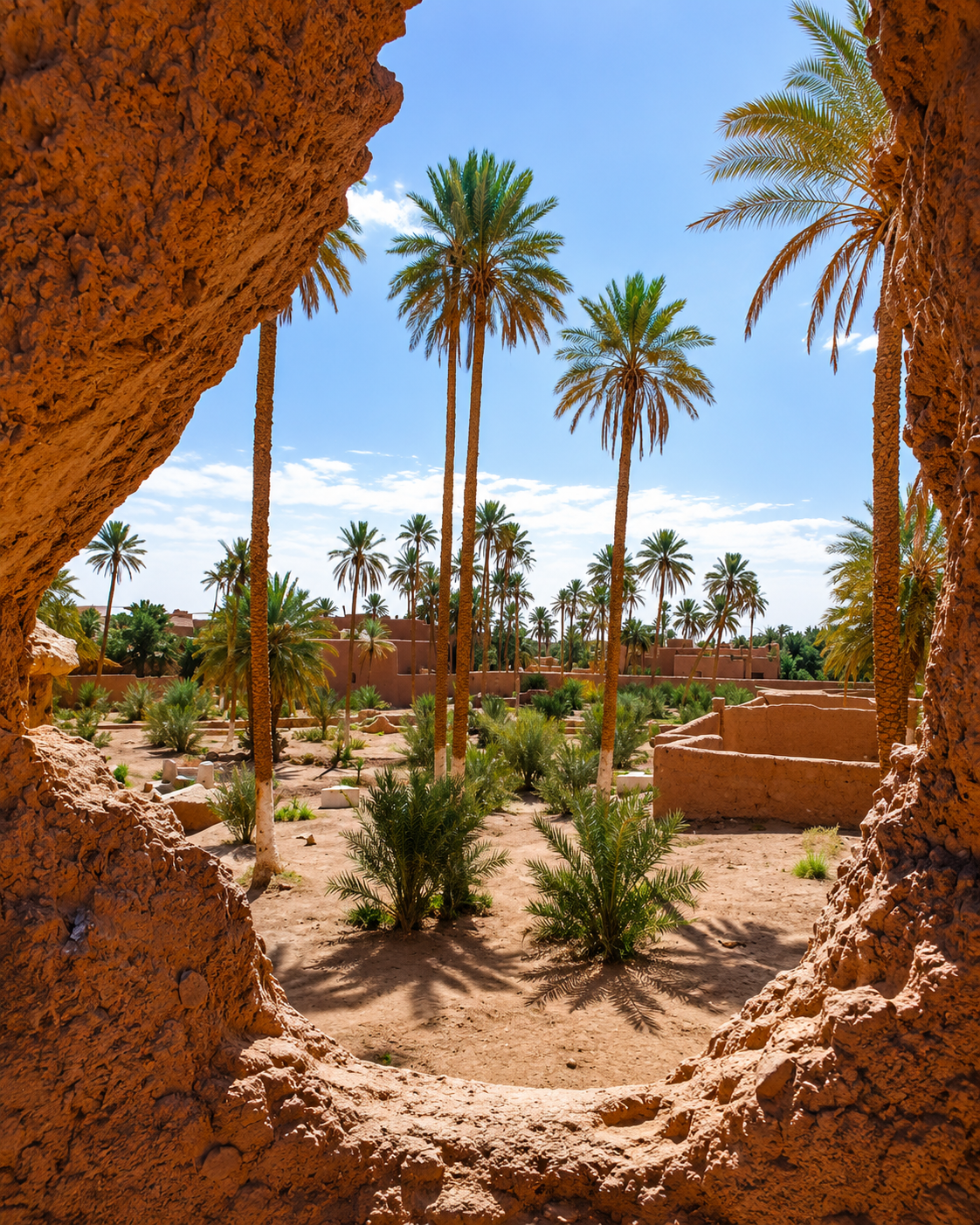
Earthen opening framing palms and gardens in Figuig, the city gateway context for Figuig Oasis

Go deeper through the nearest city context

Figuig — the city gateway to Figuig Oasis

Figuig is not merely the place you pass through to reach the grove. The city context helps visitors understand how the seven ksour, cultivated landscape, local services and settlement history fit together at Morocco’s eastern edge.

Use the Figuig guide to widen the reading after the oasis itself: urban orientation, local cultural context, built heritage and the wider desert-edge geography all make more sense when the grove is treated as part of a living town rather than a detached attraction.

Figuig city orientationKsour and settlement context Palm-grove landscapeArchitecture and water heritage Practical local structureEastern Morocco context

Continue the journey

Continue from Figuig Oasis into eastern Morocco.

Read the oasis through water, palms and earthen settlement, then continue through Figuig and the wider Oriental region with the same careful attention to landscape and place.