
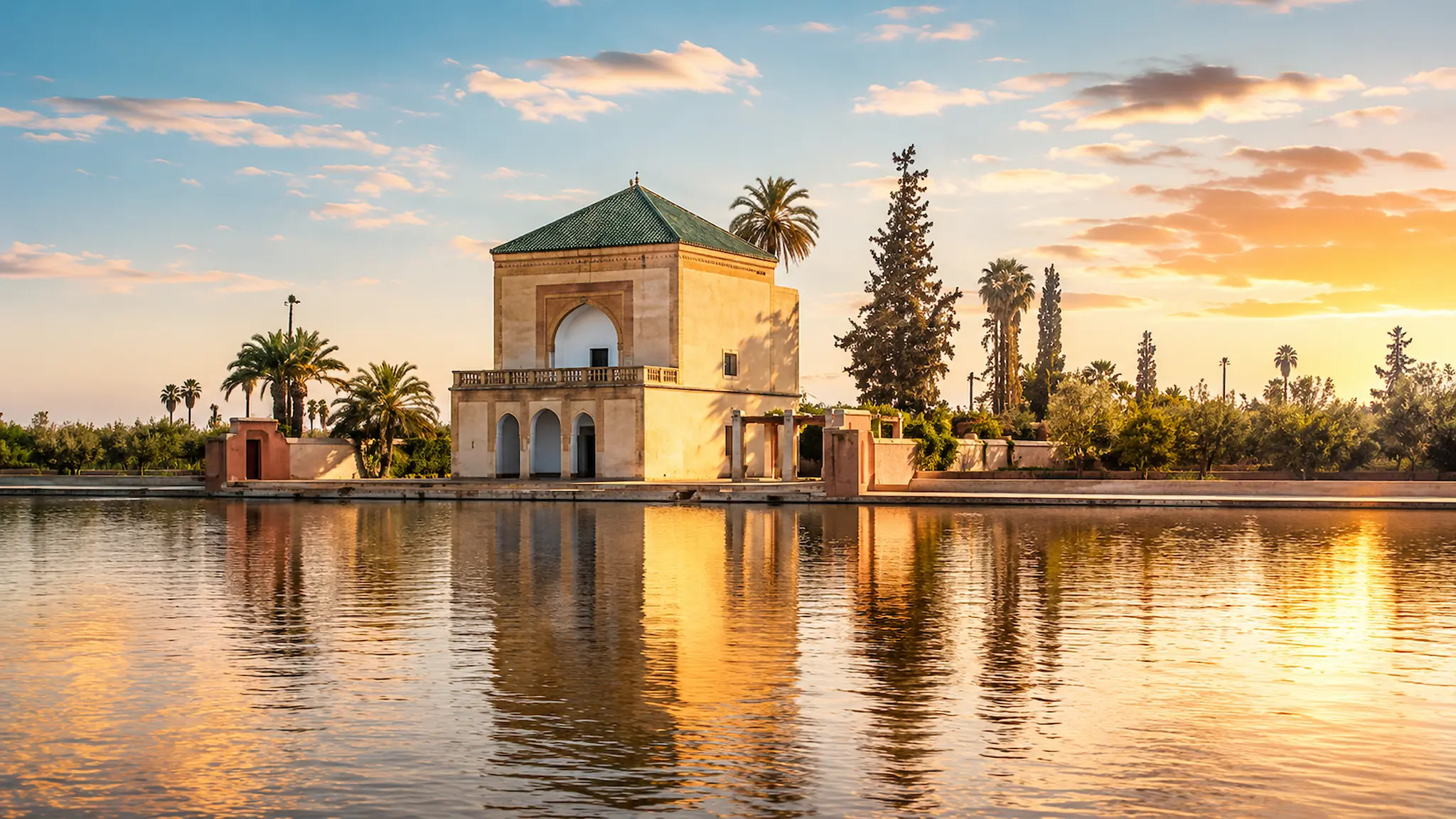
Menara Gardens pavilion reflected in the water basin with palms and Atlas light in Marrakech

Visit / Place · Marrakech · Historic garden

Menara Gardens Marrakech's water mirror of olive groves, pavilion and Atlas light

Menara Gardens are a historic public garden and orchard west of Marrakech, where a broad irrigation basin, olive groves and a green-tiled pavilion create one of the city's calmest views.

Begin with the water before the photograph. The pavilion is memorable because the basin, trees, flat horizon and distant Atlas line all work together; remove any one layer and the view loses its quiet intelligence.

Why Menara Gardens matter

A working garden before it is an icon.

Menara Gardens matter because they make Marrakech's relationship with water visible. The famous view is not only a pavilion beside a pool; it is an irrigation landscape, an orchard and a city-edge place where engineering, shade, agriculture and royal leisure meet in one clear composition.

The garden is commonly linked to the Almohad period, when Marrakech became a major western Islamic capital and large-scale water systems shaped the city around its walls, gardens and palm groves. The site still reads through that logic: a reservoir at the centre, productive planting around it, and architecture placed where water, view and movement become legible.

UNESCO's World Heritage text for the Medina of Marrakesh specifically names the Menara water feature and pavilion among the monuments that reflect the city's Outstanding Universal Value. That matters because Menara should be read as part of Marrakech's wider historic fabric, not as a detached photo stop on the edge of town.

The pavilion gives the garden its silhouette, but the basin gives it authority. Its calm horizontal surface turns the building into reflection, measures the open sky and allows the Atlas Mountains to enter the scene on clear days. The result is one of the rare Marrakech views where architecture becomes quieter by being placed inside landscape.

For visitors, Menara rewards patience. The best experience is not to rush straight to the front-facing photo. Walk the edge, notice the grove, read the waterline, watch how light changes the green roof and rose-toned walls, then let the city feel briefly wider, lower and slower.

Core heritage facts are grounded in the UNESCO World Heritage Centre listing for the Medina of Marrakesh and the Med-O-Med profile of the Agdal and Menara Gardens. Practical details such as access, prices and hours should be checked close to travel.
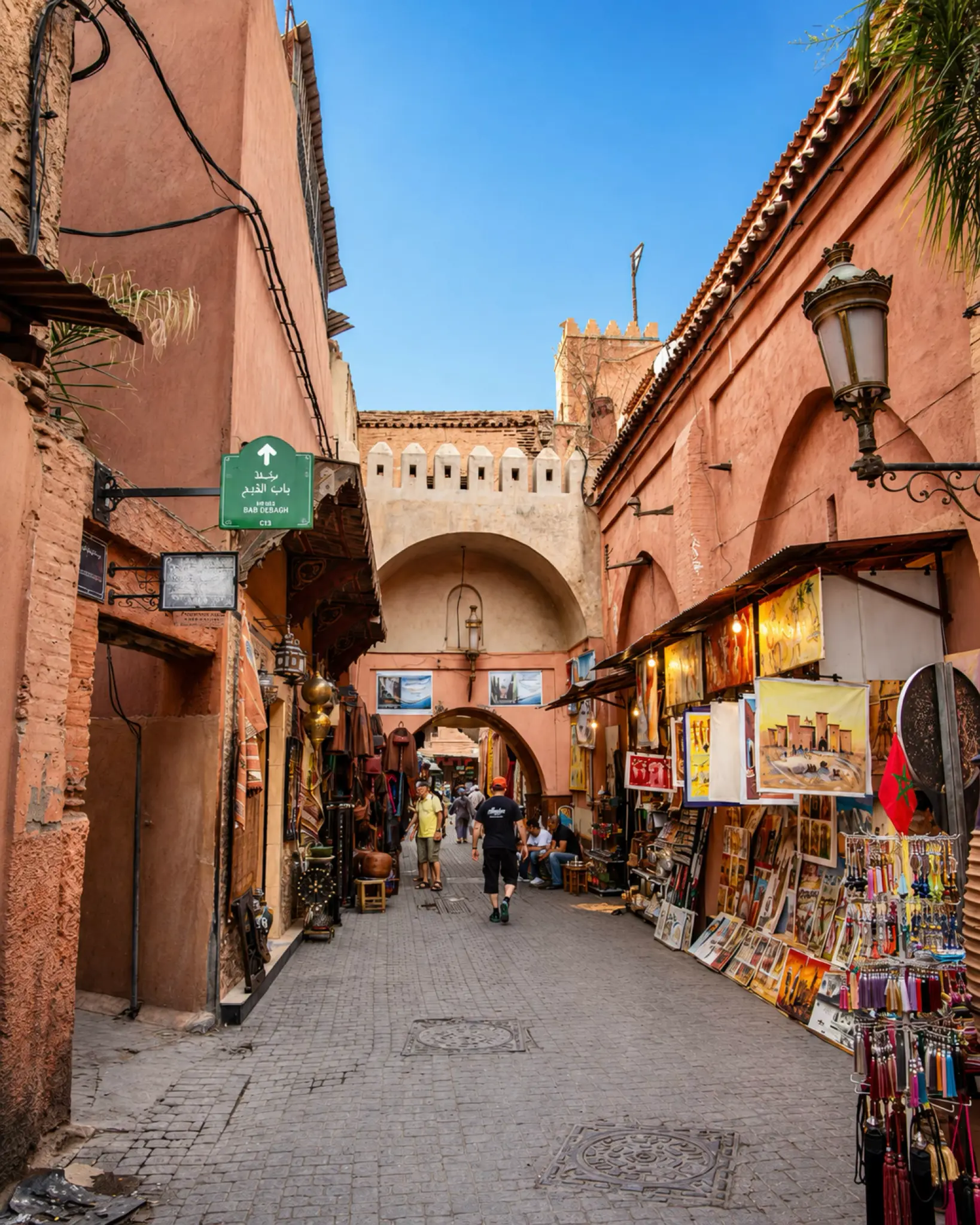
Marrakech medina passage with rose-toned walls and craft stalls, the city context for Menara Gardens

Map orientation

Use the map to place the basin and pavilion west of the medina, where Marrakech opens toward airport edge, olive groves and the Atlas horizon.

Editorial reading

Its beauty is hydraulic, agricultural and architectural.

The Menara view is famous because it is simple, but its simplicity is not empty. A low pavilion, a large basin, a regular garden and a mountain horizon create a composition that is easy to recognise and difficult to exhaust.

Look first at the waterline. It turns the scene into a measured plane: wall, roof, palm, cloud and mountain all gain shape by being reflected or interrupted by the reservoir. The photograph works because the garden has already done the visual editing.

The green-tiled roof matters too. Against Marrakech's warm earth tones, the roof gives the pavilion a precise accent without overwhelming it. It is not a decorative shout; it is a small, disciplined piece of colour held inside a wide field of water and olive shade.

The olive grove changes the reading. Menara is not a manicured flower garden where display is the main subject. It is a productive garden landscape, and that gives the place its sobriety: trunks, dust, channels, shade, open paths and a sense that beauty can come from use.

The Atlas backdrop should be treated with the same restraint. On clear days it completes the view; on hazier days the garden still works through proportion, reflection and calm. The mountain line is a gift, not the only reason to visit.

A careful visitor reads Menara as a pause inside Marrakech rather than an escape from it. The medina, ramparts, historic gardens and modern city all remain close, but around the basin the tempo changes. That shift is the point.

Give the place a slow circuit. See the pavilion frontally, then from the side, then from farther back through the trees. The strongest memory often comes from the intervals between the classic views: shade under olives, wind moving over water, and the small scale of the pavilion against the open sky.

Historical and heritage orientation

Read the garden through water, orchard and city memory.

Menara Gardens are best understood as a designed water landscape, not as a decorative park. Their importance comes from the meeting of reservoir, orchard, pavilion and Marrakech's long history of gardens, irrigation and city-edge leisure.

01Place type

Historic garden and reservoir

The site is a public historic garden and orchard organised around a large rectangular basin. The water feature is central to both the image and the older agricultural logic of the place.

02Almohad origins

A twelfth-century garden tradition

Sources link Menara to the Almohad period, when Marrakech's gardens and water systems helped define the city beyond its walls. The safest reading is to see the site as part of that wider hydraulic and garden tradition.

03Pavilion

The green-roofed menzeh

The familiar pavilion beside the basin reflects later dynastic work and nineteenth-century renewal. Its restrained form gives the view a focal point without breaking the calm geometry of water and grove.

04UNESCO 1985

Part of Marrakech's protected value

UNESCO lists the Medina of Marrakesh in 1985 and names the Menara water feature and pavilion among the monuments that express the city's Outstanding Universal Value. The garden belongs to that larger heritage reading.

A visual bridge

Three readings between water, grove and horizon

Before Menara Gardens become a photograph, they are a relationship between stored water, cultivated trees, a modest pavilion and the open west of Marrakech. These three readings help visitors slow down and see the design behind the calm.

01

Water

Reservoir before reflection

The basin is beautiful because it is purposeful. Its surface gives the pavilion a mirror, but its deeper meaning is irrigation, storage and the discipline of managing water in a hot, dry city.

  • Read the basin as infrastructure, not only scenery.
  • Notice how the waterline organises the whole view.
  • Watch reflection change with wind, light and distance.
02

Grove

Olive shade and productive order

The surrounding olive groves give Menara its quiet intelligence. Rows, trunks, dust and shade remind visitors that historic Moroccan gardens could be productive landscapes as well as places of pleasure.

  • Walk beyond the front-facing photo point.
  • Notice older trunks, open paths and patchy shade.
  • See order, use and beauty working together.
03

Horizon

Pavilion, roof and Atlas line

The pavilion is small enough to let the setting breathe. Its green roof, rose-toned walls, water reflection and mountain backdrop create a layered view that changes with clarity, season and hour.

  • Frame the pavilion with enough water and sky.
  • Let the Atlas appear naturally when visibility allows.
  • Use distance to keep the composition elegant.

Quick orientation

Type of place

A historic public garden, orchard and water landscape in Marrakech, centred on a large basin and the green-roofed Menara pavilion.

Landscape context

The garden sits west of the medina, where the city opens into flat olive groves and, on clear days, the High Atlas gives the pavilion its wider horizon.

Best for

Calm walking, reflective photography, garden history, water-system reading, olive-grove atmosphere and a quieter counterpoint to the dense medina.

Closest city context

Marrakech is the essential frame: Menara belongs with the medina, Koutoubia, historic gardens, palaces and the city's long relationship with water.

What visitors experience here

A wide pause on the edge of Marrakech.

Menara Gardens change the scale of the city. After narrow streets and busy squares, the eye suddenly has room: water, sky, rows of trees, a pavilion set low against the horizon and a view that depends on stillness as much as architecture.

Arrival

The long, open approach

The arrival feels broader than most Marrakech monuments. The city gives way to a flatter garden landscape, and the pavilion only becomes fully meaningful when the basin opens in front of it.

Light

Water holding the sky

Light is the main drama here. Morning calm can sharpen the reflection, late afternoon warms the pavilion face, and a clear horizon allows the Atlas Mountains to complete the composition without forcing it.

Movement

Edges, paths and slow circuits

The best walking rhythm is simple: approach the basin, move along the edge, step back into the grove, then return to the view. Each shift changes the relationship between building, water and shade.

Material

Earth tones and green tile

The pavilion's strength comes from restraint. Warm walls, arched openings, plain mass and a green tiled roof create a precise focal point against water, palms and pale sky.

Water

A basin with purpose

The reservoir should be read as a working heritage element. Its visual calm is inseparable from irrigation and the older garden systems that helped Marrakech survive and expand in a demanding climate.

Pace

Local quiet, not empty space

Menara can feel peaceful, but it is not blank. Families, walkers, photographers and city residents give the garden a gentle public rhythm, especially when heat softens and the water begins to catch colour.

Place details and orientation

Read Menara Gardens through six defining elements

No single detail explains the garden. Its meaning comes from the relationship between water storage, orchard planting, pavilion architecture, light, city edge and the wider Marrakech heritage landscape.

1
Rectangular basin

The large reservoir gives Menara its centre. It creates reflection, cools the composition visually and reminds visitors that water management is the foundation of the site.

2
Green-tiled pavilion

The pavilion is modest in scale but powerful in placement. Its roof, arches and balcony become memorable because they stand at the edge of so much open water.

3
Olive groves

The surrounding trees keep the garden connected to productive land, shade and seasonal work rather than pure display. Their quiet repetition gives the site depth.

4
Historic irrigation logic

Menara is associated with older underground water-channel systems that moved water toward Marrakech's gardens. Read the basin as part of that larger hydraulic story.

5
Atlas horizon

On clear days the High Atlas completes the view behind the pavilion. The mountains turn a local garden scene into a wider reading of city, water and landscape.

6
City-edge calm

The garden sits close to Marrakech yet feels lower, wider and slower. That contrast is part of the experience: the city remains nearby, but the rhythm changes.

Garden, not scenery

The place asks for a careful eye.

Stand back before choosing a frame. The first lesson is proportion: the pavilion is small, the water is wide, the grove is low and the sky carries the scene. Menara works because no element shouts louder than the others.

Then move closer. The basin edge, arched openings, green roof tiles, old trunks and paved approaches begin to explain how architecture and landscape share the same visual discipline. The view is famous, but the details are quieter.

Finally, return to the wider setting. Menara belongs to Marrakech's historic garden culture and to the city's dependence on water. Seeing that relationship turns the visit from a postcard stop into a reading of place.

Landscape and material intelligence

Water architecture is the main design.

Menara's intelligence is not hidden behind ornament. It is visible in the way a reservoir organises the garden, how a pavilion uses restraint to hold the view, and how olive groves make the site feel both cultivated and open.

The most important material here may be water itself. It reflects, stores, cools the eye and gives the pavilion its second image. Stone edges, earth-toned walls, green tile, palms and olive trunks all become clearer because the basin slows the scene down.

What to notice slowly

  • Look at the whole basin before focusing tightly on the pavilion.
  • Notice how the green roof changes against sky, trees and reflection.
  • Read the olive grove as productive order, not leftover background.
  • Watch the wind: a still surface and a broken reflection create different moods.
  • Keep the Atlas horizon in the composition only when visibility allows it naturally.
  • Respect the basin edge, planted areas and local visitors using the garden.

Architectural reading

Three visual languages to notice

Horizontal waterline

The basin gives Menara its strongest geometry. Its flat surface turns sky into structure and gives the pavilion enough distance to feel composed rather than crowded.

Pavilion restraint

The building is memorable because it is disciplined: simple volume, arched openings, warm walls and a green pyramidal roof. Its power comes from placement and proportion.

Productive garden order

The olive groves shift the site away from pure monumentality. Rows of trees, shade and irrigation logic make Menara a working landscape as well as a historic view.

Visual atmosphere

Water, olive shade and open sky

From reflection to structure

Start with the famous mirror effect, then look at what creates it: the straight basin edge, the low pavilion, the measured roofline and the way open water removes visual clutter from the scene.

From grove to city

Move under the olive trees and Menara becomes less monumental, more local and more tactile. Trunks, dust, shade and distant city sound make the garden feel used rather than staged.

From photo to memory

The strongest memory is often quiet: rippled water, warm walls, green roof, palm silhouettes and the possibility of mountains behind the haze. Menara stays with visitors because it is spacious without being empty.

Nearby places and onward links

Connect Menara to the wider Marrakech map

Menara Gardens belong naturally inside a Marrakech itinerary. Use the city guide for the broader base, then connect the garden with historic architecture, planning context and slower cultural reading.

Marrakech

The essential city context for Menara Gardens: medina routes, historic monuments, gardens, crafts, food culture and the wider rhythm of the Red City.

Open Marrakech city guide

Imperial Morocco

Marrakech sits inside Morocco's imperial city story, where dynastic architecture, gardens, water systems and urban memory shape the visitor map.

Explore the region

Architecture & Heritage

Menara is a strong gateway into Moroccan architecture as landscape: not only walls and ornament, but water, shade, proportion and cultivated order.

Read the theme

Visit Morocco places

Continue through gardens, palaces, monuments, kasbahs, lagoons, waterfalls, valleys and heritage places beyond the city guides.

Browse Visit places

Plan your journey

Treat Menara as a calm pause in a Marrakech day, especially when you want a lower, wider contrast to dense medina routes.

Plan your journey

Stories from Morocco

Use the Stories section for richer cultural reading around water, gardens, city memory, craft, architecture and the human rhythm of place.

Read stories

How to visit respectfully

Good behaviour protects the calm.

Menara Gardens are public and open in spirit, but that does not make them a stage. Move with patience around families, walkers and local visitors; ask before photographing people; and remember that quiet is part of what makes the place valuable.

Respect also means caring for the water landscape. Stay away from unsafe basin edges, do not enter the water, avoid litter, keep planted areas intact and let the orchard remain a living garden rather than a backdrop to be pushed through.

  • Ask clearly before photographing people, guides, families or private moments.
  • Keep children and cameras safely back from the basin edge.
  • Do not enter the reservoir or treat irrigation channels as play areas.
  • Carry water and sun protection; shade can be uneven across the open garden.
  • Check current access and pavilion conditions close to travel.

A strong first visit

Begin at a distance from the basin, where the whole composition becomes clear: pavilion, water, palms, olive groves, sky and the possible Atlas line. This first view gives the visit its structure before details compete for attention.

Walk one side of the water slowly, then step back toward the trees. From there the pavilion feels smaller and the garden becomes more legible as a productive landscape. The pause under the olives is part of the experience, not a detour from it.

Return to the classic front view only after the circuit. It will feel calmer because you have already read the basin as water infrastructure, the grove as cultivated order and the pavilion as a measured focal point.

Afterward, connect the visit to Marrakech rather than isolating it. Menara speaks more clearly when paired with the medina, Koutoubia, palace architecture, historic gardens and the city's older water systems.

  • Start wide, with the full water-and-pavilion view.
  • Move along the edge before choosing close photographs.
  • Step into the olive grove to understand shade and productive order.
  • Return to the pavilion view when the light has shifted.
  • Finish by connecting Menara back to the Marrakech city guide.

Careful planning note: opening hours, prices and exact access arrangements can change. Verify practical details locally before travelling.

Marrakech medina passage with rose-toned walls and craft stalls, used as the city guide context for Menara Gardens

Go deeper through the nearest city context

Marrakech - the city context for Menara Gardens

Menara Gardens belong inside a wider Marrakech journey. The city gives visitors the right frame for understanding water, walls, gardens, monuments, craft streets, public life and the contrast between dense medina movement and open garden calm.

Use Marrakech to widen the reading after Menara itself: Koutoubia, palaces, historic gardens, souks and quieter city-edge spaces all become easier to connect when the garden is treated as part of the city's long cultural landscape.

Historic garden contextMarrakech city orientation Water and landscape systemsArchitecture and heritage reading Medina and palace routesQuiet city-edge pauses

Continue the journey

Continue from Menara Gardens into Marrakech.

Read the water slowly, then connect Menara to Marrakech's medina, historic gardens, architecture, public life and the wider heritage map of Morocco.