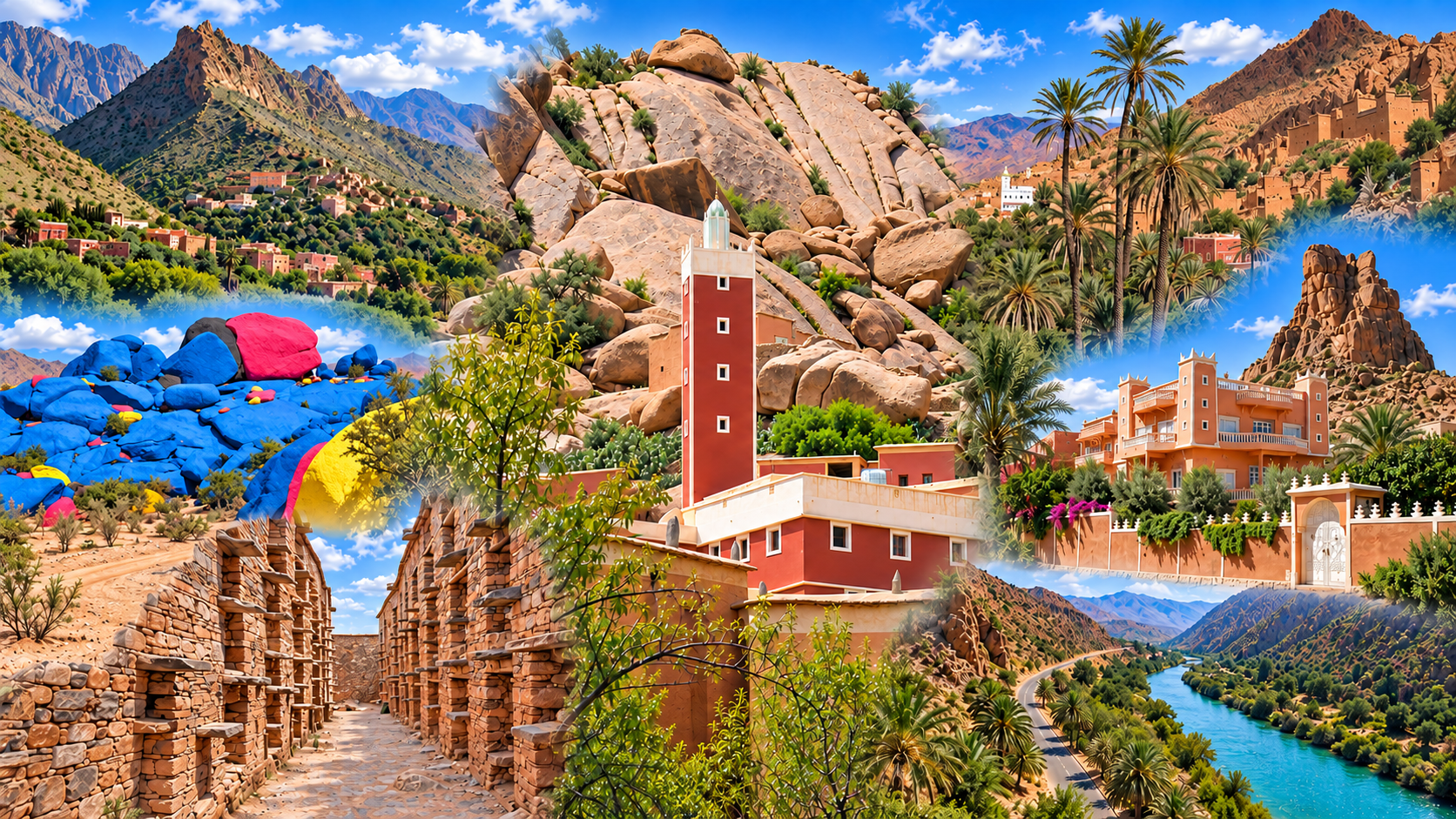
Tafraout & Ameln Valley Granite country, mountain villages and the long face of Jbel Lkest
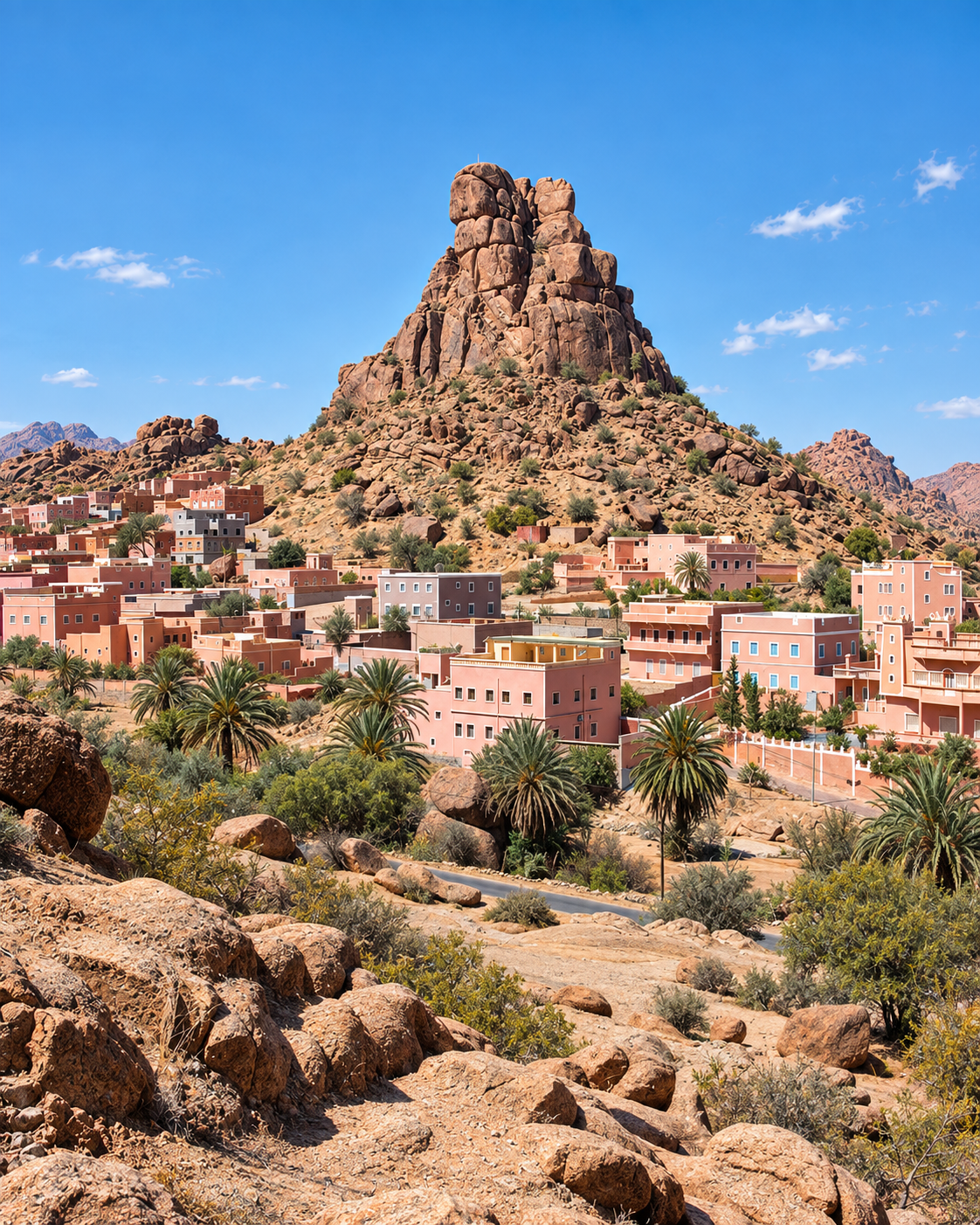
Around Tafraout, rounded rock formations give way to the Ameln Valley: a cultivated landscape of village slopes, palm clusters and paths beneath a striking mountain wall.
Give the town and the valley their own time. Begin with the open landscape, then choose a village walk that brings the scale down to gardens, doorways and everyday life.
Tafraout and the Ameln Valley belong together, but offer different ways into the Anti-Atlas. The town provides a point of arrival among pink granite outcrops. North of it, the valley opens beneath Jbel Lkest, with villages and cultivated ground held between the mountains. Seeing both makes the relationship between settlement and terrain much clearer.
The most revealing part of this landscape is often the land between its dramatic features. A path beside a garden, a wall marking a plot, or a cluster of houses on a slope brings human decisions into view. Those details invite questions about access, cultivation and the work of maintaining a home in mountain country.
This is also an Amazigh cultural landscape. Its villages have individual names, households and histories; they deserve more attention than an anonymous label on an itinerary. At Oumesnat, the traditional house and museum offer a way to approach domestic heritage through a hosted visit. Check arrangements directly before making it the centre of your day.
The contrast with Tafraout is useful. Town streets gather shops and services into a compact area, while a valley visit spreads attention across the spaces between settlements. Allowing time for both brings the surrounding countryside into a lived context: a place people move through, work in and return to.
For a visitor, the reward is a change of scale. The mountain face establishes the setting; a village path introduces its everyday dimensions. A good visit gives each its due, with enough time to follow an explanation, recognise a boundary and stop somewhere without holding up local movement.
Tafraout lies south of the Ameln Valley, beneath Jbel Lkest. Use this overview to place the town and valley together. Open the map.
Editorial reading
The spaces between the landmarks.
A photograph can pull every feature into the same scene. On the ground, distances and directions matter. The granite country around Tafraout and the mountain front of the Ameln Valley deserve separate attention; neither is explained by a single viewpoint.
Look first for the interval between the houses and the ridge. That open space gives the buildings their scale. Without it, a mountain can become a flat background; with it, the eye starts to judge height, exposure and distance.
Next, follow the way a village meets its surroundings. Which edges are built up? Where does a path turn? Where do trees interrupt the roofs? These are useful observations because they connect the large view to choices visible at ground level.
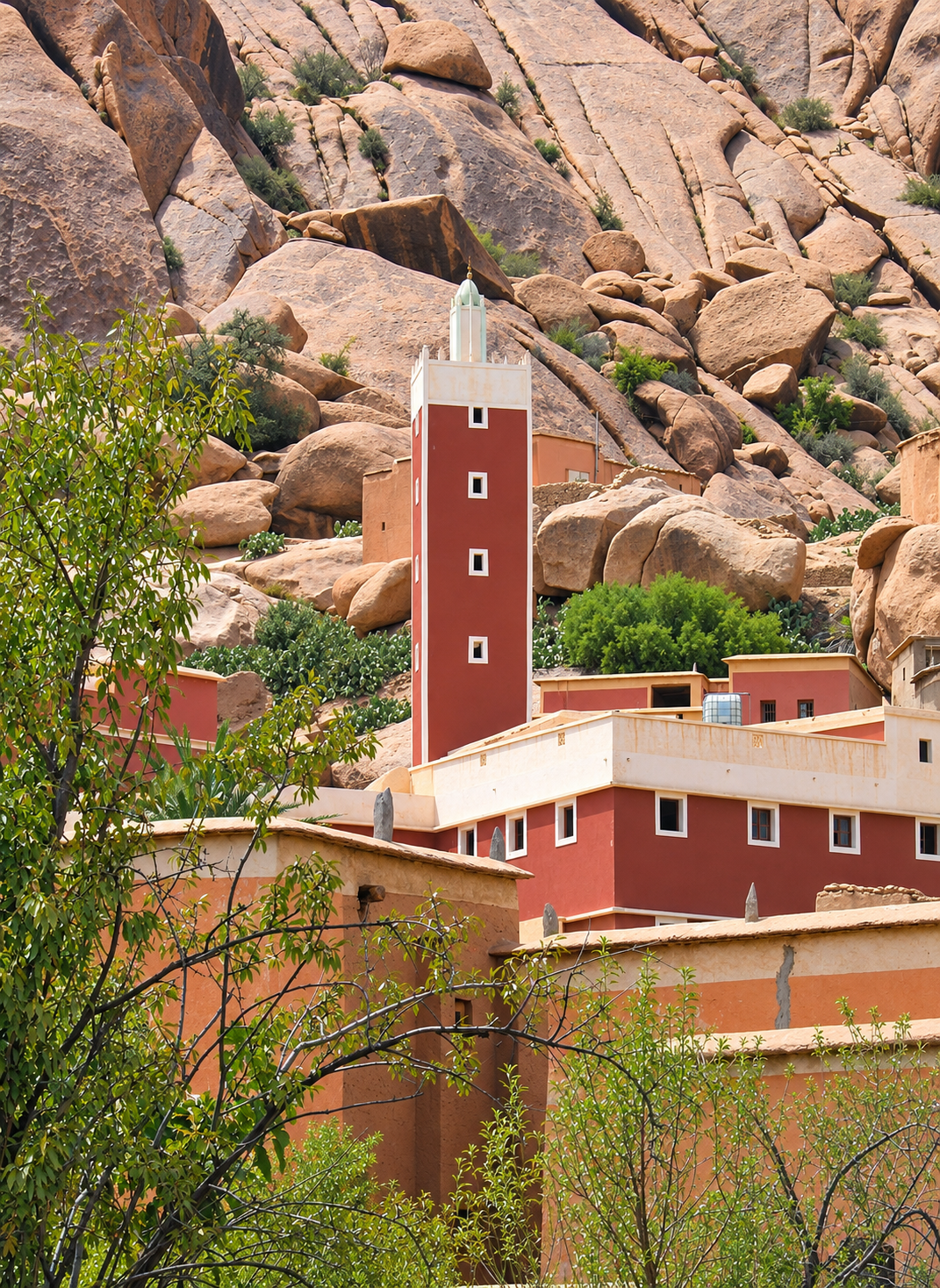
Colour provides another clue, but it needs careful reading. A pink facade and a warm rock face may look related while being entirely different materials. Let the shape, surface and joints help you distinguish built work from natural rock.
The garden edges introduce a different rhythm. Low walls, tree trunks and small divisions break the broad landscape into closer spaces. Watch how a few metres of movement change what is visible beyond them.
Keep the present in the picture. A repaired house, a shop sign or a parked vehicle belongs to the place you are visiting. Older fabric becomes more understandable when seen alongside the ways people use and alter their surroundings today.
At the end of a walk, return to the wide view. The ridge may be unchanged, but the ground below it now has names, routes and remembered encounters. That added familiarity is what gives a landscape lasting depth.
Landscape and cultural orientation
Four contexts for understanding the place.
Geology, village life, seasonal cultivation and contemporary art each contribute something different to a Tafraout visit. Keep these contexts distinct: a natural rock formation, a household museum and a painted boulder tell different kinds of story.
01Geography
The Anti-Atlas setting
The Ameln Valley lies below the Jbel Lkest massif north of Tafraout. This mountain front gives the valley its strong sense of enclosure and provides an orientation point when moving between the town and surrounding settlements.
02Village heritage
Oumesnat and domestic memory
Oumesnat’s traditional house includes a museum connected with local domestic life. A hosted visit can put objects and rooms into context. Ask what can be visited and photographed; the house also functions as accommodation.
03Seasonal landscape
The almond season
Almond blossom is associated with late winter and the approach of spring around Tafraout. Its timing varies with the year and location. Treat it as a seasonal possibility, and ask locally about conditions before planning around it.
04Art intervention
The Painted Rocks
Near Aguerd Oudad, the Painted Rocks are an outdoor artwork associated with Jean Vérame’s intervention in 1984. Their colour is applied paint. The regional tourism account explains their origin.
A visual bridge
Three ways to read a mountain valley
Use a few simple visual cues to organise the view. Start with the horizon, move through the middle ground, then look at one close detail. Each distance reveals a different part of the relationship between land and settlement.
01
Horizon
Follow the mountain line
Trace the ridge before choosing a subject in the foreground. Its rises and breaks establish the larger form of the valley. A house or palm below that line then becomes a useful measure of the terrain around it.
Choose one ridge as a reference.
Notice where slopes overlap.
Include enough foreground to show distance.
02
Middle ground
Find the cultivated spaces
Look beyond the most conspicuous rock or building. Tree groups, plot edges and open ground reveal how the view is divided. These quieter elements often explain the relationship between neighbouring parts of a settlement.
Look for divisions within the greenery.
Follow visible paths with your eye.
Keep cultivated land in the wider composition.
03
Close detail
Let a doorway set the scale
An opening in a wall gives the eye a familiar dimension. Use it to judge the height of a facade or the depth of a shaded passage. Stay on a public route so observation remains comfortable for the people living there.
Compare an opening with the wall around it.
Notice recesses and changes in shade.
Observe private thresholds from a respectful distance.
Quick orientation
Type of place
An Anti-Atlas town and neighbouring mountain valley, with village landscapes and rock formations to explore across several separate stops.
Area and landscape
Souss-Massa, in southwestern Morocco. Tafraout anchors the visit; the Ameln Valley extends beneath Jbel Lkest. Explore Morocco’s regions.
Best for
Village walks, landscape photography, domestic heritage and time outdoors. Mountain ascents require their own preparation and route decisions.
Base and travel mood
Tafraout is the local base. Allow an unhurried rhythm, with one main outing and room to adapt to conditions.
What visitors experience here
From town streets to open valley.
The experience changes as the spaces change. Tafraout gathers activity along its streets; the surrounding rock country opens the view; the valley brings attention back toward village paths and cultivated ground. There is room for both a wide panorama and a much smaller encounter.
Town
A useful beginning in Tafraout
Start with a short walk through town to get your bearings. Shops, street corners and a place to pause create a practical point of reference before you leave for the valley. Settle your return arrangements while services are close at hand.
Rock country
Walking beside larger forms
Beside an outcrop, the balance between body and landscape becomes immediate. A formation that looked modest from the road can fill the view at close range. You can appreciate that scale from an established path without climbing onto the rock.
Village paths
Turns that reveal the view
A small bend can replace a broad outlook with a wall, a tree or a narrow passage. Let those interruptions become part of the walk. They create a changing sequence that a single viewpoint cannot provide.
Shade
A pause beneath the trees
Moving from exposed ground into shade changes the feel of a stop. Take time to notice the light beyond the canopy and the ground underfoot. Choose a place where pausing does not occupy someone’s doorway or working space.
Craft
Time at a workshop
Tafraout is associated with colourful leather babouches. In a shop or workshop, ask about materials and how a pair is made. A conversation about an actual object gives a craft visit more substance than a quick photograph of the display.
Return
The landscape on the way back
Retracing part of a route can be rewarding. You recognise a turn or a roofline, but see it from another direction. The return also helps you connect individual stops into a clearer understanding of the surrounding terrain.
Place details and orientation
Six features to place on your mental map
These points distinguish the town, the valley and separate excursions around Tafraout. They help you choose where to spend time without treating every nearby name as part of the same walk.
1
Tafraout town
The service and shopping base for the surrounding landscape. Keep it as the reference point for transport, supplies and the end of an outing.
2
The Ameln Valley
A valley of settlements and cultivated spaces north of town. Plan around the particular villages and paths you want to visit.
3
Jbel Lkest
The massif above the valley. Viewing it from below and attempting its summit are very different undertakings; decide which kind of day you are preparing for.
4
Oumesnat
A village associated with the traditional house and museum. Confirm a hosted visit before relying on access to the interior.
5
Aguerd Oudad
A separate village and rock landscape south of Tafraout. Its outcrops belong to a different outing from the Ameln village paths.
6
The Painted Rocks
An artwork on boulders near Aguerd Oudad. Allow it its own context, and avoid adding paint, marks or damage to the surrounding rocks.
Reading the village edge
Notice how a place meets the ground.
Choose a public place where houses, a path and open terrain are visible together. Begin at ground level: how does the path approach the buildings, and where does it turn away? Looking at these connections can be more revealing than looking only at a facade.
Then examine the edge itself. A built wall has courses, joints, corners or a finished surface; an outcrop follows a different pattern. Where materials are exposed, compare their shapes. Where they are covered, resist guessing what lies underneath from colour alone.
Finally, look at how space is used now. An entrance, a shaded stopping place or a maintained boundary can tell you where movement is welcome and where to step back. This careful attention makes the walk easier to navigate and keeps the everyday use of the village in view.
Geology and landscape intelligence
Rounded granite, angular mountain faces.
Tafraout’s granite domes and boulders differ from the quartzite climbing terrain of nearby Jbel Lkest. The distinction is documented by the Oxford Alpine Club’s Tafraout guide. It explains why the wider landscape should not be described simply as one expanse of pink granite.
For a visual reading, compare shape before colour: broad curves, separated blocks, sharp edges and long faces organise the view differently. Light can make unlike surfaces appear similar. Observe the landforms from suitable paths, and leave close geological identification to a reliable guide or specialist account.
What to notice slowly
Compare rounded outcrops with the mountain skyline.
Look for fractures that divide a rock face into blocks.
Notice how loose ground differs from a solid-looking surface.
Separate painted colour from natural rock tones.
Use visible joints to distinguish masonry from an outcrop.
Choose walking routes independently of how climbable a rock appears.
Settlement and landscape reading
Three relationships at village scale
Ground and building
Follow the meeting line between a building and its base. A stepped edge, retaining wall or change of level can show how a structure occupies sloping ground. Read what is visible without assuming a date or construction method.
Enclosure and movement
A narrow passage and an open space create different kinds of movement. Notice where people can pass, pause or turn. That relationship helps you understand the layout while choosing considerate places to stop yourself.
Older fabric and present use
Compare maintained surfaces, newer additions and older structures where they stand beside one another. Their differences suggest questions about use and repair. A local explanation can clarify what appearance alone leaves uncertain.
Visual atmosphere
Colour, shadow and the space around a subject
A restrained palette
Look for small differences within the warm tones: a pale wall beside a deeper pink facade, a rock face in shade, a patch of dry ground. Greenery and sky give those colours a reference. The scene becomes more interesting when its variations remain visible.
The shape of a shadow
Watch a shadow describe a ledge, a recess or the gap between two forms. It can reveal depth that direct light flattens. Instead of waiting only for a dramatic sky, choose an angle where light makes the structure of your subject easier to read.
A frame with room to breathe
Leave some surrounding space around a house or outcrop. A path entering the frame or a slope continuing beyond it gives the subject a setting. For a closer image, choose one detail clearly, so the photograph does not have to explain the entire valley.
Nearby places and onward links
Continue through Tafraout and the Anti-Atlas
Use Tafraout to organise local outings, then widen the journey deliberately. Aguerd Oudad and the Painted Rocks are separate from the Ameln Valley; the Aït Mansour gorges are another excursion to plan in their own right.
Tafraout
Return to the town guide for shopping, craft and a wider sense of the base from which you explore the valley.
Village lanes, gardens and houses are part of daily life. Use recognised public paths, leave working entrances clear and ask before photographing people or private interiors. If a route’s status is unclear, ask for directions instead of continuing through a plot or courtyard.
Choose a walk suited to the conditions and your experience. Carry your own water, protect yourself from the sun and agree a return plan before leaving town. Jbel Lkest requires separate mountain preparation; the regional guidance notes both navigation difficulties and the absence of water sources on its described ascent.
Arrange and pay for hosted visits on the terms agreed with your host.
Keep out of cultivated plots and avoid taking fruit, flowers or stones.
Leave walls, rock surfaces and the Painted Rocks free of new marks.
Check weather and path conditions; avoid watercourses during rain or flood risk.
For a mountain outing, consult the Jbel Lkest guidance and arrange suitable local support.
A strong first visit
Begin in Tafraout with the practical decisions that make the rest of the day easier: where you are going, how you will return and whether you have enough water. Choose the Ameln Valley as the main outing, giving it room in the day rather than adding several distant stops.
Find a safe public stopping point with a clear view toward the valley and mountain front. Take a moment to identify the settlements and the direction of your walk. A broad view is most useful when it helps you understand where you will be moving next.
Continue with one village visit or an agreed walk. Oumesnat can add a domestic heritage perspective when a hosted visit is available. If you walk farther, use current local advice and a reliable route; a picturesque path on a screen is not confirmation of access on the ground.
Return with time left to enjoy Tafraout itself. A craft stop, a meal or a short town walk gives the day a different closing rhythm. Keep Aguerd Oudad, the Painted Rocks or Aït Mansour for another outing if adding them would make the valley visit rushed.
Prepare supplies and the return journey in Tafraout.
Take an overview before choosing a village path.
Leave time for a hosted visit when arrangements are confirmed.
Turn back in good time if conditions or access change.
Finish in town, keeping further excursions for a separate plan.
Planning note: confirm transport, hosted visits, weather and route conditions close to travel. Valley walking and summit hiking need different plans.
Go deeper through the local town guide
Tafraout — your base for the Ameln Valley
The town provides the practical counterpoint to a day in the valley. Use the Tafraout guide to bring together craft, streets, local services and the surrounding rock landscapes, then choose which part of that wider setting you want to explore next.
Keeping one base gives you more flexibility. You can adjust an outing, ask about a route and return to familiar streets at the end of the day. Build the journey around those useful connections, with the Ameln Valley given the time it deserves.
Town and street orientationLocal craft and babouchesAmeln Valley contextGranite country around townIndependent excursion planningA base for the Anti-Atlas