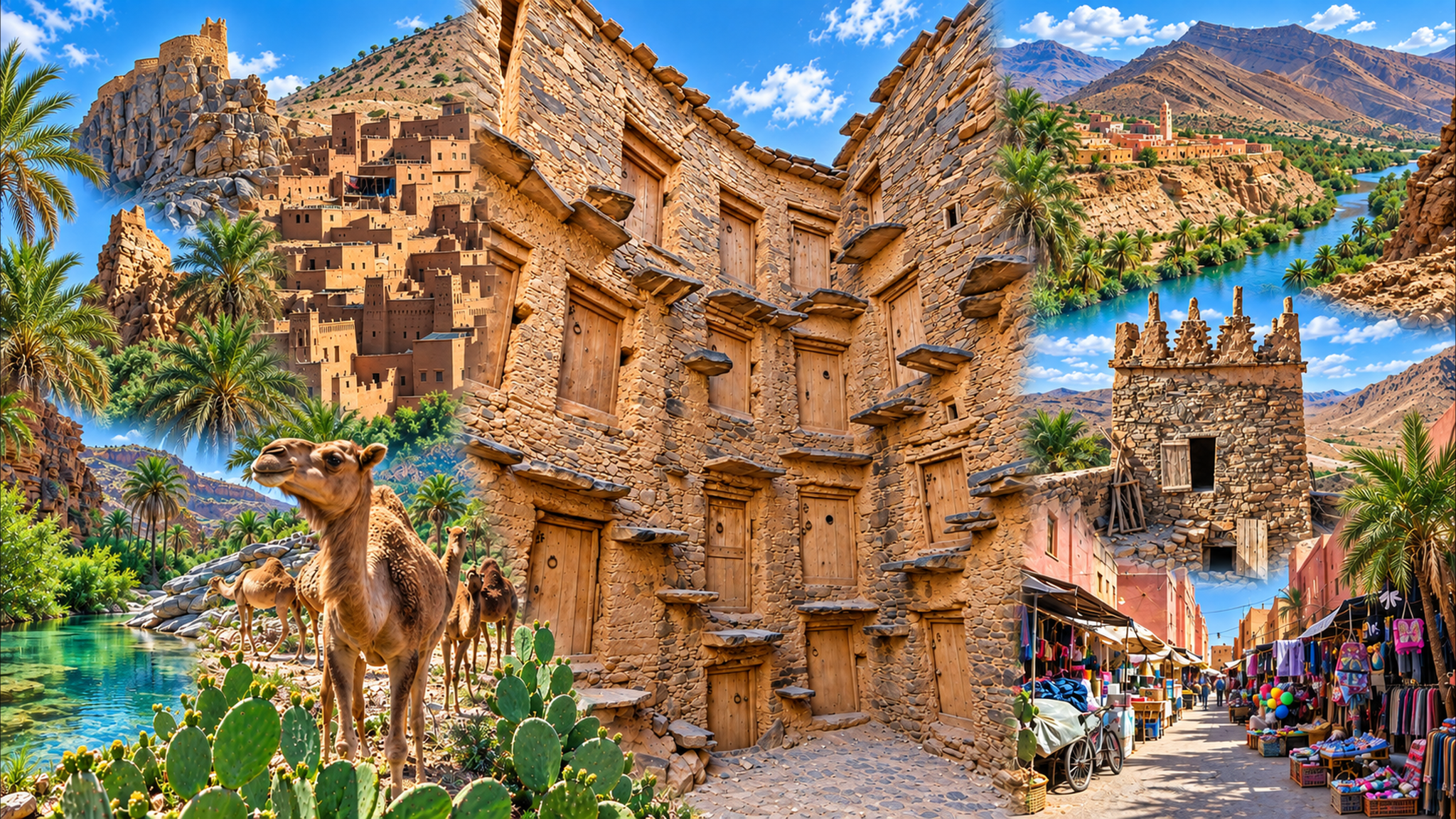
Amtoudi Granaries visual composition with stone storage cells, oasis landscapes and Guelmim market scenes

Visit / Place · Anti-Atlas · Guelmim province

Amtoudi Granaries Stone strongholds above an oasis valley

At Id Aïssa and Aguelouy, fortified granaries reveal how southern Moroccan communities gave harvests, household belongings and shared security a place in the mountains.

Follow the view from the rocky heights to the palm grove below, then look closer at the small doors and layered masonry that give these buildings their character.

Why Amtoudi Granaries matter

A community's reserves, built into stone.

Amtoudi's two granaries belong to the southern Moroccan tradition of the agadir, plural igoudar: a fortified storehouse used collectively. Within this tradition, individual families kept crops and valuable belongings in separate chambers inside a protected enclosure. The buildings make a practical idea visible: safeguarding household reserves could be a shared responsibility.

Id Aïssa and Aguelouy are distinct sites above the Amtoudi oasis, in Guelmim province. Regional tourism documentation identifies both on its fortified-granary route. Their hilltop positions give visitors an immediate sense of protection and separation from the cultivated valley. Each should be approached as its own building, with its own route and access arrangements.

Their heritage value also lies in the knowledge needed to maintain them. Architect and anthropologist Salima Naji's conservation work at Amtoudi involved local builders and training in traditional techniques. The Aga Khan Trust for Culture places this work within a wider effort to keep oasis heritage connected to the communities around it.

That connection changes what deserves attention. A small storage doorway can tell you as much as a dramatic skyline; a repaired wall can raise better questions than a claim about the building's age. Ask how spaces were used, how the fabric was repaired and which parts can be visited today.

Give the oasis time alongside the monuments. Looking back from the village helps separate the granaries from the houses, gardens and paths around them. It also keeps the visit grounded in a present-day place where people live and work.

Further reading: the regional guide to igoudar and the Aga Khan conservation profile.
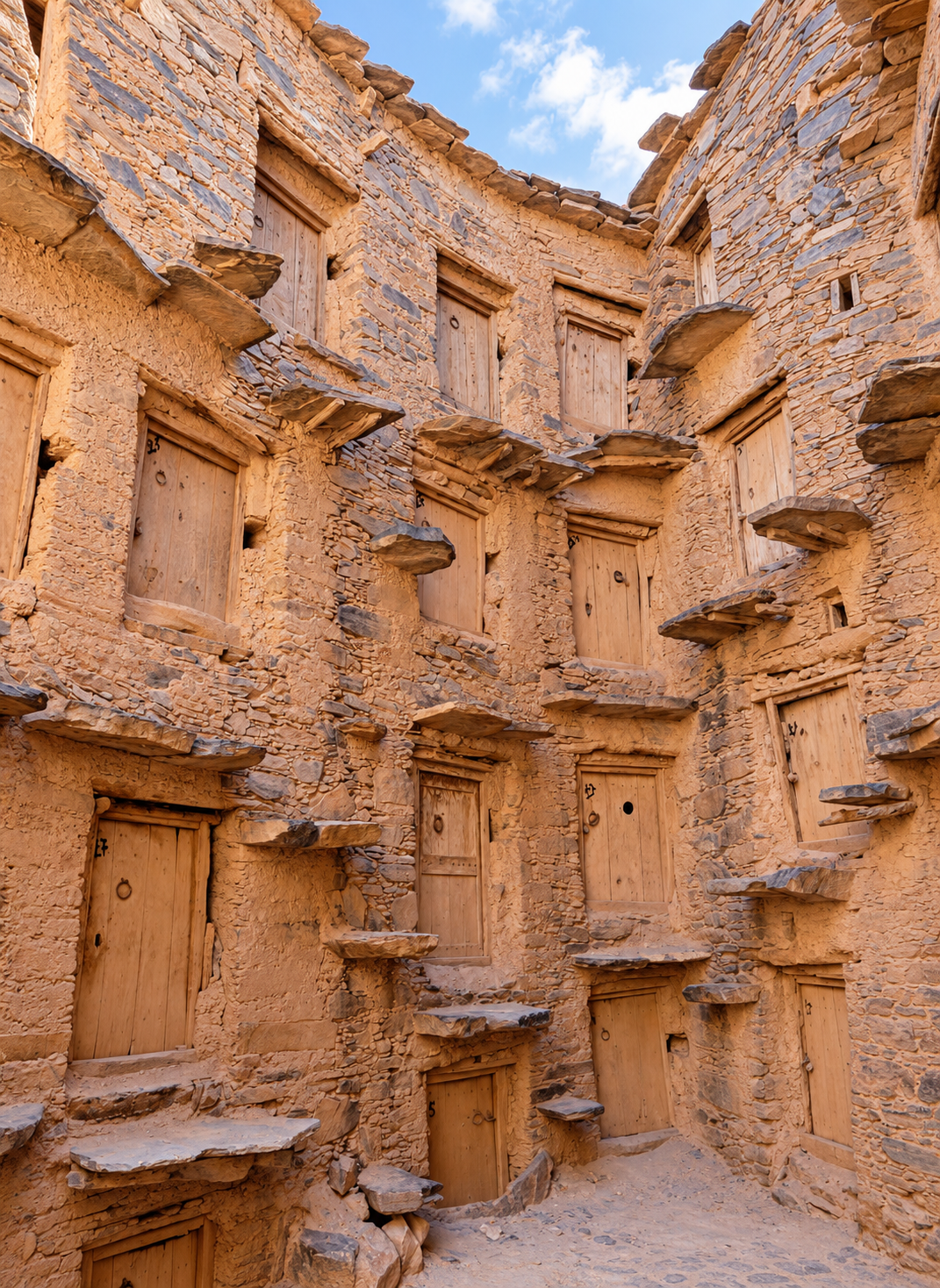
Stone granary walls with rows of timber storage doors and projecting slabs

Map orientation

Centered on Id Aïssa. Aguelouy is a separate granary farther east along the valley; confirm walking access in the village.

Open Id Aïssa in Google Maps

Editorial reading

Small doors, a larger social idea.

One useful way to read a granary is to hold two scales together: the enclosure that gathers everything into a single stronghold, and the modest opening that marks one storage compartment. The building's imposing outline contains many small, distinct spaces.

Consider the doorway as a threshold of responsibility. Who needed access? What had to remain secure? How could goods be carried in and out? These questions turn an attractive wall into something you can begin to understand.

The mountain setting adds another question: what does height make possible, and what does it make harder? A commanding position also involves an approach. Looking at the path as well as the summit helps make the human effort behind the architecture tangible.

A local explanation is particularly valuable where the fabric is difficult to interpret. A difference in stone colour does not, by itself, date a wall; a closed chamber does not reveal what it once contained. Let the details prompt questions rather than quick conclusions.

Aim to leave with one clear understanding of how the building worked. That gives the visit a stronger memory than an unconnected sequence of impressive views.

Historical and heritage orientation

Storage, stewardship and the work of repair.

The evidence is strongest when it describes what these buildings did and how they have been conserved. Their architectural interest does not depend on assigning every surviving wall a single foundation date.

01Function

More than grain

Regional accounts of igoudar describe the safekeeping of family harvests alongside manuscripts and deeds. “Granary” is therefore a useful name, but the wider tradition also concerns the protection of possessions and records.

02Two sites

Id Aïssa and Aguelouy

The 2013 Aga Khan site review records conservation of both Amtoudi granaries. It treats them as communal heritage resources, giving each a place within the same valley's history.

03Conservation

Knowledge carried forward

The review describes repairs informed by building knowledge and residents' recollections. This is a useful distinction: what survives includes conserved and partly reconstructed fabric, together with the skills used to care for it.

04Weather

Renewed attention

Salima Naji's project account documents further intervention at Id Aïssa after the torrential rains of 2014. Its exposed stone appearance should never be mistaken for immunity to weather or neglect.

Conservation history: Michele Lamprakos's 2013 site review and Salima Naji's Id Aïssa project account.

A visual bridge

From the valley floor to the storage door

Use three changes of scale to organise your looking: the landform that supports the building, the enclosure that gives it shape, and the individual opening that brings it within reach.

01

Ground

Find the meeting line

Look for the point where the rocky outcrop becomes constructed wall. Similar tones can make the transition difficult to see; corners, joints and repeated courses help the building emerge from its setting.

  • Follow the contour beneath the walls.
  • Separate natural fractures from laid stone.
  • Keep a little foreground in the view.
02

Outline

Read the edge against sky

Watch how towers and wall tops interrupt the horizon. A change of viewpoint can reveal a return wall or conceal an entrance, altering how compact or open the same structure appears.

  • Notice the spacing of vertical accents.
  • Compare the entrance side with the flank.
  • Use a safe viewpoint without blocking passage.
03

Detail

Let one doorway hold the eye

Choose a single opening and examine its frame, stone surround and relationship to the floor. Then widen your attention to its neighbours: slight differences become easier to notice within the repeated pattern.

  • Observe joins between wood and masonry.
  • Look across neighbouring compartments.
  • Leave doors and fittings untouched.

Quick orientation

Type of place

Two fortified communal granaries: Id Aïssa and Aguelouy. Plan for heritage buildings with approaches on foot and locally confirmed entry.

Best for

Vernacular architecture, attentive photography and walking with time to pause. The visit suits a measured pace and an interest in how everyday needs shape buildings.

City and local base

Guelmim provides the wider city context. Amtoudi village is the starting point for arranging visits to the granaries themselves.

What visitors experience here

A climb, a threshold, a different scale.

Allow the visit to unfold at walking speed. The change from exposed approach to enclosed space can be as memorable as the skyline, especially when you pause long enough for your eyes to adjust.

Approach

The ascent becomes visible

On a climb, height is felt through your pace and footing. Stop on a secure, open part of the route to look back; the changing view helps explain the distance between village and stronghold.

Threshold

From glare into shade

Give your eyes a moment when entering a darker space. Details around the doorway often appear gradually, and an uneven threshold deserves attention before the camera comes out.

Interior

A rhythm of compartments

Where access is permitted, follow the arrangement of small storage entrances. Looking along a wall makes their spacing legible; looking upward changes the sense of height and enclosure.

Surface

Wood beside stone

Timber grain and the irregular edges of masonry offer two very different textures in one frame. Look where they meet, especially around lintels and jambs, without testing a door or leaning against it.

Outlook

The oasis from above

A safe outward view can place the green valley within the surrounding rock. Let your gaze follow the cultivated strip beyond the nearest palms to appreciate the oasis as a continuous setting.

Return

The village at eye level

Back below, narrow your attention to the route through the village. Leave room for residents, stop clear of doorways and allow time for a local conversation if someone welcomes it.

Place details and orientation

Six elements to keep distinct

A granary visit and an oasis walk involve different spaces. Knowing which part you are approaching makes it easier to ask the right questions and choose a realistic route.

1
Id Aïssa

The granary used as this page's map reference. Ask in Amtoudi about the approach and entry before setting off.

2
Aguelouy

A separate heritage stop to the east. Check its access independently before including both buildings in one walk.

3
The enclosure

Observe the outer walls and entrance as a complete boundary before concentrating on any single tower or opening.

4
The storage cells

These are the small spaces that give the granary its internal pattern. Entry to the building need not include entry to each chamber.

5
The palm grove

Treat cultivated ground as working space. Use agreed paths and ask before entering gardens or crossing irrigation channels.

6
The gorge

The gorge is an additional valley excursion. Ask about conditions and suitable routes; a map view alone cannot establish safe passage.

An informed visit

The place asks for a careful eye.

Keep observation separate from explanation. You can see a blocked opening, an irregular wall or a change in mortar, but those details need context before they become evidence of a particular period or use.

A worthwhile question for a guide is “What changed here?” It invites discussion of repair, lost sections and remembered uses. Ask which features belong specifically to the granary you are visiting and which are shared with others in the region.

Choose a route with enough time to listen. If the second granary would make the walk rushed, one well-understood building can be a more satisfying visit. The valley still deserves attention on the return.

Architecture and material intelligence

Stone, mortar and the logic of support.

A materials study published in the Italian Journal of Geosciences examined an Amtoudi granary built directly on a rocky outcrop using stone from the underlying bedrock. That close relationship between source material and building helps explain why the walls can appear to grow out of the hill.

The researchers studied masonry, mortar and ceiling structures together. They identified the importance of stone interlocking and the loss of mortar through washing: stability depends on the connections between elements as well as the elements themselves. For visitors, this offers a useful way to look at joints, supports and spans. Read the materials study.

What to notice slowly

  • How smaller stones fit between larger pieces.
  • How a corner changes the direction of the masonry.
  • The depth of a doorway relative to the wall face.
  • The joints where timber meets stone.
  • How projecting elements cast shadows below them.
  • Whether a visible repair has a different texture, without assuming its date.

Architectural reading

Compartment, passage and enclosure

The repeated unit

The compartment is a useful starting point for reading scale. Compare its small opening with the extent of the enclosing wall: repetition allows modest individual spaces to produce a substantial architectural whole.

The shared passage

The space between storage rooms deserves its own attention. Its width, turns and changes of level organise movement through the building. Seen this way, the gaps are as important to the plan as the solid masonry.

The enclosing boundary

From an outward-facing edge, compare the scale of the interior with the land beyond. The change from close-set walls to open valley makes enclosure tangible, even without knowing every detail of the original plan.

Visual atmosphere

Relief, colour and the space between

Raking light

Light arriving across a surface gives every projection a shadow. Look for a wall where stone edges are clearly separated, then compare it with a face in even light. The structure can feel markedly different without anything in the building changing.

A restrained palette

Allow variations within the stone and timber to hold the image. A small patch of sky or greenery may provide enough colour contrast; the quieter details can disappear when attention is drawn only to a bright panorama.

Breathing room in the frame

Leave space around a doorway or above a wall instead of filling every edge. A measured composition lets the eye follow the structure. Settle your footing first, take the photograph from an allowed position and move on without obstructing others.

Nearby places and onward links

Place Amtoudi within a wider southern journey

Begin with the village and its two granaries, then widen your planning through Guelmim and the region. Keep onward destinations separate from what can comfortably be visited on foot here.

Guelmim

Use the city guide to connect your Amtoudi visit with a broader stay in the province and to organise the next stage of your journey.

Open Guelmim city guide

Southern Morocco, Oases & Sahara

Compare the wider region's oasis, mountain and desert settings before deciding where the road should lead after Amtoudi.

Explore the region

Architecture & Heritage

Continue exploring how Moroccan buildings respond to everyday needs, available materials and the responsibilities of preservation.

Read the theme

Visit Morocco places

Find another place to study in depth, whether your interest lies in built heritage, water landscapes or a quieter walking stop.

Browse Visit places

Plan your journey

Leave room for local access arrangements, a comfortable walking pace and the onward transfer when fitting Amtoudi into your itinerary.

Plan your journey

Stories from Morocco

Follow the cultural questions raised by the visit through stories about places, people and the ways heritage is understood.

Read stories

How to visit respectfully

Arrange access, then choose your pace.

Ask in the village about entry, the caretaker and suitable walking routes. Confirm any fee or guiding arrangement before the visit begins. Treat Id Aïssa and Aguelouy as separate stops rather than assuming one arrangement covers both.

Wear footwear that grips uneven ground and carry water and sun protection. Choose a cooler part of the day when conditions call for it. If the ascent feels unsuitable, ask about a lower viewpoint; a rewarding view need not involve entering every building.

  • Follow local directions and remain on permitted paths.
  • Keep off wall tops, projecting slabs and closed upper levels.
  • Ask before photographing people or private interiors.
  • Leave stones, doors, fittings and cultivated plants untouched.
  • Recheck conditions after rain before adding a gorge walk.

A strong first visit

Start with a conversation in Amtoudi. Establish which granary you will visit, where the walk begins and whether a guide or caretaker will meet you. Agree a turnaround that leaves enough time for the descent and your onward plans.

At the building, choose one feature to understand properly: the entrance, the arrangement of storage compartments or a repaired section. Ask for an explanation, then take a moment to look again with that information in mind.

Afterward, pause in an appropriate village space before deciding whether to continue. Add Aguelouy or a valley walk only if access, daylight, conditions and your energy support it. A flexible plan makes it easier to give each place proper attention.

  • Agree the route and any charges before setting off.
  • Keep hands free on uneven sections and stop to photograph.
  • Give residents and working guides room to pass.
  • Leave extra time for the walk back.

Planning note: confirm current entry arrangements locally. This guide does not promise fixed opening hours, fees, transport or access to every interior.

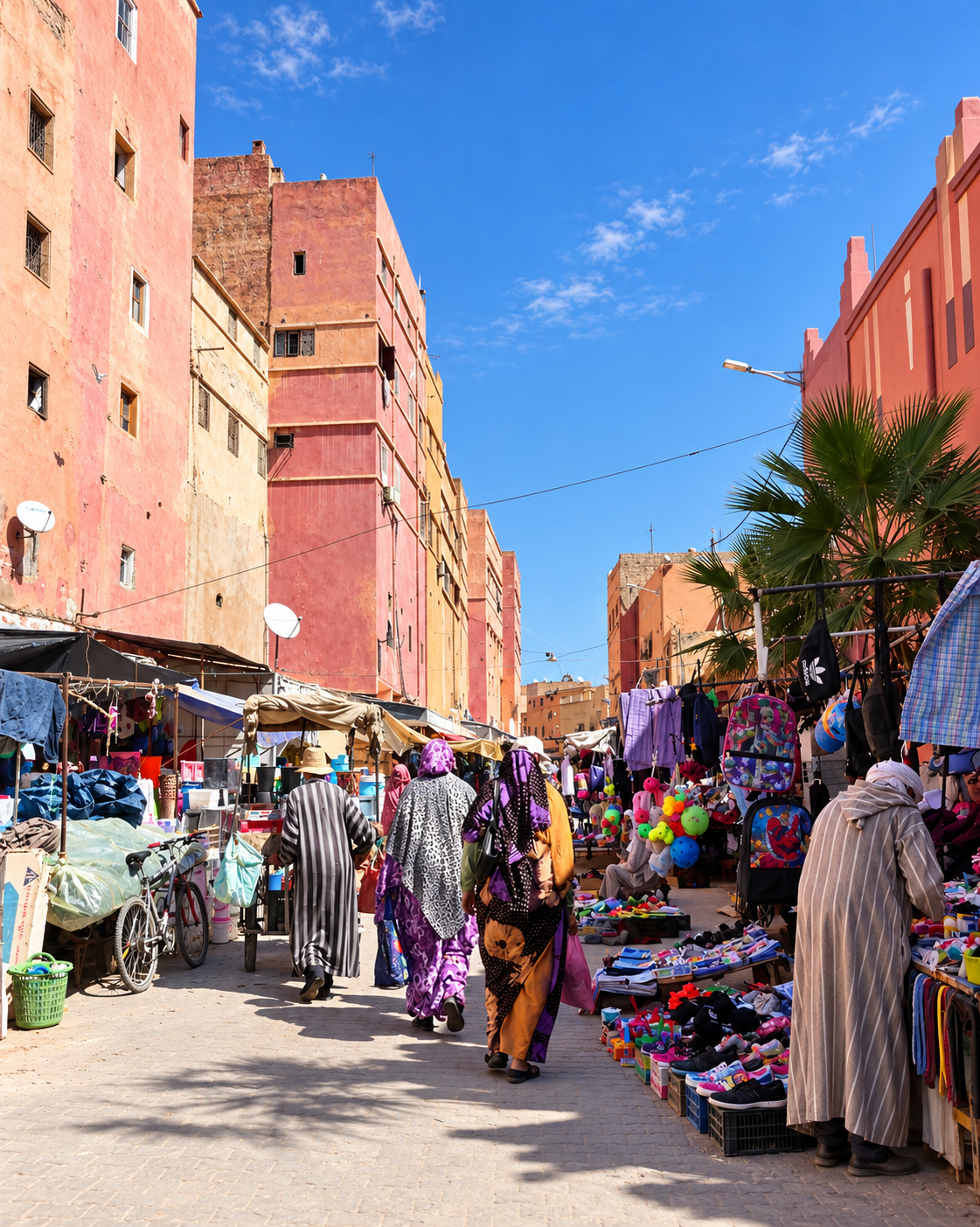
Guelmim market street with warm-toned buildings, colourful stalls and shoppers

Continue through the city context

Guelmim — the wider journey beyond Amtoudi

Pair the close observation of Amtoudi's granaries with a city visit in Guelmim. The change of pace gives the journey variety: time spent reading a mountain building can sit alongside an unhurried walk through streets and markets.

Use the Guelmim guide to shape that next chapter and the regional guide to compare onward options. Arrange the transfer as a separate part of the day, leaving enough space for both the granary visit and the city.

Guelmim city orientationStreets and market life Amtoudi visit planningOasis and mountain context Southern regional linksA measured travel pace

Continue the journey

From Amtoudi's granaries to Guelmim.

Carry an understanding of the buildings with you, then make time for the city and the next southern landscape.