
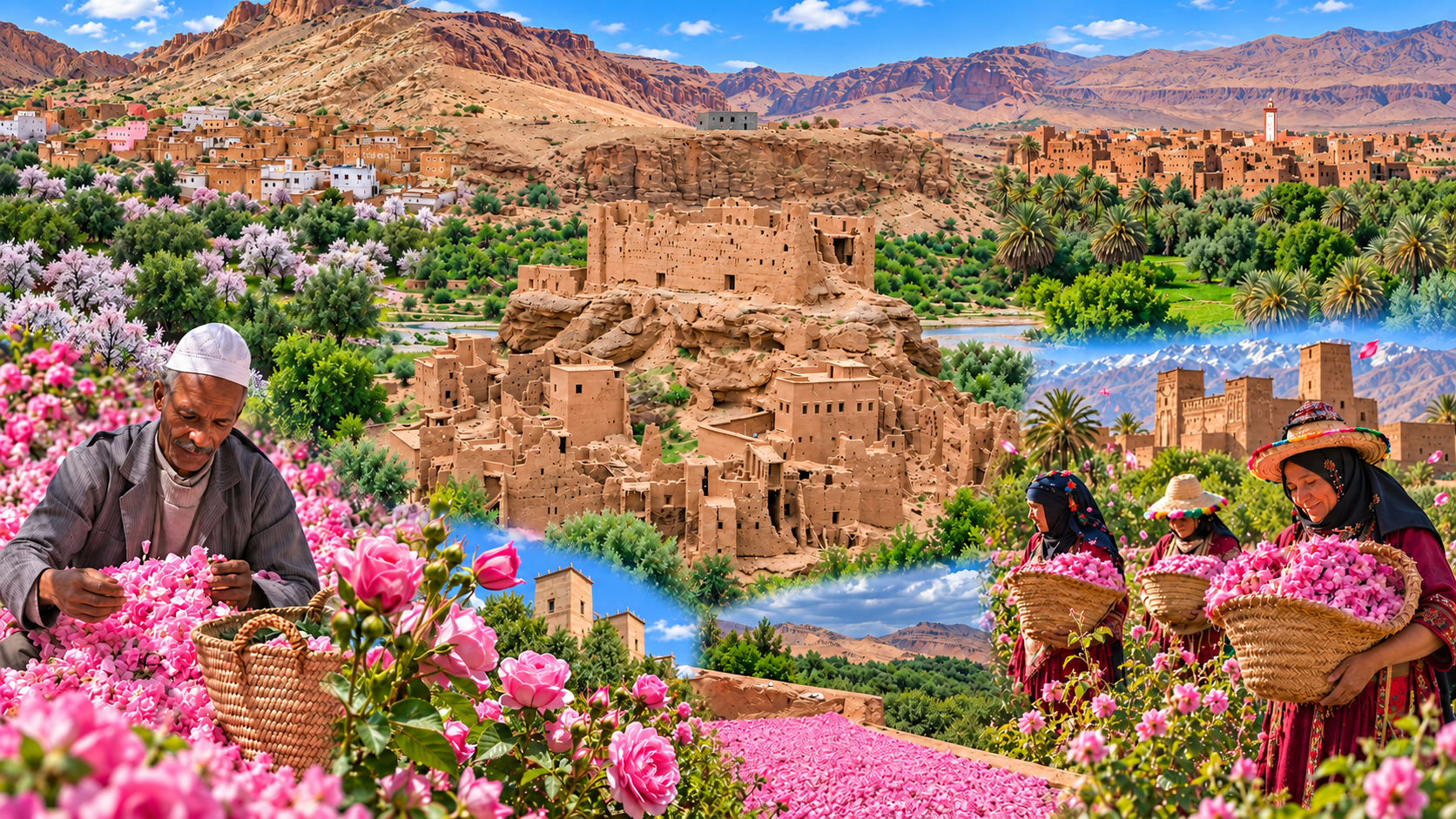
Rose Valley montage with pink rose harvesting, valley villages and earthen architecture around Kelaat M’Gouna

Visit / Place · M’Goun Valley · Drâa–Tafilalet

Rose Valley Kelaat M’Gouna · Rose gardens beneath the High Atlas

Along the M’Goun, cultivated gardens and villages follow the water through bare mountain country. Roses give this valley its name; the landscape reveals the work behind their fragrance.

Come for the valley as well as the flowers. The rose harvest is brief, while field paths, village architecture and the changing mountain backdrop give a visit substance beyond the flowering season.

Why Rose Valley matters

A cultivated valley, shaped by water and work.

Rose Valley is the name associated with the rose-growing landscape around Kelaat M’Gouna, including the lower M’Goun Valley and neighbouring Dadès cultivation areas. Kelaat M’Gouna stands near the meeting of those rivers in Tinghir province. It is the natural starting point for understanding how the valley connects mountain water, farming and trade.

The celebrated flower is the Damask rose, Rosa damascena. Its presence is woven into a mixed agricultural landscape: rose hedges border plots used for crops and fruit trees. These boundaries have a practical role as well as a visual one. They define small parcels and help protect cultivation from grazing animals.

What appears green and effortless from the road depends on irrigation and repeated attention. Channels, field edges and paths form a closely worked landscape. Read them alongside the surrounding dry slopes: the contrast makes the value of productive ground immediately visible, without turning rural life into a romantic tableau.

The rose economy also links the gardens to activities beyond the field. Picking, sorting, drying, processing and selling involve different skills. A flower may become dried rosebuds, rosewater or an aromatic extract. Understanding that sequence makes a producer conversation more revealing than simply browsing bottles with similar labels.

For a visitor, the most useful change of perspective is to notice what a beautiful view contains. A hedge is a boundary; a channel serves a plot; a doorway belongs to a household. Rose Valley becomes more interesting when these ordinary functions remain visible within the landscape.

For the valley’s geography and farming context, see Bertini, Caruso & Vitolo’s Rose Valley study. The Rose Dades Mgoun cooperative documents local Damask-rose production. Flowering and visitor arrangements should be checked locally.
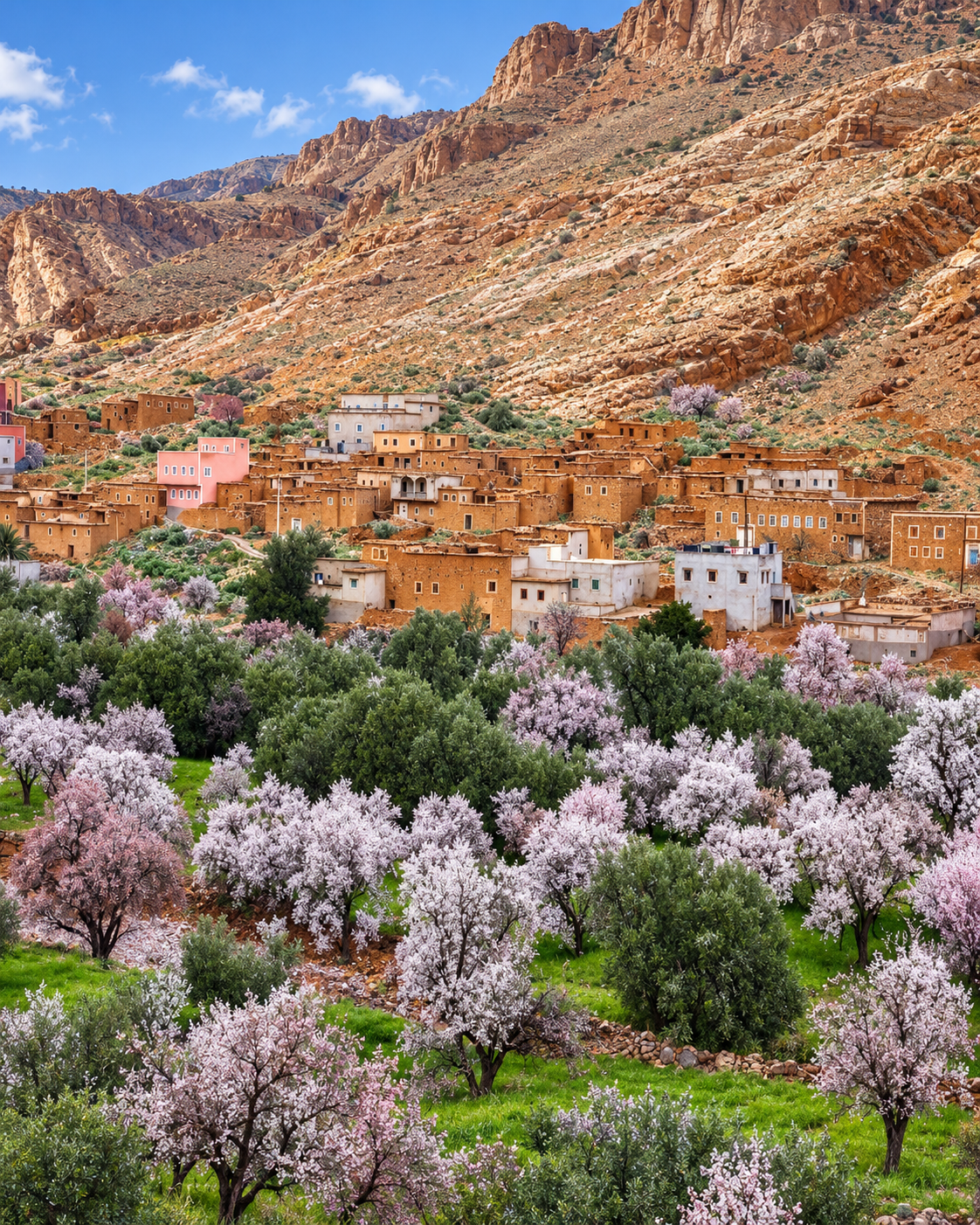
Blossoming orchard trees below a village and rocky slopes in the Rose Valley landscape
Rose ValleyM’GounKelaat M’Gouna

Map orientation

Follow the lower M’Goun north from Kelaat M’Gouna towards Boutaghrar. This is a valley overview, not a marked walking route. Open Google Maps ↗

Editorial reading

The margins tell the story.

Look first at the edges of the cultivated ground. The meeting of a narrow green plot and an exposed slope explains the valley more clearly than a close-up of petals alone. Your eye can follow that boundary from the foreground into the distance.

Then notice how the view is divided. Hedges draw fine lines, trees interrupt them and buildings gather into denser groups. The landscape has several scales at once: the individual plant, the worked parcel and the larger valley corridor.

A raised public viewpoint can make this arrangement easier to read. At ground level, the same view becomes a succession of small changes: a bend in the path, a shaded wall, an opening between gardens and a ridge briefly coming back into sight.

Flowering trees and rose hedges can both appear in valley photographs. Blossom high in an orchard canopy should not be confused with roses growing on shrubs. Look at the plant’s shape and position before giving a photograph a botanical caption.

Buildings bring another rhythm. Compare the warm surfaces of older earthen fabric with painted façades and newer construction. This is a changing inhabited landscape; differences between buildings can be as informative as a harmonious view.

Keep seasonal photographs in perspective. A frame made during flowering describes a moment in the agricultural year. It cannot promise that every garden, village or month will offer the same colour.

A satisfying visit leaves room for this variety. Choose a few observations you can explain afterwards: where the water runs, what separates the plots, or how the path changes the view. Those connections give the landscape a lasting identity.

Agricultural and cultural orientation

A landscape with a seasonal livelihood.

Understand the place through four distinct layers: its valley setting, the cultivated rose, the knowledge used to process it and the public celebration of the harvest. None requires a picturesque origin legend to be meaningful.

01Geography

Two connected valleys

The M’Goun meets the Dadès at Kelaat M’Gouna. Rose cultivation is associated with both valleys, so the name Rose Valley describes a growing landscape rather than one enclosed attraction.

02Cultivation

The Damask rose

Rosa damascena is grown here for its fragrant flowers. The plant’s low, branching form is distinct from orchard trees, even when both appear pink in photographs.

03Knowledge

From flower to product

Local producers work with dried flowers, rosewater and essential oil. These are different products, with different methods of preparation; ask what was made locally and how its origin is recorded.

04Season

Harvest and celebration

Kelaat M’Gouna’s rose festival is associated with the spring harvest. Treat flowering, picking and the festival programme as related but separate events; confirm the current schedule before making fixed plans.

A visual bridge

Three ways to compose a valley view

Use the view itself as a guide: follow a line, compare two surfaces and choose a useful sense of scale. These readings work whether the roses are flowering or the valley is between harvests.

01

Lines

Follow the garden edges

Instead of searching immediately for a landmark, trace a hedge or field boundary across the scene. Its turns make the cultivated ground readable and show how many small plots contribute to the larger view.

  • Let one boundary lead the eye into the distance.
  • Notice where trees interrupt a straight line.
  • Include enough surrounding ground to explain the pattern.
02

Surfaces

Read green against stone

The green of a garden is especially clear beside bare rock and pale ground. Keep both in view: removing the dry slopes from a photograph can also remove the strongest clue to the valley’s setting.

  • Compare planted ground with the slope above it.
  • Look for small changes in soil and wall colour.
  • Keep the natural contrast without exaggerating saturation.
03

Scale

Give the mountains room

An isolated flower fills a frame but says little about where it grows. A wider composition can hold a garden, a village edge and a mountain ridge together, giving the smaller subject a clear setting.

  • Use a path or tree to establish foreground scale.
  • Leave breathing space around the skyline.
  • Photograph from public ground without entering crops.

Quick orientation

Type of place

An inhabited agricultural valley associated with Damask-rose cultivation. Best explored as a landscape of gardens, villages and river corridors, with time for walking and observation.

Best for

Seasonal flower interest, landscape photography, field patterns, village architecture and conversations about rose products. The travel mood is unhurried, with a few considered stops.

Closest town

Kelaat M’Gouna is the immediate gateway. Start with its local services and then choose a valley outing suited to current conditions. See the Kelaat M’Gouna city guide.

What visitors experience here

From the town road to the garden path.

The experience changes with your position. A road gives a broad introduction; a permitted walk brings the scale down to walls, hedges and the ground beneath your feet. Choose the pace that lets you notice those transitions.

Arrival

The valley opens northwards

From Kelaat M’Gouna, the lower M’Goun gives the journey a direction towards the mountains. Pause where stopping is safe and the view is open; an unhurried first look helps you choose which part of the valley to explore.

Flowering

Pink at shrub height

During the rose season, look along garden boundaries for flowers among branching stems and green leaves. The effect can be intimate rather than panoramic: small concentrations of colour within a larger working landscape.

Walking

A sequence of short views

A field path rarely presents everything at once. Walls, vegetation and turns reveal the landscape in parts. Walking at this scale brings attention to surfaces and small openings that disappear in a roadside panorama.

Light

Relief in the valley walls

Side light brings out folds and ledges in the surrounding slopes. Under stronger overhead sun, the scene can look flatter and more exposed. Choose a comfortable place to pause rather than pursuing a particular photograph in difficult light.

Making

A producer conversation

Where visits are offered, ask to understand the difference between drying flowers and distilling them. A demonstration depends on the producer’s work and season; arrange it beforehand rather than expecting every shop to operate a still.

Town life

The return to Kelaat M’Gouna

Returning to town reconnects the gardens with everyday commerce. A café stop or considered purchase gives the outing a natural finish. Leave time for questions about a product instead of turning the final stop into a hurried transaction.

Place details and orientation

Six elements that give Rose Valley its shape

Use these elements to orient yourself on the ground. They connect the place name with things you can identify, while keeping the valley distinct from a single viewpoint or one flowering field.

1
The M’Goun corridor

The valley gives a clear north–south reference between the mountain approaches and Kelaat M’Gouna. Use it to orient the journey before choosing individual stops.

2
The Dadès connection

At the southern end, the Dadès places the outing within a wider east–west journey. Nearby rose-growing areas belong to this connected river landscape.

3
Rose boundaries

Hedges provide a finer scale than the valley itself. Notice where a plot begins and ends, and how flowers sit within the productive ground.

4
Orchards and crops

Roses share the scene with other cultivation. The variety of heights and leaf textures helps explain why a garden remains visually rich outside the rose harvest.

5
Village edges

Buildings, lanes and gardens meet at many small thresholds. They are useful places to observe from public paths without assuming access to courtyards or fields.

6
Boutaghrar direction

Boutaghrar is a reference point further up the lower valley. Treat an excursion towards it as a route to plan locally, with stops and walking sections chosen in advance.

Looking with precision

Let details earn their names.

A pink tree, a rose hedge and a display of dried petals tell different stories. Look at the form of the plant, where it grows and how it is being used. Accurate observation makes a visit richer and keeps captions useful to the next traveller.

Apply the same care to buildings. A towered outline does not identify an owner, a dynasty or a construction date. Enjoy the massing, openings and materials you can see, and ask for reliable local context before attaching a historical claim.

Routes need equally careful reading. A track visible across a riverbed is not evidence that a crossing is suitable today. Distinguish a distant view from an accessible path, and let current local advice determine where the walk goes.

Landscape and water intelligence

The smallest channels have a large role.

The valley’s cultivated appearance depends on water reaching individual parcels. Irrigation connects the river landscape with gardens at a much finer scale than a map can show. This is why a narrow channel deserves the same attention as a dramatic hillside: one is visually modest, but central to the ground’s use.

Water scarcity and drought place pressure on oasis agriculture. For a visitor, that context has a simple consequence: treat water infrastructure as working equipment. Do not block a channel for a photograph, move stones at an intake or step across a soft bank where an established crossing is available.

What to notice slowly

  • Notice how a small channel relates to the plots beside it.
  • Observe the difference between a riverbed and an irrigation channel.
  • Use established crossings rather than stepping on garden banks.
  • Keep bags, vehicles and litter away from water intakes.
  • Ask a local guide about features whose purpose is unclear.
  • Let a closed or damaged path change the route.

Visual reading

Three relationships beyond the postcard

River and road

A river, a road and a walking path serve different movements. Watch where they converge and separate. A convenient road stop may give a good overview without being the start of a suitable walk.

Home and garden

A garden seen beside a house is still a place of work and ownership. Doorways and small access paths help explain everyday movement; appreciate that arrangement from shared space rather than entering it uninvited.

Old fabric and new needs

Earthen walls and newer façades can share one view. Compare their proportions and surfaces without assuming the older building is more authentic to current life. Settlements continue to adapt to the people who use them.

Visual atmosphere

Colour, depth and the changing hour

A restrained palette

The valley can hold several greens beside pale soil, warm walls and muted mountain tones. Roses add a precise accent when flowering. Give those quieter colours attention too; they keep the bright details connected to a believable landscape.

Depth in an open view

Foreground leaves can look dense and sharply textured while distant ridges become lighter and less distinct. That change in clarity creates depth. A carefully chosen viewpoint often communicates the valley’s scale better than a tightly cropped dramatic feature.

A memory with context

Choose one moment you can place: shade beside a garden wall, a conversation about rosewater or the view where the road turns towards the mountains. Its value comes from the setting and encounter, without needing a claim that every visitor will experience the same thing.

Nearby places and onward links

Connect the valley to the southern route

Kelaat M’Gouna is the immediate gateway. Beyond it, choose a wider theme or route that adds a different perspective, leaving enough time for the valley visit itself.

Kelaat M’Gouna

Return to the town for the local context behind the valley: rose-related commerce, everyday services and the starting point for onward arrangements.

Open Kelaat M’Gouna city guide

Southern Morocco, Oases & Sahara

Place this mountain-fed agricultural valley within the wider southern landscape of oases, settlements and routes towards the desert.

Explore the region

Architecture & Heritage

Continue the reading of earthen buildings and village form, with attention to materials, maintenance and the changing uses of inherited structures.

Read the theme

Valleys and other Visit places

Browse the Visit collection to compare this cultivated corridor with other valleys, natural sites and heritage places along a wider journey.

Browse Visit places

Plan your journey

Fit the valley into a realistic itinerary between southern travel bases. Leave room for current road advice, a walking outing and the return journey.

Plan your journey

Events and festivals

Use the events section when shaping a trip around a celebration. Confirm the announced rose-festival programme locally before booking to match it.

Explore events

How to visit respectfully

Walk as a guest in a working landscape.

Ask before entering a field, joining harvesting or photographing people at work. A roadside view does not imply permission to step into a garden. If someone agrees to a portrait, make the exchange clear and courteous, without interrupting the task they are doing.

Keep walking routes practical. Wear footwear suited to uneven ground, carry drinking water and sun protection, and arrange longer outings with a knowledgeable local guide. River crossings, narrow gorges and mountain routes need current advice, especially after rain.

  • Stay on agreed paths; do not pick flowers or fruit without permission.
  • Keep irrigation channels, plot edges and access lanes clear.
  • Ask before photographing households, workers or private interiors.
  • Agree the scope and price of guiding or demonstrations beforehand.
  • Take litter away and use established places to stop or park.

A strong first visit

Start in Kelaat M’Gouna by deciding what the day is for: a short valley drive, an easy walk or a pre-arranged producer visit. Check the weather and local route advice, then choose one coherent outing instead of combining several uncertain detours.

Continue into the lower M’Goun Valley and pause at a safe public viewpoint. Give yourself time to recognise the river corridor and the relationship between gardens and villages. Use that overview to select a walking section with a known return route.

On foot, keep the plan modest enough to stop comfortably. Where a garden path is private or a crossing is unsuitable, turn back or follow the guide’s alternative. Leave spare time so a changed route does not create pressure to hurry.

If a producer visit is arranged, finish with focused questions about origin, ingredients and processing. Rosewater, essential oil and a fragranced cosmetic should not be treated as interchangeable purchases. Buy what you understand and can use.

  • Confirm a start point and return plan before setting out.
  • Check flowering locally if roses are the main reason for the visit.
  • Choose a public viewpoint and one suitable walking section.
  • Arrange demonstrations directly with the producer in advance.
  • Allow time to return to town before onward travel.

Seasonal planning: the rose harvest generally falls in April–May, but flowering varies. Check the actual bloom and festival dates for your travel year; a festival booking does not guarantee fields in flower.

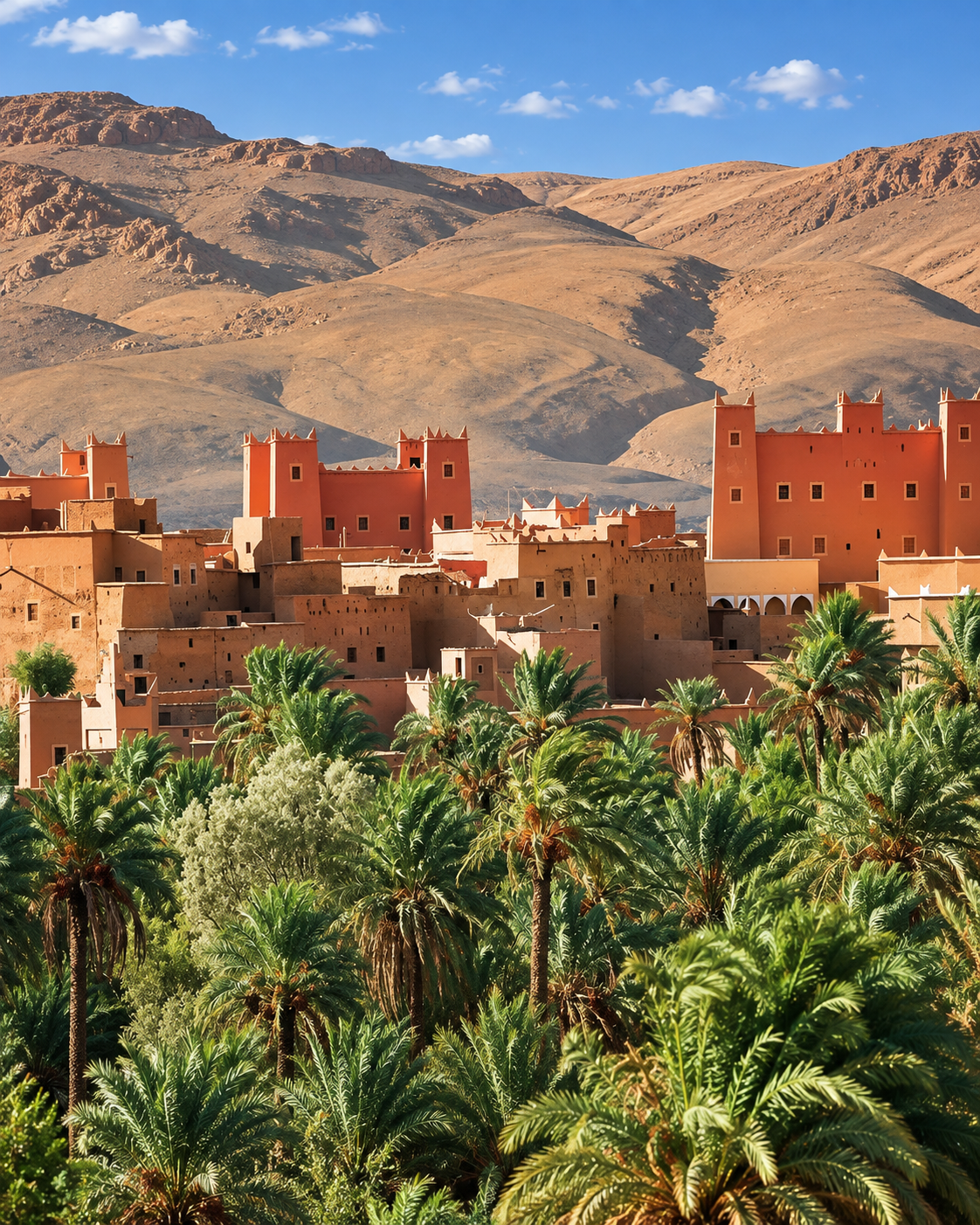
Warm towered buildings and greenery in the Kelaat M’Gouna gateway landscape

Continue through the gateway town

Kelaat M’Gouna — the gateway to Rose Valley

Use Kelaat M’Gouna to give the valley outing a practical centre. It brings the garden landscape back to a town where you can arrange the next stage, ask about local producers and understand how the rose economy connects with everyday commerce.

The city guide widens that context beyond the walk: town orientation, regional setting and onward travel. Keep it alongside the valley page when planning a stay, with space for local advice to shape the final route.

Kelaat M’Gouna orientationLocal rose products Valley outing contextTown and landscape connections Southern route planningSeasonal visit preparation

Continue the journey

From Rose Valley, let the journey unfold.

Continue through Kelaat M’Gouna, then connect the valley’s gardens and mountain setting with your next southern Morocco destination.