
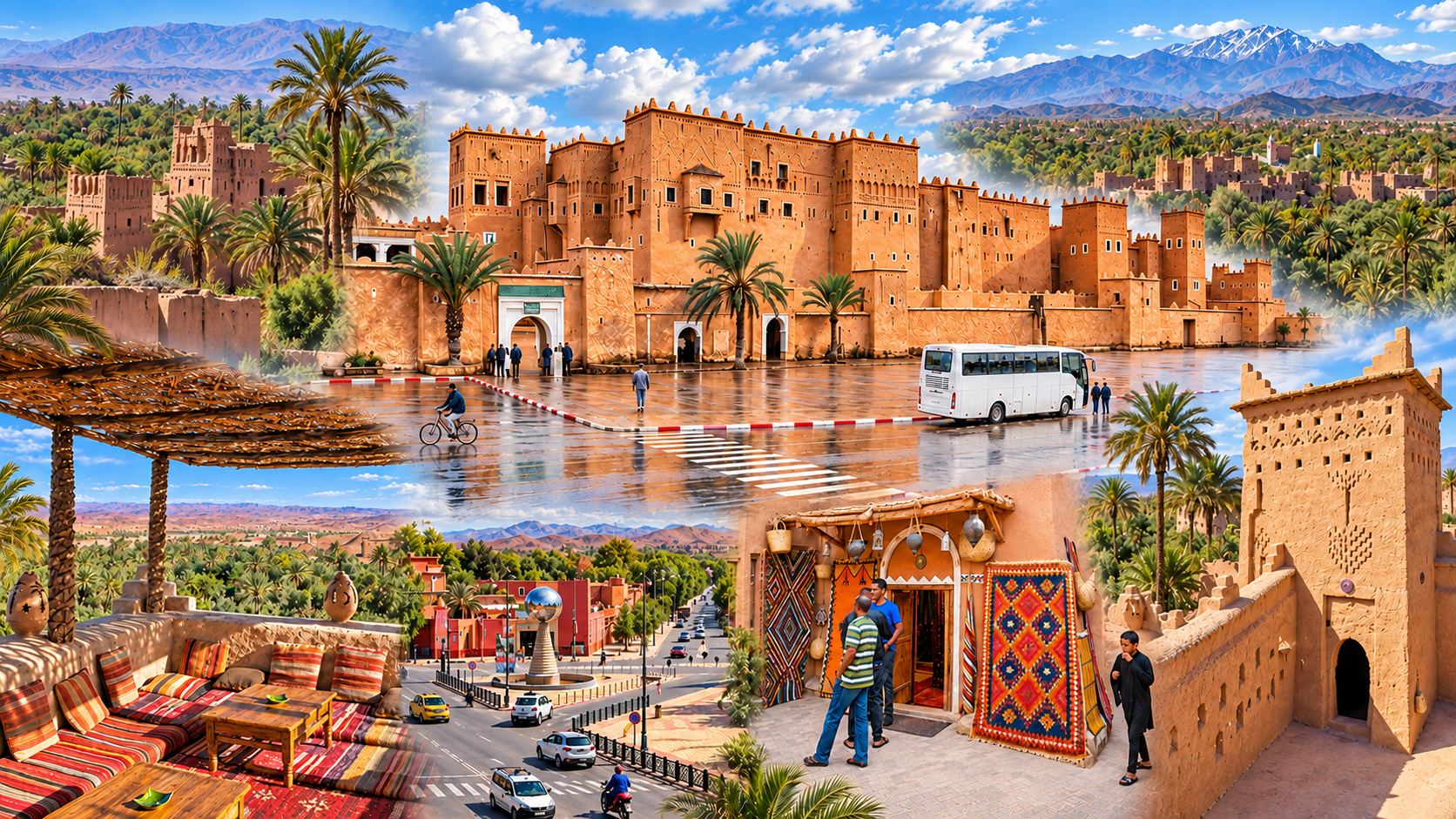
Panoramic composition of Skoura palm groves, earthen kasbahs and the Ouarzazate gateway

Visit / Place · Oasis landscape · Ouarzazate province

Skoura Palm Grove Palm gardens, earthen kasbahs and the High Atlas horizon

East of Ouarzazate, Skoura brings cultivated gardens and fortified homes into one oasis landscape. Its character emerges along the paths between them, beneath a canopy of date palms.

Leave time for both a kasbah visit and a walk through the grove. The first reveals the buildings; the second brings their agricultural setting into focus.

Why Skoura Palm Grove matters

An oasis sustained by knowledge and work.

Skoura is a cultivated oasis in Ouarzazate province, in the Drâa-Tafilalet region. The palm grove includes gardens, homes, tracks and earthen kasbahs; the modern town stands along its eastern edge. Understanding this distinction helps visitors move beyond the roadside centre and into the landscape they came to see.

Agriculture gives the grove its purpose. Date palms rise above fruit trees and lower crops, creating several growing levels within the same ground. The pattern varies between plots: a dense orchard, a recently worked bed and an open patch tell different stories about cultivation. The green view represents land that people manage and depend upon.

Water makes that cultivation possible. Skoura’s irrigation heritage includes khettaras, underground galleries that bring groundwater towards the oasis, and surface channels that distribute it. Their significance lies as much in the organisation of supply as in the engineering. A garden’s relationship to its neighbours can be traced through the water that reaches it.

The kasbahs add another layer of history. These substantial fortified residences stand among smaller buildings and agricultural land, giving the grove a dispersed skyline. Their size, towers and decorated upper walls invite questions about households, wealth and local authority. Each building has its own history; the whole oasis cannot be explained through one celebrated façade.

Skoura also has a contemporary agricultural economy. A case study published by FAO describes local olive-growing families working together through the Al Mohammedia cooperative to improve the value of their production. That perspective matters on a visit: the orchards belong to people making decisions about livelihoods, water and the future of their land.

For further context, see FAO’s Skoura agriculture case study and Sudestmaroc’s account of the oasis.
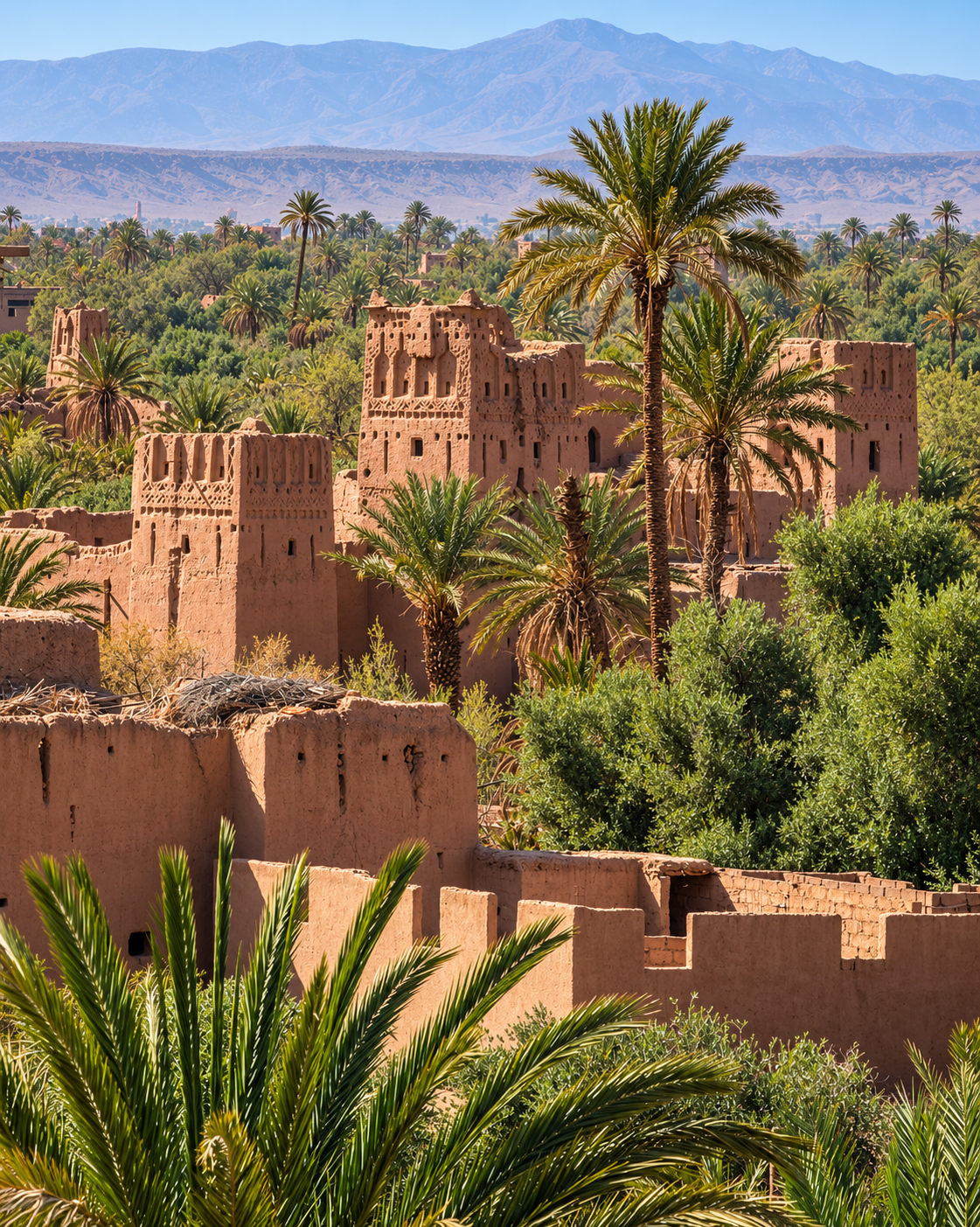
Earthen kasbahs among Skoura’s palms with mountains in the distance

Map orientation

The map shows Skoura and the surrounding oasis. Choose your arrival point with your host or guide. Open Google Maps.

Editorial reading

The spaces between the kasbahs matter.

A photograph naturally favours the tallest towers. On the ground, the less conspicuous spaces deserve equal attention: a bend beside an orchard, a narrow passage between walls, or the point where a garden opens towards the sky.

Follow those transitions with your eye. A wall can enclose a plot, guide a path and frame a distant roof at once. Its role becomes clearer when you look along it rather than only at its surface.

The grove also changes how buildings are seen. Palm fronds interrupt a façade; an olive canopy conceals its lower storeys. This partial visibility gives each approach a different composition, without requiring a higher or more intrusive viewpoint.

Amridil is a useful architectural reference within that wider setting. Treat it as one chapter of the visit, then give attention to the ordinary lanes and cultivated spaces that connect the larger landmarks.

Take care with visual assumptions. An old-looking surface does not establish a building’s age, and a handsome entrance does not establish public access. Local explanations are more useful than guessing from appearances.

Look at the margins of the view as well as its centre. A channel, a field boundary or a change in ground level may help explain the scene more clearly than the most imposing tower.

The lasting impression can be a sequence rather than a single panorama: bright track, shaded turn, textured wall, then palms opening towards the mountains. Let the walk reveal that sequence at its own pace.

Historical and heritage orientation

A cultivated landscape with many histories.

Skoura’s heritage includes water management, earthen building and the histories of the communities who shaped the oasis. These strands have changed over time; they deserve more care than a single founding date or a claim that life here has stood still.

01Settlement

A dispersed oasis

Gardens and village clusters spread through the palmeraie, while the roadside town provides a separate point of orientation. Plan to explore a chosen part of the grove rather than expect one entrance to the entire site.

02Built heritage

Kasbah Amridil

Amridil is among Skoura’s best-known fortified residences. Its complex developed in stages, so descriptions of the older settlement and the later towered house should not be treated as the same construction date.

03Community memory

Several cultural layers

Local accounts describe Amazigh, Arab, Jewish and sub-Saharan contributions to the oasis’s history. Traces of former Jewish communities remain among its heritage. These histories belong to particular people and places, and reward informed local interpretation.

04Continuity

Buildings with different futures

Some earthen structures remain in use, others have been adapted, and others have deteriorated. Their different conditions are part of the landscape’s history. A restored exterior or an open doorway alone cannot tell you how a building is used.

A visual bridge

Three ways to read the palm grove

Change the scale of your attention: first the skyline, then the cultivated middle ground, then the path at your feet. Each reveals something that the others leave out.

01

Above

The broken skyline

Notice the different silhouettes of palms, towers and mountains. They overlap unevenly, giving the view depth. A clear gap between them may be more revealing than a viewpoint with everything crowded into one frame.

  • Find one clear relationship between tower and canopy.
  • Keep the distant landscape in proportion.
  • Notice what each foreground layer conceals.
02

Between

Gardens in layers

Look beneath the tallest palms for the orchard level and, where visible from the path, lower planting. The eye moves through several heights rather than across a single green surface.

  • Distinguish palms from the trees below.
  • Observe cultivated plots from established paths.
  • Allow seasonal differences into your reading.
03

Below

Lines across the ground

At walking level, attention shifts to channels, plot edges and junctions. These small lines help you understand how the grove is organised, even when foliage hides the wider layout.

  • Look for changes in level beside the track.
  • Keep channel edges clear.
  • Confirm a path before following an unfamiliar turn.

Quick orientation

Type of place

An inhabited agricultural oasis with a palm grove, village paths and earthen kasbahs. Choose a manageable walking area and a specific heritage visit; access arrangements vary between properties.

Landscape context

Ouarzazate province, Drâa-Tafilalet, south of the High Atlas. Skoura lies on the route east from Ouarzazate towards Kelaat M’Gouna and the Dadès country.

Best for

Palm-grove walks, kasbah architecture, close observation and an unhurried break within a southern itinerary. Allow flexibility for heat, shade, the weather and the interests of your group.

What visitors experience here

From the road to the shelter of the palms.

The experience becomes more intimate once you leave the main road. Broad views give way to changing patches of shade, closer textures and junctions that make a little local orientation valuable.

Arrival

A change in scale

At the edge of the grove, open road views give way to walls, tree trunks and patches of sky. The horizon becomes less continuous. Notice how quickly the scale changes from a broad landscape to the width of a path.

Light

Shade that keeps moving

Palm fronds cast narrow, shifting shadows rather than one continuous roof. Expect bright gaps between sheltered stretches. Early or late light can make these transitions easier to read and more comfortable to explore.

Texture

Fronds, trunks and earth

The upright fibres of a palm trunk, a rough wall and fine foliage catch light differently. Notice these changes from the path: the pleasure lies in their proximity, without needing to touch the surfaces.

Sound

Listen at a quiet turn

Pause where you can stand clear of other people. You may hear leaves moving, footsteps or activity nearby. Let the sounds present on the day define the visit rather than expect the oasis to be silent.

Architecture

A façade revealed gradually

At Amridil or another permitted stop, look upwards from the building’s base to its upper details. Compare solid wall surfaces with small openings and patterned relief before stepping back to see their overall balance.

Movement

Walking with room to stop

Walking reveals small intervals that disappear from a vehicle: the length of an orchard wall, the shade around a bend and the distance between neighbouring buildings. A short route with pauses can make these relationships surprisingly vivid.

Place details and orientation

Six elements that give Skoura its character

These features offer useful points of attention during a walk. Their visibility varies with the route, the season and the permissions available at individual properties.

1
Date palms

The tallest cultivated layer gives the grove its vertical rhythm. Look for the spacing between trunks and the way their crowns filter the sky.

2
Olive orchards

Olives are an established part of local farming. Their lower, denser canopies add a different texture to the landscape and connect the view to agricultural production.

3
Irrigation channels

A surface channel, or seguia, carries water towards plots. It is distinct from a khettara’s underground gallery; a visible channel does not reveal the whole supply network.

4
Kasbah Amridil

The towered residence provides a clear architectural focal point within the grove. Compare its vertical profile with the lower buildings around it, then notice how the upper decoration draws attention towards the roofline.

5
Village thresholds

Doorways and garden boundaries mark transitions between shared routes and private space. Keep those distinctions in mind, especially where tracks pass close to homes.

6
The Atlas horizon

When visibility allows, the mountain backdrop gives the oasis a wider frame. Snow cover, haze and clouds vary; a clear mountain view is never a guaranteed feature of the visit.

A careful eye

Learn the names of what you see.

Three words are useful on a guided walk: palmeraie for the palm grove, kasbah for a fortified residence, and seguia for a surface irrigation channel. They distinguish the setting, the building and the watercourse instead of merging them into one scenic impression.

Ask your guide which building you are looking at and what is known about it. A family name, a change of use or the explanation of a repaired section can make an ordinary-looking detail more meaningful than a general story about all kasbahs.

Separate observation from interpretation. You can see a tower’s shape or a channel’s direction; you need evidence to explain who built it, when it changed or how water is allocated. The best questions begin with a detail in front of you.

Water and landscape intelligence

Part of the oasis lies out of sight.

A khettara uses a gently sloping underground gallery to move groundwater towards lower land by gravity. Much of that infrastructure is invisible during an ordinary walk. UNESCO’s explanation of Moroccan khettaras provides a useful introduction to the principle.

Skoura’s water supply also involves surface flows and distribution channels. Conditions differ across the grove, so do not assume every old gallery still carries water or every dry bed is permanently disused. Ask about the particular network you are seeing; never enter a shaft or tunnel to investigate it.

What to notice slowly

  • Distinguish a surface channel from the underground system that may supply it.
  • Notice how a small change in elevation affects the direction of a channel.
  • Ask how water reaches a particular garden and who maintains that section.
  • Observe water infrastructure from an established, stable path.
  • Keep clear of shafts, excavations and unsupported channel edges.
  • Leave all gates, water controls and planted beds undisturbed.

Architectural reading

Three details in the earthen buildings

Tower proportions

Compare the height of a corner tower with the wall beside it. Then look at how the upper part narrows or breaks into smaller forms. The relationship between those masses explains much of a façade’s visual rhythm.

Pattern and shadow

Geometric relief is especially legible where light falls across it. Follow one band rather than scan the whole façade at once. Small projections and recesses can create surprisingly strong contrasts without a change of material.

Construction and maintenance

Rammed earth and earthen brick require knowledgeable maintenance. Look for the meeting of wall, roof and ground: exposed tops and bases deserve attention as well as decorated façades. A building’s continued use depends on care for these less conspicuous parts.

Visual atmosphere

Colour, movement and the limits of a frame

Greens with different weights

An olive canopy can appear silvery beside the darker folds of palm fronds. In one view, foliage may shift from almost black shade to pale highlights. Preserve that range when photographing instead of forcing every tree into the same saturated green.

Warm walls, cooler distance

Warm earthen forms give the foreground weight, while distant mountain layers can recede into softer blue-grey tones. When the horizon is visible, leave room for that contrast. Let distance remain soft; it is part of the depth of the view.

A view shaped by a pause

Choose where to stop before lifting the camera. A slight shift along the public path can separate overlapping towers or reveal a patch of sky. Once the frame is made, lower the camera and notice what movement adds beyond its edges.

Nearby places and onward links

Continue through Ouarzazate and the southern routes

Skoura fits naturally into a journey east of Ouarzazate. Use the city guide for your base, then the regional and planning pages to decide which landscapes deserve their own time.

Ouarzazate

Return to the city for Taourirt’s architectural context and broader travel orientation. The change from urban streets to Skoura’s gardens helps distinguish two settings within the same province.

Open Ouarzazate city guide

Southern Morocco, Oases & Sahara

Place the palm grove alongside the region’s other valleys and oasis landscapes. Use the regional overview to understand connections before choosing the next leg of a journey.

Explore the region

Architecture & Heritage

Continue the questions raised by Skoura’s buildings: how earthen structures are made, how their forms express use, and what maintenance means for their survival.

Read the theme

Visit Morocco places

Browse the place collection to choose an onward stop that adds something different to your itinerary. Allow each valley, monument or natural site the time its setting requires.

Browse Visit places

Plan your journey

Build in a walk, a confirmed heritage visit and a comfortable return from the grove. A little flexibility is valuable when heat, weather or local access changes your plans.

Plan your journey

Stories from Morocco

Continue reading about the people, materials and landscapes behind a journey. Further context can help turn questions gathered on a walk into a more informed understanding of place.

Read stories

How to visit respectfully

Visit gardens and homes with care.

The grove contains working land and private homes. Stay on routes confirmed for visitors, leave space for residents and farm traffic, and ask before entering a garden or photographing people. An open gate is not an invitation to cross a boundary.

Choose a walking plan suited to your group. Shade is intermittent, tracks can be uneven, and watercourses need particular caution after rain. Ask locally about current conditions; do not cross flowing floodwater or enter fragile buildings for a viewpoint.

  • Ask permission for portraits, private interiors and access beyond a doorway.
  • Avoid walking on crop beds, picking fruit or moving irrigation controls.
  • Carry drinking water and sun protection; allow breaks before fatigue builds.
  • Agree the route, service and price with a guide before setting out.
  • Take litter away and keep noise low near homes and places of worship.

A strong first visit

Start by agreeing a clear meeting point and a route through one part of the grove. If you are combining a walk with Amridil, confirm the kasbah visit first so that the rest of the outing fits around an arrangement you can rely on.

Let the walk answer a few specific questions: where do the gardens begin, how are the plots divided, and which buildings can be identified? Ask your guide to explain one visible water feature rather than seek access to underground infrastructure.

At the kasbah, follow the permitted route and let the host explain which parts can be visited. Allow time to look at the façade from a suitable distance as well as any accessible interior. Do not assume roofs, stairs or upper rooms are open.

Finish with enough daylight, water and energy for the return. If your group has limited mobility or wants a shorter outing, arrange a compact visit from the outset rather than discover the limitations halfway along an unfamiliar track.

  • Keep your meeting point and your host’s contact details with you.
  • Choose footwear with grip for loose or uneven ground.
  • Tell your guide which aspect of Skoura interests you most.
  • Allow a separate pause for the kasbah’s exterior.
  • Arrange onward transport before the walk begins.

Before you go: confirm current kasbah access, fees, guiding arrangements and weather locally. The palm grove has no single entrance serving every property.

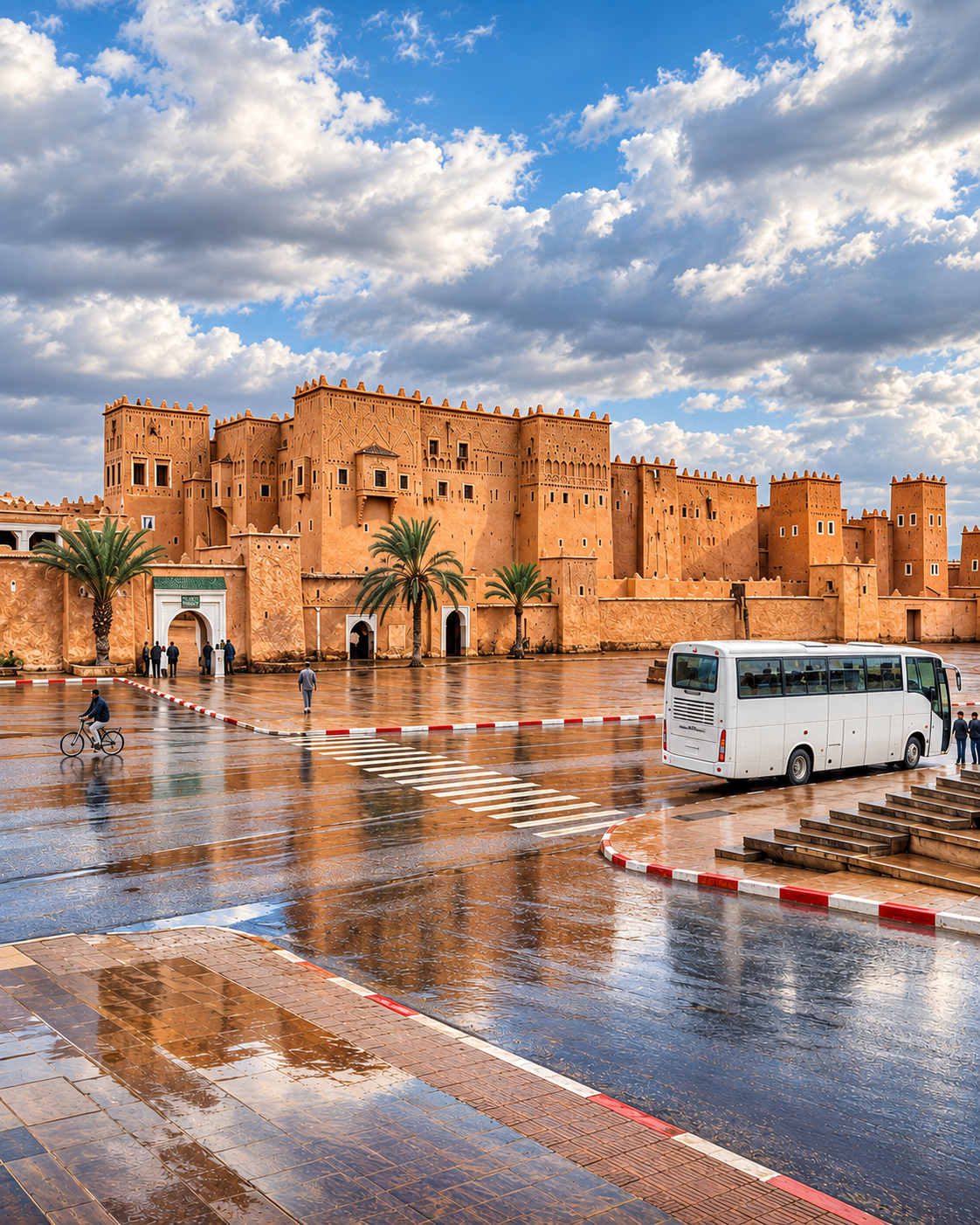
Taourirt Kasbah facing the street in Ouarzazate

Your city gateway

Ouarzazate — the gateway to Skoura Palm Grove

Ouarzazate provides a natural city connection for Skoura. Its Taourirt kasbah offers a different architectural setting, while the road east leads into the gardens and village landscape of the palm grove.

Use the city guide to organise the wider stay: arrival, urban heritage and onward travel. Give Skoura its own space within that plan, with time to leave the roadside and explore the oasis on foot.

Ouarzazate city guideTaourirt context Skoura’s eastern approachOasis and kasbah connections A base for onward travelSouthern Morocco orientation

Continue the journey

From Skoura’s gardens to the wider south.

Continue through Ouarzazate and choose the next chapter of your southern Morocco journey.