Visit / Place · Drâa-Tafilalet · Southeastern Morocco
Tafilalt Oasis Palm groves, earthen villages and the long memory of Saharan trade
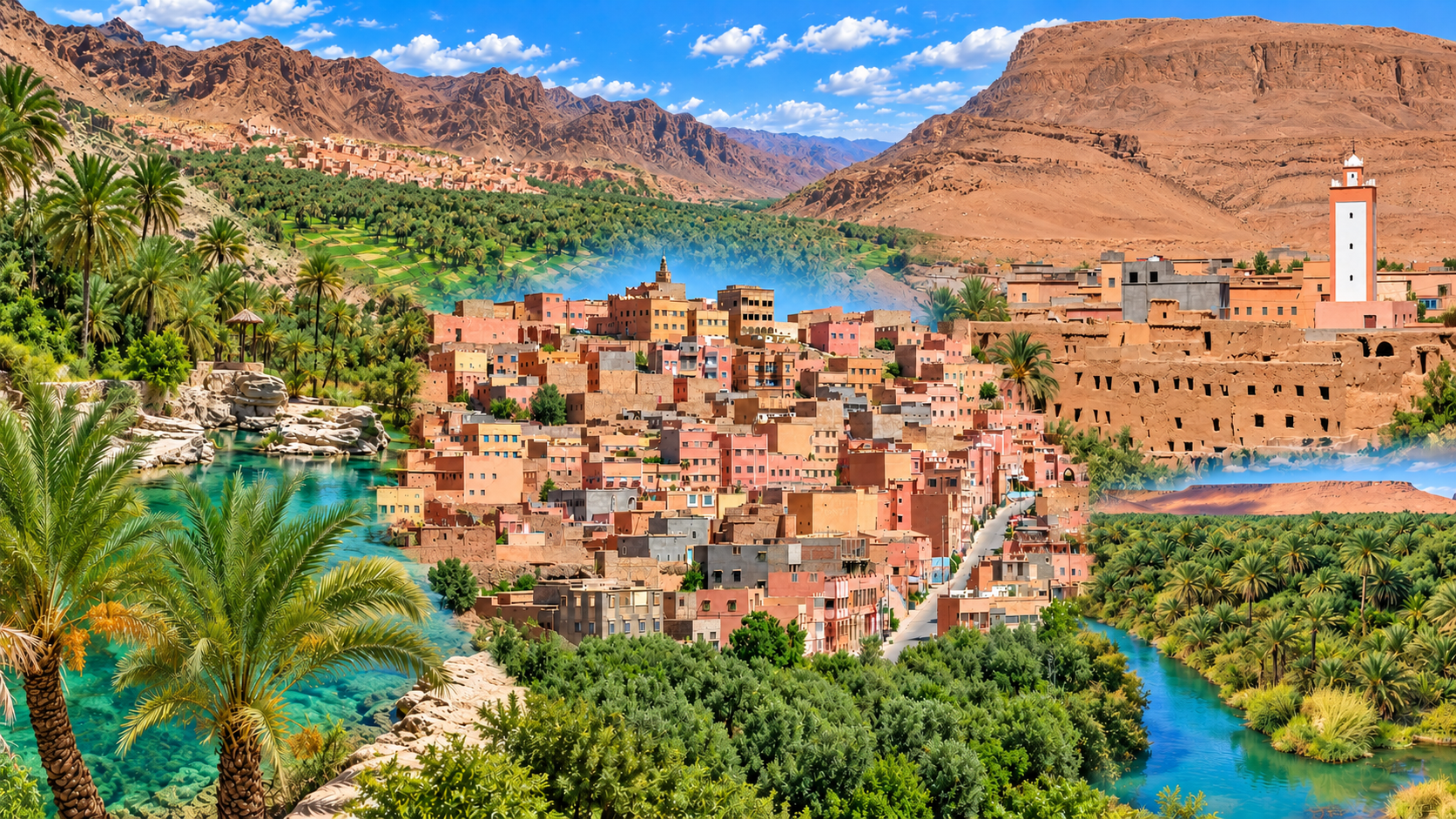
Around Rissani and Erfoud, Tafilalt brings together cultivated land, irrigation and settlement on the Sahara’s northern margin. Its beauty begins with the work that makes an oasis possible.
Make time for the oasis within an Erfoud stay. Choose a locally agreed walking route, explore the history around Rissani, and leave room for the landscape between the stops.
Tafilalt, also written Tafilalet, names an oasis region rather than one enclosed garden or a single visitor site. Its core lies around the lower Ziz and Ghéris valleys, with Rissani and Erfoud as useful points of orientation. Knowing that scale changes the visit: a map pin locates the landscape, while the particular grove, village or path still needs to be chosen.
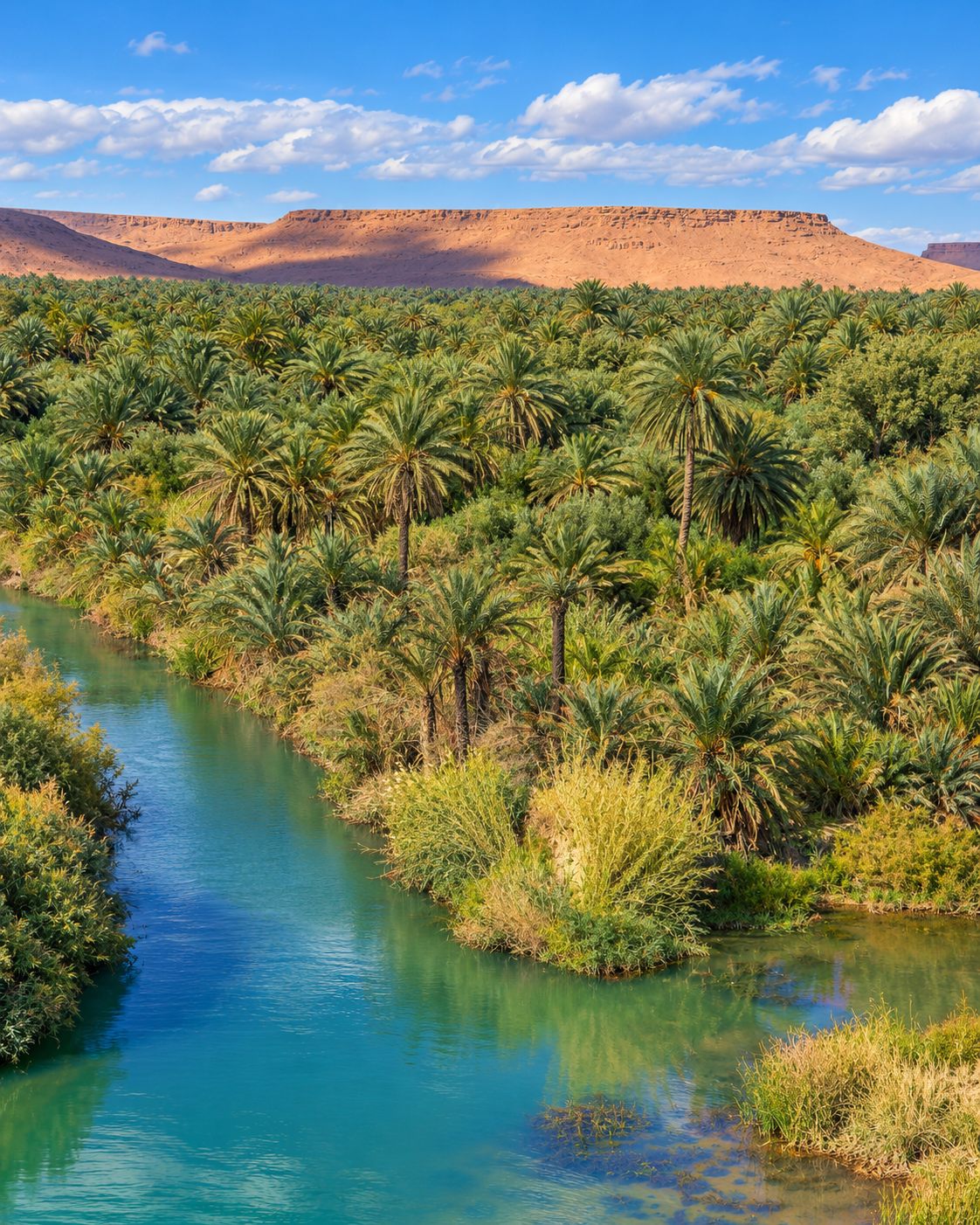
The palms belong to an agricultural landscape. Fields, water channels, access tracks and homes give the greenery its purpose. Look at where a cultivated plot ends, how a path reaches it and where buildings gather nearby. These ordinary connections reveal more than treating the whole oasis as a scenic foreground.
The region also carries the history of Sijilmassa, the medieval trading city near Rissani. Its position on Saharan trade routes connected this oasis country to a much wider world. That history gives a useful counterpoint to the apparent seclusion of a palm grove: this was a landscape of exchange as well as cultivation.
Earthen ksour, or fortified settlements, add another scale to the view. Their compact fabric, passages and gateways belong beside the fields in any reading of Tafilalt. Architecture here is part of inhabited territory, with spaces that may be domestic, agricultural or religious rather than open to visitors.
A good visit leaves space for present-day life. Ask what is grown in a particular plot, how the local water supply is managed and which paths are appropriate to use. Specific answers from the people who know that place make the experience richer than a single story applied to every oasis.
The map centres on the oasis region. Choose your specific walking start locally; this is not a single entrance. Open map.
Editorial reading
Follow the edges of the green.
A palm canopy can make the oasis appear continuous. At ground level it breaks into individual plots, crossings, walls and clearings. Begin with one small stretch and notice those divisions: they turn a distant wash of green into a landscape that people use.
Choose a place where cultivated ground meets a public path. Watch how the view opens and closes between trunks, then compare it with the exposed land beyond. The transition is often more revealing than the densest part of the grove.
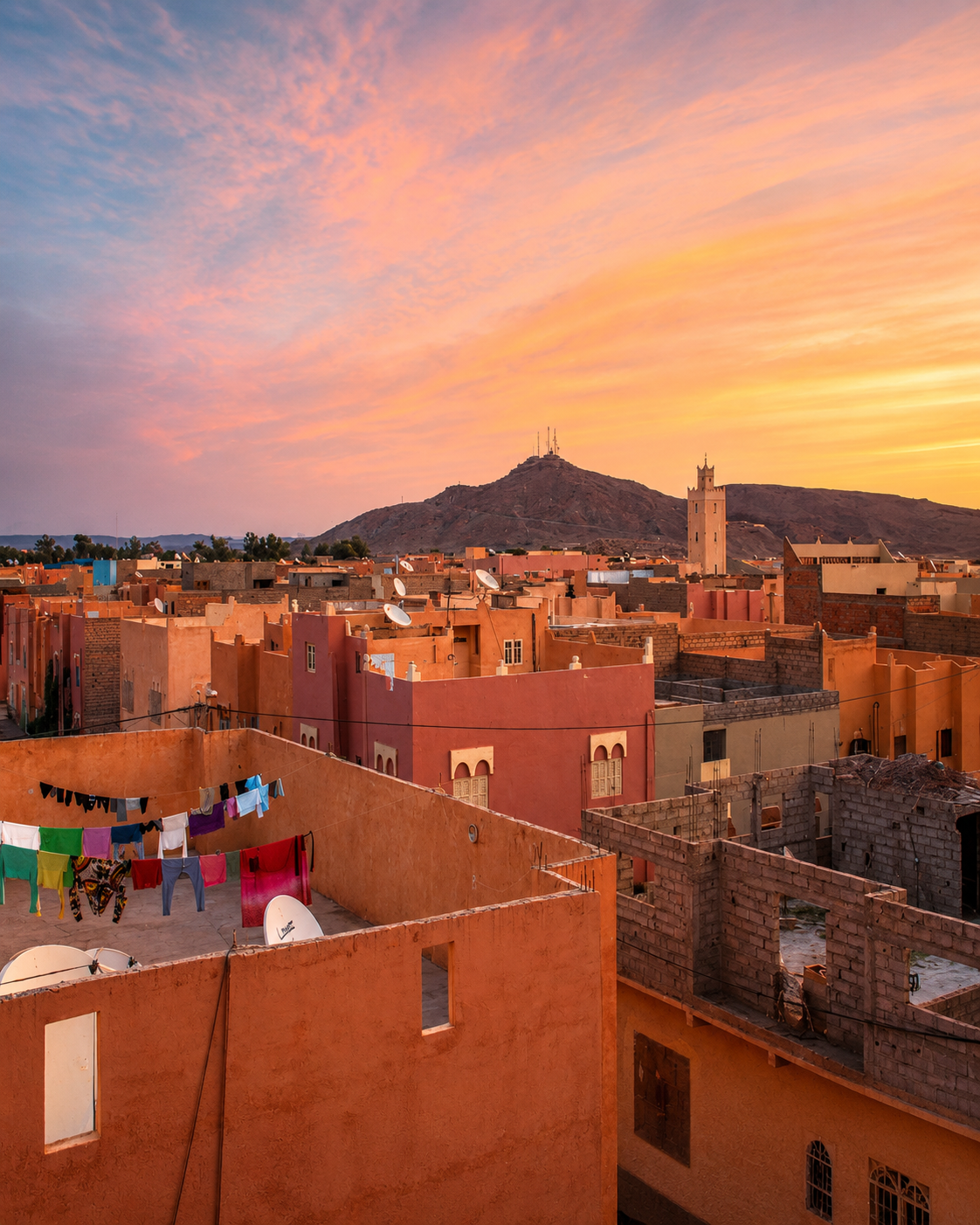
Buildings provide a second measure of scale. A gateway, roofline or shaded passage gives the eye something familiar against the height of the palms. Let it remain part of its surroundings instead of isolating it as a decorative detail.
Water is not always visible. A channel may be dry when you pass, and an attractive image cannot establish the current condition of a particular river reach. Ask about that place and that season before drawing conclusions from colour alone.
The wider context includes environmental pressure. UNESCO’s account of Moroccan oases describes drought, silting and the effects of intensive agriculture and climate change. A green view is one moment in a changing landscape, not evidence of a secure water supply.
Contemporary additions also belong to the scene. They are a reminder that villages continue to change, and that people living here need homes and services as well as a connection to inherited building traditions.
The most useful question is simple: what makes this particular stretch different? It might be the relationship to a settlement, the pattern of cultivation or a glimpse of the surrounding plain. Let that observation guide the next stop.
Historical and heritage orientation
Cultivation, trade and settlement share the same ground.
Tafilalt’s history is best approached through distinct layers. The oasis landscape, the remains of Sijilmassa and the settlements around it are related, but they should not be assigned one date or treated as a single surviving monument.
01Oasis geography
A network of cultivated places
The lower Ziz and Ghéris valleys place Rissani and Erfoud within a connected oasis setting. Use both towns to orient a visit, while allowing time for the agricultural landscape between destinations.
02Trade history
Sijilmassa’s wider horizon
Sijilmassa prospered through medieval Saharan commerce, including the gold trade. Its archaeological remains offer a historical anchor; approach them with local guidance and an understanding of their fragile condition.
03Settlement
The scale of a ksar
Ksar is the singular of ksour: fortified settlements found in this region. Read a gateway in relation to the lanes and dwellings behind it, and distinguish shared passage from private space.
04Present-day landscape
Change belongs in the story
Oasis heritage includes today’s choices about farming, buildings and livelihoods. Ask what has changed within living memory. Local accounts can connect the visible landscape to experiences a brief stop would otherwise miss.
A visual bridge
Three ways to connect the view
Use three changes of attention: from canopy to ground, from open country to settlement, and from one stop to the wider route. Each reveals a relationship that a panoramic view alone can conceal.
01
Vertical layers
Look below the palms
Tall crowns dominate the first impression. Lower your gaze to trunks, planting beds and the spaces between them. The shift introduces the practical scale of the grove without requiring a distant viewpoint.
Follow a trunk down to the ground.
Notice openings between planted areas.
Observe crops only from an agreed path.
02
Built edges
Find the meeting with the village
Where a wall meets a track or a gateway faces open land, settlement becomes easier to read. Keep enough of the surroundings in view to understand the relationship between a building and its approach.
Notice the change from field to lane.
Compare enclosed and open spaces.
Give gateways room in the wider frame.
03
Regional scale
Place the oasis on your route
Keep a separate mental map of Rissani, Erfoud and the onward journey to Merzouga. An oasis walk, a historic stop and a dune excursion offer different experiences; each deserves an appropriate pace.
Locate the day’s stops before setting out.
Choose a clear purpose for each stop.
Allow time to look between destinations.
Quick orientation
Type of place
A cultivated oasis region with date palms, agricultural plots and earthen settlements. Plan a sequence of selected places rather than expecting one entrance and a fixed circuit.
Landscape context
Southeastern Morocco, in Drâa-Tafilalet. The oasis core lies around the lower Ziz and Ghéris valleys. Explore the wider Southern Morocco, Oases & Sahara region.
Best for
Oasis agriculture, settlement history, close observation and unhurried photography. A locally arranged walk helps connect visible details to the way a particular grove is used.
Towns and travel base
Erfoud is a useful town base for exploring Tafilalt’s palm groves and settlements. Nearby Rissani adds historical context through Sijilmassa; arrange the start of each grove visit locally.
What visitors experience here
The landscape becomes more intricate on foot.
The road gives an overview; a short, agreed walk brings the scene to a different scale. What you notice will depend on the particular grove, the weather and the work taking place that day.
Arrival
An opening in the canopy
A break between palms can reveal a wall, a path or the land beyond. Pause where it is safe to stop and let the view separate into foreground and distance before moving closer.
Light
Broken patterns of shade
Fronds divide sunlight into narrow moving shapes. Look at the ground as well as the trees: a shaded track can show this pattern more clearly than the sky behind the canopy.
Sound
Listen to the place you find
Wind in the leaves, voices or activity along a lane may shape the visit. Leave expectations of complete silence behind and make room for the everyday sounds of a working landscape.
Texture
Trunks, soil and wall surfaces
The roughness of palm trunks offers a useful comparison with earthen walls and cultivated ground. Observe from close enough to see detail without touching vulnerable surfaces or entering planted areas.
Walking
Turns that change the view
A path may narrow, bend or pass a household entrance. Follow the route agreed with your host or guide, leave working access clear and pause where your group can stand comfortably.
Encounter
One well-chosen question
Ask about something actually in front of you: a crop, a channel or the use of a building. A specific conversation can give an ordinary feature meaning without turning residents into part of a performance.
Place details and orientation
Six elements that give Tafilalt its shape
These are points of orientation across the oasis region. They will not all appear on every walk, and some require a separate stop or a locally arranged visit.
1
Date palms
The region’s defining crop gives the grove its upper silhouette. Ask about the palms in front of you instead of assuming every variety or plot is the same.
2
Cultivated plots
Small boundaries reveal how land is divided and reached. Observe their shape from the path, keeping clear of crops and the edges used to contain irrigation water.
3
Water channels
Channels make the movement of water easier to understand where they are visible. Their condition at one moment does not describe the water supply of the whole oasis.
4
Earthen ksour
Gateways, clustered dwellings and lanes introduce the settlement layer. A visible entrance is not permission to explore every passage or interior beyond it.
5
Sijilmassa
Near Rissani, the remains of the medieval trading city connect the oasis to a wider history of exchange. Confirm the appropriate way to visit before approaching archaeological areas.
6
The surrounding dry land
Keep some of the exposed ground beyond the cultivation in view. It supplies the scale and contrast that disappear when a photograph contains only greenery.
An attentive eye
Let the photograph keep its context.
A wide frame can show how a grove sits beside a settlement. Before selecting a close detail, look for a position on an established route where both can be understood together. Avoid stepping onto a field border or a wall to gain a little height.
Choose a second frame with a different purpose. A doorway might explain an approach; a channel crossing might clarify the ground plan; a palm trunk might give a sense of scale. A varied record is more informative than repeating the same canopy view.
Leave room for what was outside the image when you describe the visit. The place name, the route you actually walked and a locally explained detail make an honest caption. Water levels and greenery seen in photographs should never be promised as permanent conditions.
Water and landscape intelligence
Water has a route, a timetable and a task.
Traditional water management in Tafilalt includes khettaras: gently sloping underground galleries that collect groundwater and carry it by gravity toward an outlet. They are one part of the region’s irrigation history. Do not assume that every grove uses a khettara or that every surviving gallery still carries water.
Research on Tafilalt’s khettara irrigation helps explain the system’s changing use. For visitors, the useful distinction is between a visible channel, its source and the arrangements that determine delivery. Ask about the local example; never enter galleries or approach unprotected shafts.
Questions that open the landscape
Which crops are being grown in this particular plot?
Where does the water reaching this channel come from?
Is it flowing regularly, seasonally or at allocated times?
Which parts of the path are appropriate for visitors?
What work is needed to maintain the grove?
How has this stretch changed within local memory?
Landscape reading
Three patterns worth following
Lines across the ground
Follow a visible field edge or channel with your eye. See where it bends, meets a path or disappears behind planting. The exercise makes the layout legible without leaving the public route.
Thresholds around buildings
Compare a broad approach with the narrower space beyond a gateway. Where access is permitted, notice how the proportions change. Avoid reading every enclosed area as either a monument or an abandoned place.
Gaps in the canopy
Look at what an opening reveals: a roofline, a strip of sky or bare ground. These intervals give depth to a grove that can otherwise appear as an undifferentiated green surface.
Visual atmosphere
Green, earth and the movement of light
A changing palette
Palm leaves can appear dark, silvery or yellow-green as their angle to the sun changes. Compare neighbouring crowns before reaching for a single colour description. The variety is part of the scene, even within one grove.
The weight of a wall
An earthen surface can hold the eye differently from the fine lines of fronds beside it. Frame the solid and the delicate together, allowing light to reveal texture without needing to exaggerate the contrast.
A memory with particulars
Keep one observation that a photograph cannot fully carry: the route of a conversation, the changing shade along a walk or the explanation of an unfamiliar crop. These details make the visit recognisably your own.
Nearby places and onward links
Connect oasis country with the wider southeast
Use Erfoud as your town base and include Rissani for its historical context. The regional guide connects this oasis visit with the wider southeast. Keep cultural stops and time on foot within the plan.
Erfoud
A nearby town base for the Tafilalt oasis country. Connect a stay here with locally arranged palm-grove walks, earthen settlements and a cultural stop around Rissani.
Arrange a suitable route before entering a grove. Agricultural tracks can lead to private plots or homes, and an open gate does not settle the question of access. A local guide or host can help choose a walk that is both worthwhile and welcome.
Keep channels, cultivated beds and field boundaries intact. Do not pick dates, move irrigation barriers or step onto earthen walls. Ask before photographing people and household spaces; follow locally stated rules around religious sites and archaeological remains.
Keep vehicles on established roads and park without blocking access.
Carry drinking water and sun protection; adapt the walk to the heat.
Avoid smoking and open flames among palms and dry vegetation.
Take litter away, including small packaging and cigarette ends.
Agree the route and price before using a guiding or transport service.
A strong first visit
Choose one area around Rissani or Erfoud rather than trying to cover the whole oasis. Begin by confirming the walking start, where access is welcome and how you will return. A short, coherent route leaves more room for useful observation than several hurried stops.
Combine a grove walk with a distinct cultural focus. If Sijilmassa is part of the plan, ask about current access and seek an explanation of the remains. Keep the historical visit separate enough to understand it on its own terms.
For the walk itself, agree a pace that allows pauses without obstructing paths. Ask your guide to explain one practical feature in detail. A clear account of a local channel or planted plot will be more memorable than a list of general oasis facts.
Build the outing around your return to Erfoud. Keep the final stop within the agreed transport plan and leave time to pause along the way. A day focused on the oasis is most rewarding when the schedule allows for a conversation or an unexpected detail.
Choose a particular grove and agree the access point.
Keep the return route and transport arrangements clear.
Allow time for one locally explained feature.
Add a cultural stop only when access is confirmed.
Leave enough flexibility for the onward journey.
Planning note: confirm access, weather and road conditions close to departure. Riverbeds and unprotected waterworks are unsuitable shortcuts; the map provides regional orientation, not a walking itinerary.
Explore the oasis from nearby Erfoud
Erfoud — a town base for Tafilalt Oasis
Erfoud is closely connected to the Tafilalt oasis landscape. A stay in town gives the journey a practical centre from which to plan visits to palm groves and earthen settlements, with Rissani adding a separate historical focus nearby.
Use the Erfoud guide to place the town within your itinerary and organise the surrounding visits. Choose a specific grove and agree access locally, then give Rissani and Sijilmassa their own time if they form part of the route.
Erfoud town orientationTafilalt oasis contextPalm-grove visitsRissani and SijilmassaRegional connectionsPractical route planning
Connect the palm groves with a stay in Erfoud, make time for Rissani’s historical context, and build the wider journey around what you want to understand.