
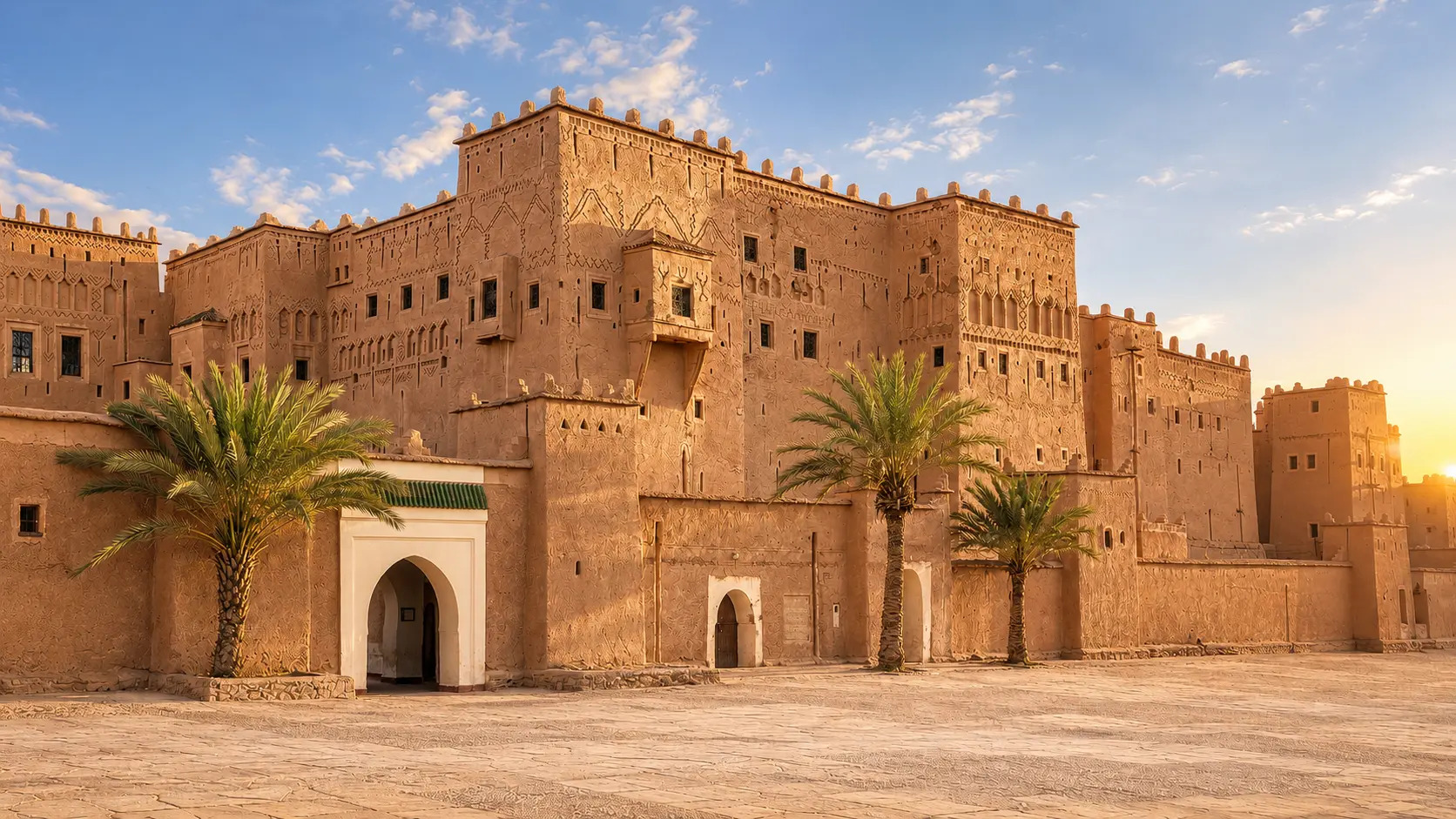
Taourirt Kasbah's earthen towers and carved facade in Ouarzazate, Morocco

Visit / Place · Ouarzazate · Southern Morocco

Taourirt Kasbah A fortified earthen residence where Ouarzazate reads its southern route memory

Taourirt Kasbah is one of Ouarzazate's defining earthen landmarks: a layered fortified residence complex tied to Glaoui power, city life and the fragile intelligence of southern Moroccan building.

Begin outside, where the facade, towers, palm shadows and broad city setting can be read together. Taourirt is strongest when it is seen first as architecture in Ouarzazate, then slowly as material, threshold, history and conservation.

Why Taourirt Kasbah matters

Ouarzazate's city kasbah before it is a backdrop.

Taourirt Kasbah matters because it brings southern Moroccan earthen architecture into the middle of Ouarzazate. It is not a remote ruin seen only from a road. It stands within the city, where fortified walls, decorated towers, urban movement and High Atlas horizons all meet in one concentrated place.

The kasbah is strongly associated with the Glaoui family, whose influence shaped much of the southern Atlas and pre-Saharan route world in the nineteenth and early twentieth centuries. Published accounts differ on the earliest fabric, so the cleanest visitor reading is cautious: Taourirt grew into a major residence and administrative complex through Glaoui-era expansion rather than a single simple building moment.

The architecture teaches through mass first. Thick earthen walls, corner towers, small openings, carved relief, guarded thresholds and high exterior surfaces show how power, privacy, climate and craft were organised in built form. The beauty is not an applied skin; it comes from how earth, shadow, height and proportion work together.

Taourirt also matters because it became a reference point for conserving earthen heritage. The Getty Conservation Institute and CERKAS developed work around the kasbah as a model for thinking about physical repair, local building traditions, public use and the long-term care of fragile earthen architecture in southern Morocco.

For visitors, the site asks for a disciplined eye. The facade is impressive, but the richer experience comes from noticing relief patterns, repairs, timber details, balconies, small windows, courtyards, closed areas and the way a city landmark can still feel vulnerable when its material is earth.

Conservation context is grounded in the Getty Conservation Institute and CERKAS Taourirt project. Practical details such as prices, opening hours, access arrangements and restoration conditions should be checked close to travel.
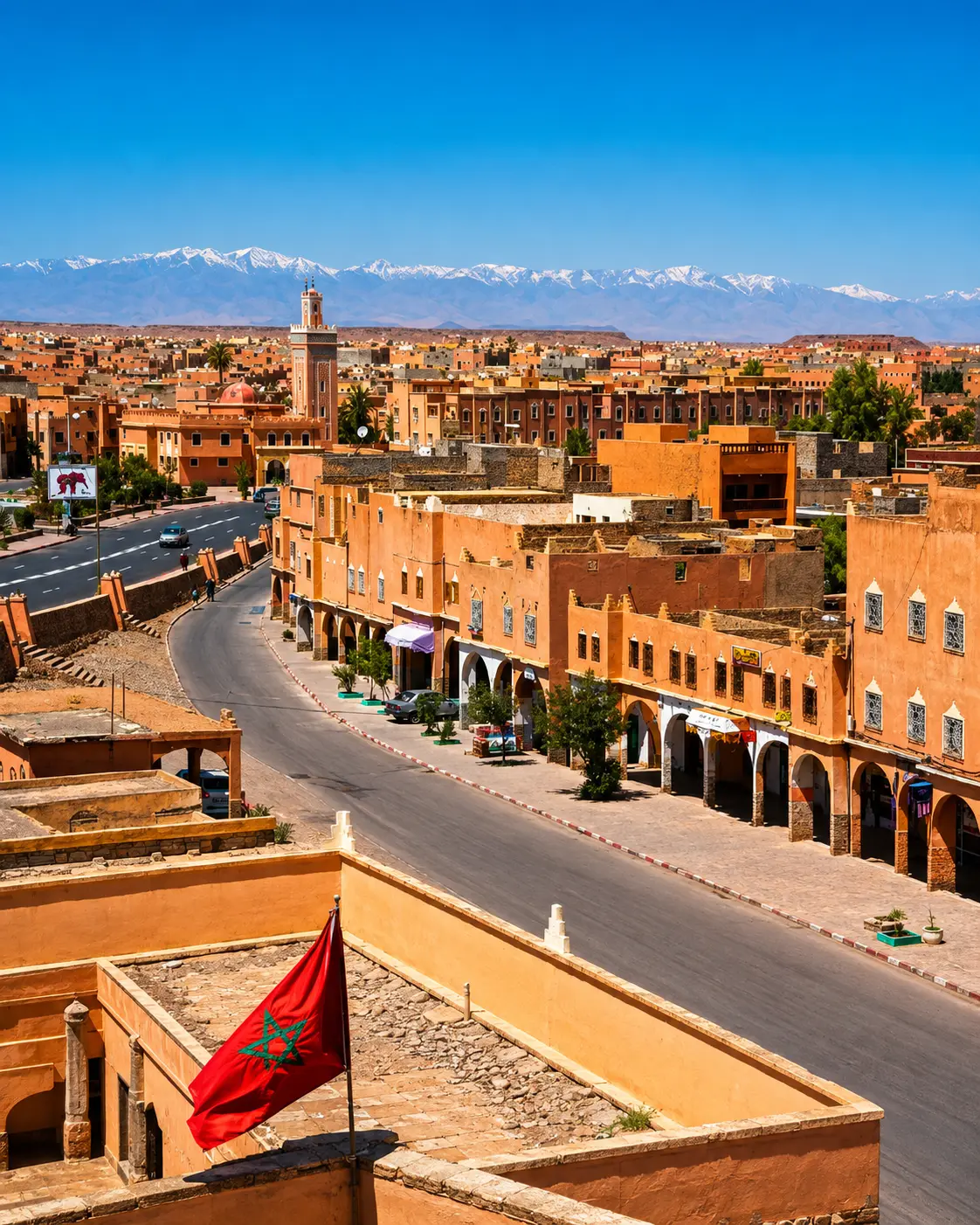
Ouarzazate city and High Atlas landscape, the wider context for Taourirt Kasbah

Map orientation

Use the map to place Taourirt directly inside Ouarzazate, where the kasbah reads as city landmark, heritage anchor and southern-route memory.

Editorial reading

Its ornament only works because the structure is strong.

The first visual force is the mass: long walls, square towers, high corners and a facade that seems to grow from the same earth as the ground around it. Only after the mass settles in does the surface detail become readable.

Look at the relief work slowly. Geometric marks, recessed forms, window rhythms and projecting elements are not loose decoration. They give scale to walls that could otherwise feel blank, and they help the kasbah hold both severity and refinement.

The most rewarding visit keeps two ideas together. Taourirt is connected to power, family residence and regional authority; it is also fragile earthen heritage that depends on maintenance, knowledge and respectful public use.

That balance prevents the place from becoming only a cinematic image. Ouarzazate is famous for film landscapes, but Taourirt deserves to be read as architecture first: material intelligence, urban memory, craft and conservation layered inside one city landmark.

Notice the difference between exterior authority and interior intimacy where access allows. From outside, the kasbah reads as enclosure. Inside or near thresholds, the body reads cooler shade, narrower movement, plaster, timber, painted surfaces and the practical rhythm of rooms.

A careful visitor also respects what cannot be entered. Closed, restored, inhabited or fragile areas are not failures in the experience; they are part of the truth of the site. The kasbah is not a set. It is an old earthen complex still negotiating public attention and long-term care.

Leave with the whole structure in mind: towers, walls, city street, mountain horizon, craft marks, repairs and quiet restrictions. That is where Taourirt becomes memorable, not as one photo, but as a lesson in how southern Moroccan architecture carries history through material.

Historical and heritage orientation

Read the kasbah through power, material and care.

Taourirt is best understood as a large earthen residence complex rather than a simple monument. Its significance comes from the relationship between Glaoui-era authority, Ouarzazate's position in southern Morocco, architectural detail and the continuing challenge of conserving rammed-earth and adobe fabric.

01Place type

Urban fortified residence

The kasbah is a fortified earthen residence complex in Ouarzazate. Its identity comes from the whole ensemble: exterior walls, towers, residences, thresholds, courtyards, service spaces and city-facing edges.

02Glaoui era

Regional authority

The site is closely tied to the Glaoui family and to southern route power. Read it as architecture shaped by residence, administration, protection, hospitality, hierarchy and the political geography of the Atlas edge.

03Materials

Rammed earth and adobe

Taourirt's strongest surfaces are built from earth-based materials. Their mass gives the kasbah authority, while their vulnerability explains why repair, drainage, skilled maintenance and visitor restraint matter.

04Conservation

A living preservation case

Getty and CERKAS work around Taourirt frames the kasbah as more than a restored attraction. It is a case study in conserving architecture, local knowledge, public use and fragile historic fabric together.

A visual bridge

Three readings between city, earth and authority

Before Taourirt becomes a photograph, it is a relationship between Ouarzazate, earthen material and built power. These three readings help visitors slow down and understand why the kasbah feels monumental from outside, then more intricate at human scale.

01

Material

Earth as power

Earth gives the kasbah its colour, mass and climate intelligence. It also explains why the place should be treated carefully: what looks monumental is still made from materials that depend on skilled repair and protection.

  • Read wall thickness, shade and surface texture.
  • Notice repair, weathering and small changes in tone.
  • Understand beauty as construction, not ornament alone.
02

City

Ouarzazate as context

Taourirt makes most sense when connected to the city around it. Ouarzazate gives the kasbah its present rhythm: streets, guides, craftspeople, passing visitors, desert-edge routes and Atlas views all press close to the architecture.

  • Place the kasbah inside the city before entering.
  • Connect the site to Atlas and desert-edge routes.
  • Read Taourirt as urban heritage, not an isolated image.
03

Looking

Distance before detail

The strongest visit begins outside the walls. Distance reveals towers and facade rhythm; walking reveals thresholds, shade and human scale; close looking brings carved surface, timber detail and conservation marks into one reading.

  • Start with the whole facade and tower line.
  • Move slowly through thresholds where access allows.
  • Use details to understand structure, not only decoration.

Quick orientation

Type of place

A historic fortified earthen kasbah and residence complex in Ouarzazate, best understood through architecture, power, craft, conservation and city context.

Landscape context

The kasbah stands south of the High Atlas within Ouarzazate's desert-edge urban landscape, where earthen walls, bright light and mountain horizons shape the visual experience.

Best for

Earthen architecture, Glaoui-era history, carved facades, careful photography, conservation awareness, Ouarzazate orientation and southern Morocco route planning.

Closest city context

Ouarzazate is not only the nearest city; it is the immediate setting. Use the city guide to connect Taourirt with kasbah routes, film culture and southern travel structure.

What visitors experience here

A city kasbah that changes from facade to threshold.

Taourirt works in stages. First comes the public face: warm earthen walls, towers, carved relief and the open Ouarzazate light. Then come the edges: gates, small windows, shadows, protected passages and areas that ask for restraint. Only after that do the smaller details begin to speak.

Arrival

The kasbah inside the city

The approach is urban rather than remote. Streets, visitors, guides, shops and everyday movement sit close to the walls, reminding you that Taourirt belongs to Ouarzazate before it belongs to any travel image.

Light

Relief catching the sun

The carved earthen facade changes with light. Warm sun makes the towers glow; side light sharpens the relief; hard midday brightness reveals the dryness, repairs and surface variation of earth architecture.

Movement

Thresholds and pauses

The best rhythm is not rushing from outside to inside. Pause at gates, shaded passages and courtyard edges where access allows. Taourirt rewards small transitions: public to private, glare to shade, mass to detail.

Material

Earth, timber and plaster

Look for the way materials cooperate. Rammed earth and adobe provide mass; timber and reed traditions appear in ceilings and openings; plaster and painted surfaces bring refinement where interiors are accessible.

Detail

Decoration with discipline

Exterior patterns, niches, small windows and projecting elements make the facade legible. They are beautiful, but they also measure scale and hierarchy across a very large earthen surface.

Pace

A slower kind of visit

The kasbah loses meaning when treated only as a backdrop. A stronger visit gives time to conservation, craft, closed areas, visible repairs and the way Ouarzazate continues around the heritage fabric.

Place details and orientation

Read Taourirt through six defining elements

No single detail explains the kasbah. Its meaning comes from the relationship between fortified exterior, residence logic, surface decoration, urban setting, craft detail and the vulnerability of earthen construction.

1
Fortified outer mass

The long earthen exterior gives Taourirt its authority. It reads as protection first, then as residence, then as a city-facing architectural statement.

2
Towers and high corners

Square towers and raised corners set the rhythm of the skyline. They make the building legible from distance and sharpen the sense of enclosure.

3
Carved earthen facades

Geometric relief, niches and openings break down the scale of the walls. The detail is controlled, repeated and closely tied to southern Moroccan earthen design.

4
Residence and administration

Taourirt should be read as a complex tied to residence, authority and management of a wider region, not as a single empty shell or decorative ruin.

5
Courtyards and thresholds

Where access allows, the interior rhythm shifts from public monument to human scale: passages, shade, doors, rooms, stair movement and protected pauses.

6
Conservation layers

Restored, fragile, closed and weathered areas can sit close together. Those layers are part of the visit and should be treated as evidence, not inconvenience.

Kasbah, not scenery

The place asks for a careful eye.

Stand back before entering. The first lesson is spatial: a fortified earthen complex facing the city, shaped by power, climate, privacy and public visibility. The facade is not simply picturesque; it explains how the kasbah announces itself.

Then move closer. Wall thickness, shaded thresholds, repaired surfaces and small openings make the place human again. This is where the visit becomes more than a view: the eye starts to understand how authority, craft and comfort were organised through material.

Keep the wider setting in mind. Ouarzazate, the High Atlas horizon and southern route geography are not background decoration. They help explain why a kasbah like Taourirt could become both a residence and a marker of regional power.

Architecture and material intelligence

Earth architecture is not a style effect.

The earthen character of Taourirt is not just visual atmosphere. Earth construction is tied to local availability, climate response, repair cycles and the way buildings create shade, privacy and mass. It gives the kasbah warmth, but it also gives the place its fragility.

Rammed earth, adobe, timber, reed, plaster and painted detail belong to one architectural intelligence. The visitor should not separate the decorative surface from the technical system beneath it. Material, setting and care all belong to the same heritage reading.

What to notice slowly

  • Look at the whole facade before focusing on individual doors, windows or carved patterns.
  • Notice where earth surfaces are smooth, rough, repaired, sunlit or shadowed.
  • Read towers and high walls as architecture of protection, prestige and controlled access.
  • Watch how shade changes the feeling of thresholds, courtyards and interior edges.
  • Keep Ouarzazate in view; the city setting is part of the kasbah's meaning.
  • Respect closed spaces and fragile surfaces, especially where walls or passages show wear.

Architectural reading

Three architectural languages to notice

Power and enclosure

Taourirt speaks first through authority: defensive walls, towers, guarded openings and an exterior that controls how the building is approached, viewed and entered.

Surface and hierarchy

Relief patterns, balconies, window placement and upper-wall detail help the eye understand hierarchy. The decoration is refined, but it is disciplined by the structure beneath it.

Repair and restraint

Earthen surfaces record light, weathering, maintenance and vulnerability. Their beauty depends on care, which is why the most respectful visitor avoids touching, climbing or treating fragile fabric as scenery.

Visual atmosphere

Light, texture and quiet transitions

From city to facade

Start with the whole street-facing mass, then move closer to read doorways, windows, wall thickness, repaired earth and the way shade gathers near thresholds. The shift from public view to close surface is essential.

From earth to sky

The strongest visual contrast is not artificial colour, but the meeting of earthen walls, pale ground, palms, tower lines and open southern sky. The same wall can feel dense, warm, dry or sculptural depending on light and angle.

From photo to memory

The image is powerful, but the deeper memory comes from walking slowly enough to connect Taourirt with Ouarzazate, material and living heritage. A careful visitor leaves with more than one frame: glare, shade, carved surface and a sharper respect for repair.

Nearby places and onward links

Connect Taourirt to the wider southern Morocco map

Taourirt belongs to a broader Ouarzazate itinerary. The city gives the clearest context, while the wider region opens toward oases, kasbah landscapes, desert-edge routes and architecture-focused travel.

Ouarzazate

The direct city context for Taourirt. Use it to frame kasbah landscapes, film-route identity, Atlas views and practical southern travel orientation.

Open Ouarzazate city guide

Southern Morocco, Oases & Sahara

The regional home for desert-edge travel, oasis routes, valley landscapes and earthen architecture across Morocco's south.

Explore the region

Architecture & Heritage

Taourirt is a strong gateway into Moroccan earthen architecture, heritage preservation and the relationship between material, authority and place.

Read the theme

Visit Morocco places

Continue through kasbahs, valleys, waterfalls, lagoons, caves, monuments and natural heritage places beyond the city guides.

Browse Visit places

Plan your journey

Treat Taourirt as a city anchor, not just a stop. Link it logically with Ouarzazate, High Atlas approaches and southern Morocco planning.

Plan your journey

Stories from Morocco

Use the Stories section for richer cultural reading around place, memory, materials, landscapes and the human rhythm behind visual heritage.

Read stories

How to visit respectfully

Good behaviour protects the experience.

Taourirt is easy to approach from the city, which can make the visit feel casual. Treat that closeness with care. Move quietly through narrow areas, avoid blocking paths, ask before photographing people, and remember that not every threshold is public just because the kasbah is famous.

Respect also means caring for material heritage. Earthen surfaces can look massive and still be vulnerable. Do not climb on walls, scratch surfaces, lean into unstable edges, leave litter, shout through passages or treat interiors as props. A slower visitor sees more and harms less.

  • Ask clearly before photographing local people, guides, shopkeepers or private interiors.
  • Keep to appropriate walking routes and avoid pressure on fragile walls or edges.
  • Support local services with courtesy and fair-minded interaction.
  • Carry water, protect yourself from exposed light, and avoid turning discomfort into impatience with the place.
  • Check current access, local guidance and restoration conditions close to travel.

A strong first visit

Begin outside the kasbah so the full facade, tower rhythm and defensive outline can be read. This first view gives the visit its structure: wall mass, carved relief, guarded openings and city position can be understood together before the details begin to compete for attention.

Inside or near accessible thresholds, move slowly enough to notice shade, wall thickness, repaired surfaces and the change from public exterior to more private architectural rhythm. Pause where guides or signs indicate appropriate access, and let closed areas remain closed.

If you arrive with a guide, listen for the words that clarify the site: kasbah, tighremt, rammed earth, adobe, Glaoui residence, conservation, courtyard and Ouarzazate route context. These terms help organise what the eye is seeing and prevent the visit from becoming only a sequence of photographs.

Afterward, connect the visit to Ouarzazate and the wider southern route. That wider context helps Taourirt feel less like an isolated attraction and more like part of a regional landscape of earth architecture, city memory and careful heritage reading.

  • Start outside, where the facade and tower rhythm are easiest to understand.
  • Enter slowly, giving attention to thresholds, shaded turns and wall thickness.
  • Respect closed, restored or fragile areas without trying to force access.
  • Leave space for local movement, guides and small businesses around the site.
  • Finish by connecting the kasbah back to Ouarzazate and southern Morocco.

Careful planning note: opening hours, prices and exact travel times can change. Verify practical arrangements locally before travelling.

Ouarzazate cityscape with High Atlas mountains, the guide context for Taourirt Kasbah

Go deeper through the nearest city context

Ouarzazate - the city gateway to Taourirt Kasbah

Taourirt belongs naturally inside a wider Ouarzazate journey. The city gives visitors a stronger base for reading southern Moroccan routes: kasbah landscapes, film-route memory, High Atlas approaches, oasis directions and the visual grammar of earth architecture.

Use Ouarzazate to widen the context after the kasbah itself. Nearby heritage, desert-edge routes, local craft, film culture and practical southern travel planning all become easier to understand when Taourirt is treated as part of a larger regional story.

Historic and regional contextOuarzazate city orientation Kasbah and valley routesArchitecture and heritage reading Practical travel structureNearby southern highlights

Continue the journey

Continue from Taourirt Kasbah into southern Morocco.

Read the kasbah slowly, then connect it to Ouarzazate, earthen architecture, Atlas approaches, desert-edge routes and the wider heritage map of Morocco.