El Badi Palace A Saadian courtyard of ruined walls, water, scale and Marrakech light
El Badi Palace is a vast Saadian palace ruin where open court, red-earth walls, water basins and absence make royal power readable without pretending the past is intact.
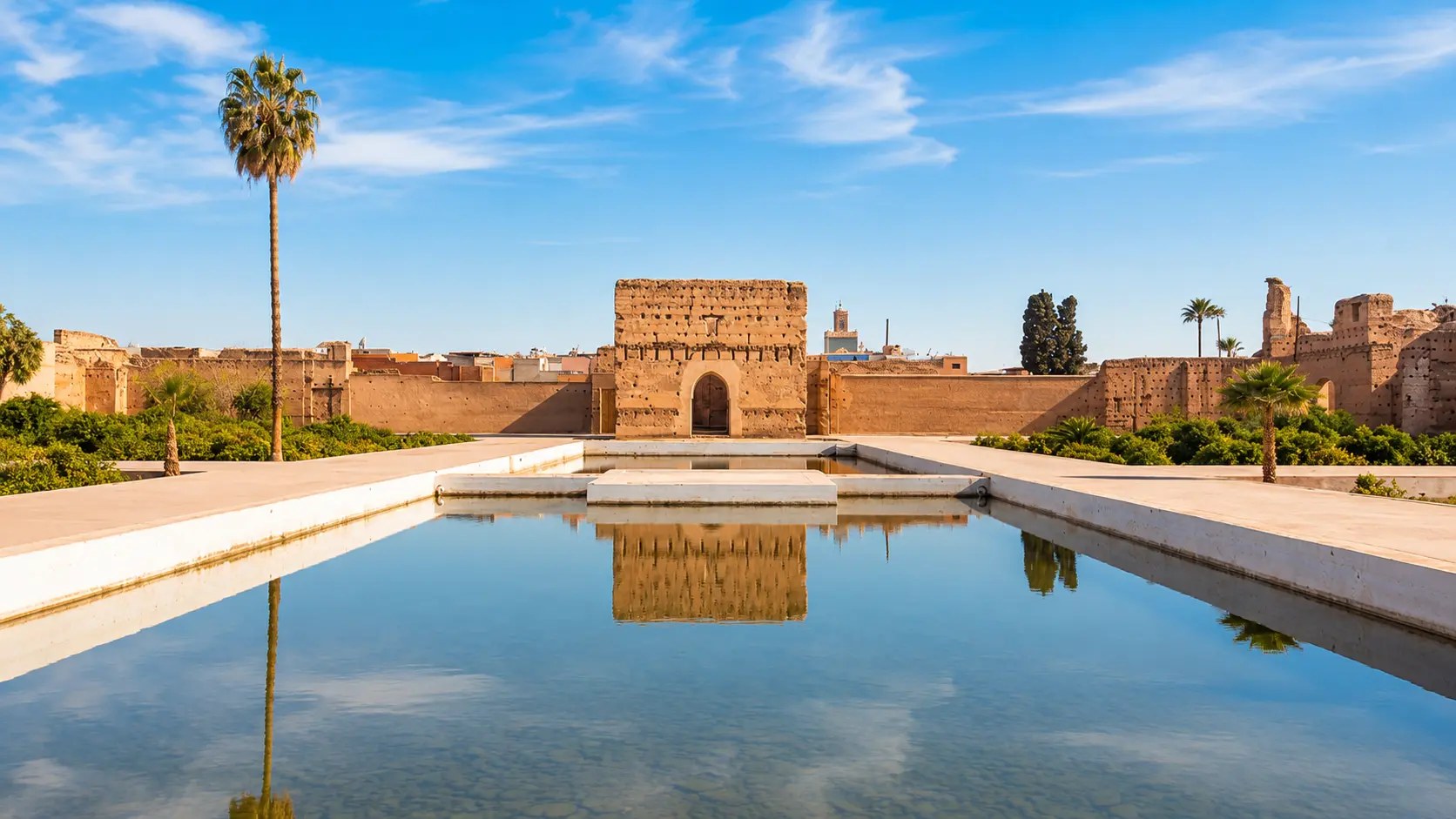
Begin with the whole courtyard. The palace is strongest when the eye first understands the scale: the long water line, the high walls, the pavilions reduced to memory and the Marrakech sky opening above them.
El Badi Palace, often written Palais El Badi or El Badii, belongs to the Saadian story of Marrakech. It was commissioned by Sultan Ahmad al-Mansur in the late sixteenth century, at a moment when royal architecture was used to stage authority, diplomacy and court ceremony.
The name is commonly translated as "the Incomparable", but the building visitors meet today is not a complete palace. Its power comes from the distance between former ambition and present ruin: immense walls, sunken garden traces, broad water basins, empty pavilions and a courtyard large enough to make the visitor feel small without theatrical tricks.
That is why the place matters before it is beautiful. El Badi teaches Marrakech through scale. Instead of leading with dense ornament, it asks visitors to read proportion, symmetry, water, height, material and loss. The palace is a memory machine: the grandeur is gone, yet its outline still explains how grandeur was organised.
The site also matters because it sits inside the southern edge of the old city, close to the Kasbah district and the heritage rhythm of Marrakech. It connects royal ceremony, craft memory, urban walls, nearby sacred and civic landmarks, and the living movement of the medina around it.
For a strong visit, resist the urge to treat the ruins as empty scenery. Look at how water once structured the court, how red walls hold heat and shadow, how storks claim the high edges, and how the palace turns absence into an architectural experience.
Use the map to place the palace on Marrakech's southern medina edge, near the Kasbah district and the city's dense heritage core.
Editorial reading
Its drama comes from scale, not finish.
El Badi Palace is not trying to impress visitors with a restored interior. It works through a more demanding form of beauty: a court so broad that the body understands power before the eye starts counting details.
The long pools are essential to that reading. They do not simply decorate the space; they organise it. Water sets the axis, doubles the walls in reflection, cools the visual field and turns open emptiness into measured architecture.
The walls should be read slowly. Their red-earth surfaces carry shadow, erosion, repair, nesting birds and the roughness of time. What looks simple from far away becomes layered when the sun catches small openings, edges and broken masonry.
The palace also rewards looking upward. Storks on the high walls have become part of the contemporary visual memory of the site, not because they explain the Saadian court, but because they show how the ruin has entered another rhythm of life.
Visitors often arrive expecting lost luxury. A better reading asks what remains after luxury is removed. The answer is architecture: orientation, courtyard geometry, water, wall height, ceremonial scale and the strong silence created by open space.
That silence is not emptiness. It is the main lesson of the place. El Badi Palace shows how Marrakech can hold splendour and ruin in the same frame, with neither needing to cancel the other.
Leave time for a second look after walking the court. The first view gives scale; the second starts to reveal structure. By then the ruin has stopped being a backdrop and become a document of power, material, loss and endurance.
Historical and heritage orientation
Read the palace through Saadian ambition, water and survival.
El Badi Palace is best understood as a royal reception landscape rather than a decorative shell. Its late sixteenth-century Saadian origin, immense courtyard, traces of gardens and surviving wall mass show how architecture could arrange ceremony, prestige and controlled movement inside the old city.
01Place type
A Saadian palace ruin
The site is a ruined royal palace in Marrakech, associated with Sultan Ahmad al-Mansur and the high point of Saadian architectural ambition.
02Court ceremony
Architecture for reception
The palace was designed for grandeur and ceremony. Visitors should read the open court, pavilions and axes as a setting for royal presence, not as an ordinary residence.
03Water and gardens
Scale made legible
The central water basins and sunken garden traces turn the court into a measured composition. Reflection, symmetry and planted voids were part of the palace's intelligence.
04Afterlife
Ruin as evidence
Many costly finishes disappeared over time, leaving the vast architectural frame. The absence is part of the heritage reading: it reveals structure, reuse and fragility.
A visual bridge
Three readings between court, water and wall
Before El Badi Palace becomes a photograph, it is a lesson in proportion. These readings help visitors move from the first wide view into a sharper understanding of how the ruin still holds its authority.
01
Distance
The whole court first
Stand back before chasing details. The palace needs distance because its meaning is carried by the full composition: pool, wall, pavilion remains, sky and the empty centre between them.
Read the rectangular court before isolating fragments.
Notice how water divides and steadies the view.
Let the scale explain the original ambition.
02
Material
Red walls and heat
The surviving surfaces carry Marrakech in their colour and exposure. Earth-toned walls, pale paving, hard light and shadow make the palace feel architectural even where decoration has vanished.
Watch how the walls change under direct sun.
Look for openings, scars and repaired edges.
Understand texture as history, not imperfection.
03
Memory
Absence as structure
The palace is powerful because it does not hide what has been lost. Empty spaces, broken elevations and stripped surfaces help visitors imagine ceremony without turning the ruin into a fantasy reconstruction.
Notice what the voids still organise.
Keep the ruin honest; avoid over-reading decoration.
Let the remaining frame guide the story.
Quick orientation
Type of place
A historic Saadian palace ruin in Marrakech, best understood through courtyard scale, water geometry, surviving walls and the memory of royal ceremony.
City context
The palace sits in the Kasbah district area on the southern side of the medina, close to the heritage rhythm that gives Marrakech its layered urban character.
Best for
Architecture reading, careful photography, Saadian history, stork-dotted walls, courtyard scale, water reflections and a quieter counterpoint to the city's dense lanes.
Linked guide
Marrakech is the natural city guide for this visit, connecting El Badi Palace with medina walks, craft streets, gardens, food culture and nearby historic monuments.
What visitors experience here
A palace that opens into silence.
El Badi Palace changes the pace of Marrakech. After narrow streets and busy edges, the visitor enters a vast open court where water, wall height and sky do the work. The experience is spacious, bright and more thoughtful than ornamental.
Arrival
The Kasbah edge
The approach places the palace inside a living district, not outside the city. That contrast matters: everyday movement gives way to a monumental court where the scale suddenly widens.
Water
The reflecting axis
The pool line gives the palace its calm. It reflects walls and sky, clarifies the geometry and makes the central space feel measured instead of merely empty.
Walls
Red mass and shadow
The surviving walls are not smooth stage scenery. They show surface, age, openings, nesting edges and sun-cut shadow, turning material weathering into part of the visit.
Scale
A court larger than expectation
The palace is most impressive when the visitor walks slowly across the open ground. Distance keeps changing the relationship between body, basin, wall and sky.
Life
Storks above the ruin
High nests and birds overhead give the ruins a present-tense rhythm. They do not soften the history; they remind visitors that old architecture keeps entering new lives.
Pace
A slower Marrakech pause
The best visit is not rushed. Look once for scale, then again for details: basins, edges, wall thickness, fragmentary pavilions, light and the way silence settles in the court.
Place details and orientation
Read El Badi Palace through six defining elements
No single fragment explains the palace. Its meaning comes from the relationship between court, water, gardens, ruined pavilions, high walls and the visible afterlife of a royal project.
1
Main courtyard
The vast open court is the palace's central experience. It turns royal scale into something visitors can physically feel.
2
Water basins
The basins organise reflection, cooling memory and symmetry, making the composition readable even after much of the decoration disappeared.
3
Sunken garden traces
The planted voids and garden structure show that emptiness was designed, not accidental. Landscape belonged to the palace plan.
4
Pavilion remains
Fragmentary pavilions and elevated edges help visitors imagine ceremonial architecture without needing a false reconstruction.
5
High red walls
The walls hold the court together visually. Their colour, height and worn surfaces make Marrakech's material language immediate.
6
Storks and skyline
Nests along the upper walls have become part of the site's atmosphere, connecting ruin, height, sky and present-day observation.
Palace, not a shell
The ruin asks for a precise eye.
Stand in the central space before moving around the edges. The first lesson is spatial: the court is not leftover emptiness, but the main instrument through which the palace expressed order, ceremony and control.
Then move closer to the walls. Openings, masonry scars, worn surfaces and changes in colour begin to show how the building survived, changed and lost many of the materials that once announced wealth.
Return to the water line before leaving. The reflection restores a partial image of the architecture, but only temporarily. That is the quiet intelligence of El Badi Palace: it lets visitors sense splendour without pretending the ruin is whole.
Architecture and material intelligence
Ruin is an architectural document.
El Badi Palace should not be read only as a lost luxury palace. Its present form shows the deeper structure of royal architecture: planned voids, axial water, massive enclosure, controlled views and surfaces that once carried more ornament than they do today.
The stripped condition of the site makes the bones unusually visible. Without relying on heavy decoration, visitors can study how scale was composed, how water disciplined the courtyard and how high walls separated ceremonial space from the surrounding city.
What to notice slowly
Look at the full court before focusing on doors, wall openings or nests.
Use the water basins to understand symmetry and visual cooling.
Read ruined pavilions as evidence of ceremony, not as isolated fragments.
Watch how red wall surfaces shift between sun, shade and reflection.
Connect the palace to Marrakech's Kasbah district and medina edge.
Respect fragile masonry, closed spaces and any current conservation guidance.
Architectural reading
Three architectural languages to notice
Court and symmetry
The palace speaks through a large ordered void. Its central court, basins and opposing edges make power legible through proportion rather than crowding the visitor with detail.
Water and authority
Water was part of the architectural intelligence of the palace. It cooled the eye, organised the view and made the open court feel deliberate, ceremonial and controlled.
Absence and reuse
The loss of costly finishes is not a footnote. It is the reason the ruin reads so clearly today: what remains is structure, wall mass, void and the evidence of historical change.
Visual atmosphere
Water, red wall and open sky
From reflection to wall
The most memorable view often begins in the water. Reflection softens the mass of the walls, then the eye moves upward to broken edges, red surfaces and the hard clarity of Marrakech light.
From ruin to city
El Badi feels open, but it is not detached from Marrakech. The palace sits within the city's heritage fabric, so the quiet court and the busy medina edge should be understood together.
From photo to memory
A good photograph catches the pool and walls; a better memory includes scale, heat, bird calls, footsteps, shadow and the strange dignity of a palace that still commands attention through what it no longer has.
Nearby places and onward links
Connect El Badi Palace to the wider Marrakech map
El Badi Palace belongs inside a broader Marrakech reading. Use the city guide for medina rhythm, the region guide for imperial context and the Visit section for nearby heritage places across Morocco.
Marrakech
The natural city context for El Badi Palace, linking the Kasbah district with medina walks, craft streets, gardens, food culture and the city's layered heritage.
El Badi Palace is spacious, but it is still a heritage site. Move with care around walls, stairs, basins and edges. Do not climb on masonry, scratch surfaces, disturb nesting birds, leave litter or treat fragile areas as a photo prop.
Respect also means remembering where the palace sits. This is part of Marrakech's living urban fabric, not a sealed museum island. Be patient at entrances, keep voices measured in quiet corners and ask before photographing people, guides, workers or shopkeepers around the route.
Ask clearly before photographing people or private thresholds near the site.
Stay off fragile walls, restricted edges and surfaces that show wear.
Give space to guides, families, workers and other visitors moving through the court.
Use shade, water and a slower pace rather than rushing through exposed light.
Check current access, conservation guidance and visitor conditions close to travel.
A strong first visit
Begin with the central court before moving toward details. Stand where the pool, wall and sky align, then let the full size of the palace settle. That first pause gives structure to everything that follows.
Walk the edges slowly. Look for the relationship between ruined pavilions, red wall mass, garden traces and the water line. The palace is easier to understand when the visitor keeps returning to the court as the organising centre.
Do not force the site into a complete mental reconstruction. Let the missing ornament remain missing. El Badi Palace is powerful because the surviving frame still communicates ambition, while the losses make time visible.
Afterward, reconnect the visit to Marrakech. The contrast between the open palace court and the dense medina rhythm nearby is one of the best ways to understand the city's range.
Start wide, with the full courtyard and basin alignment.
Move toward details only after the overall geometry is clear.
Look up to read wall height, nests and skyline.
Keep respectful distance from fragile fabric and any closed areas.
Finish by linking the palace back to Marrakech's Kasbah and medina context.
Careful planning note: opening hours, prices and exact access arrangements can change. Verify practical details locally before travelling.
Go deeper through the nearest city context
Marrakech — the city gateway to El Badi Palace
El Badi Palace belongs naturally inside a wider Marrakech journey. The city gives visitors the right frame for reading Saadian memory, medina movement, craft streets, palace architecture, garden pauses and the red-earth material language that appears across the old city.
Use Marrakech to widen the context after the palace itself. The route can move from open ruin to dense souk, from water basin to garden, from high wall to narrow lane, and from royal memory to everyday city rhythm.
Medina orientationKasbah district contextSaadian heritage readingCraft and souk rhythmGardens and palace pausesPractical city planning
Read the palace slowly, then connect its water, walls, ruin and Saadian memory to the wider city of medina lanes, gardens, craft streets and imperial heritage.