Why the Saadian Tombs matter
A royal cemetery before it is an ornamented room.
The Saadian Tombs matter because they turn dynastic history into a spatial experience. The visitor is not entering a palace or a museum display, but a royal necropolis attached to Marrakech's Kasbah district, close to the Kasbah Mosque and the southern edge of the medina's historic power landscape.
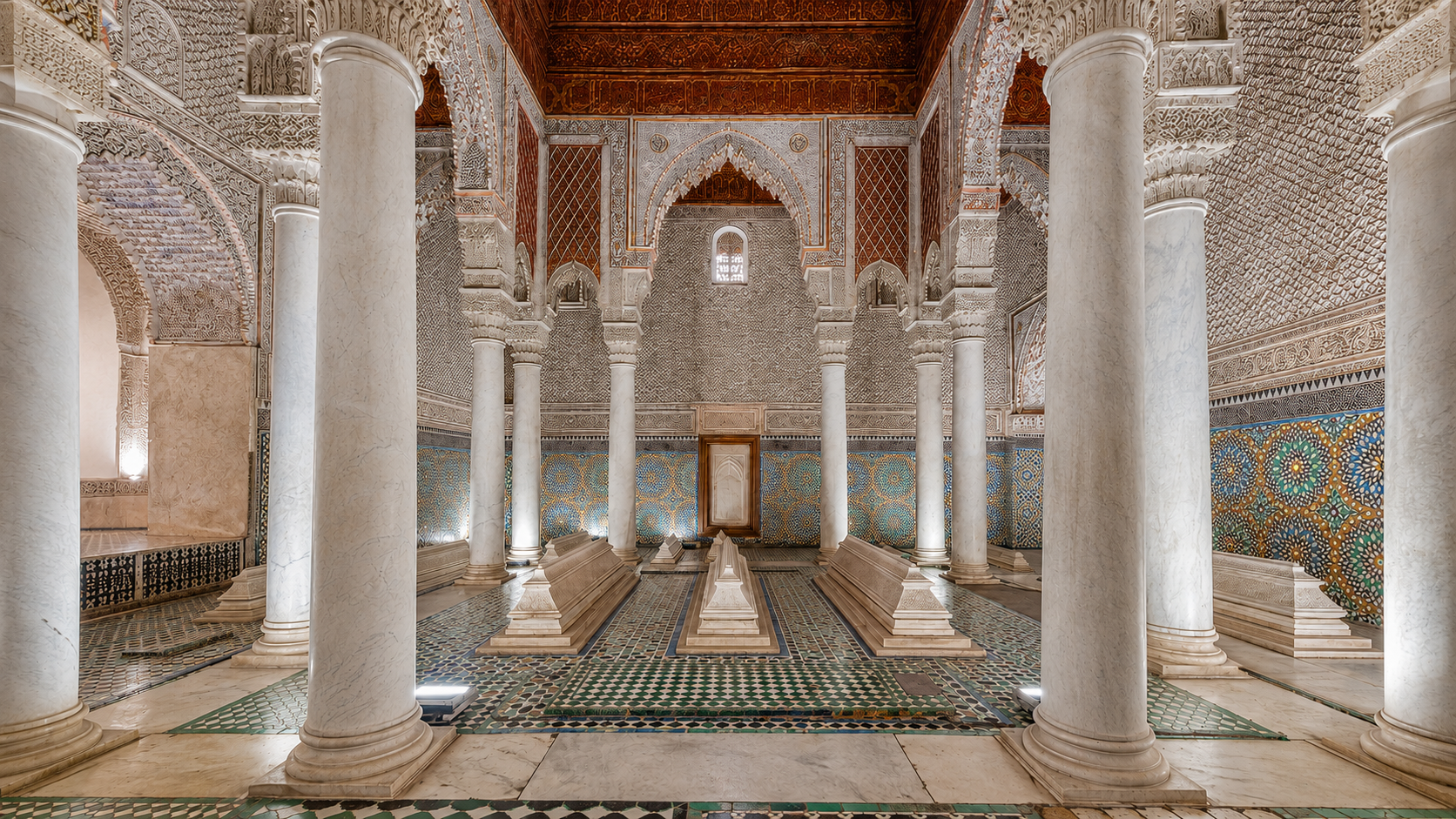
Official Marrakech tourism identifies the site as the royal necropolis of the Saadian family and connects its first funeral rooms to the burial of Prince Mohamed Cheikh in 1557. It also highlights the later building with the Chamber of the Twelve Columns, the Chamber of the Mihrab and the Chamber of the Three Niches.
The place matters visually because its richness is controlled. Zellige, carved stucco, marble columns, painted cedar and inscribed tombstones do not compete randomly. They are organized by chamber, axis, light and burial hierarchy, so the beauty feels ceremonial rather than decorative excess.
It also matters in Marrakech's urban reading. Around the tombs are the Kasbah Mosque, royal-kasbah memory, nearby palace remains and the living city. The tombs are quiet, but they are not isolated; they belong to a neighborhood where worship, authority, craft and movement have long overlapped.
For visitors, the stronger experience comes from slowing down. The tombs reward attention to thresholds, ceiling geometry, the way marble catches light, the density of surface carving and the difference between the garden cemetery and the most formal interior chambers.
Core place facts are grounded in the official Marrakech Tourism listing for the Saadian Tombs. Practical details such as prices, opening hours, queue conditions and access arrangements should be checked close to travel.