Sijilmasa Ruins Where oasis earth remembers Morocco's Saharan routes
Sijilmasa was one of medieval Morocco's great caravan cities, remembered through earthen traces beside Rissani, the Ziz oasis landscape and the routes that once connected the Maghreb with the Sahara.
Begin with the landscape before looking for monuments. The ruins are powerful because they ask visitors to read low earth, palm groves, water memory and trade-route scale together.
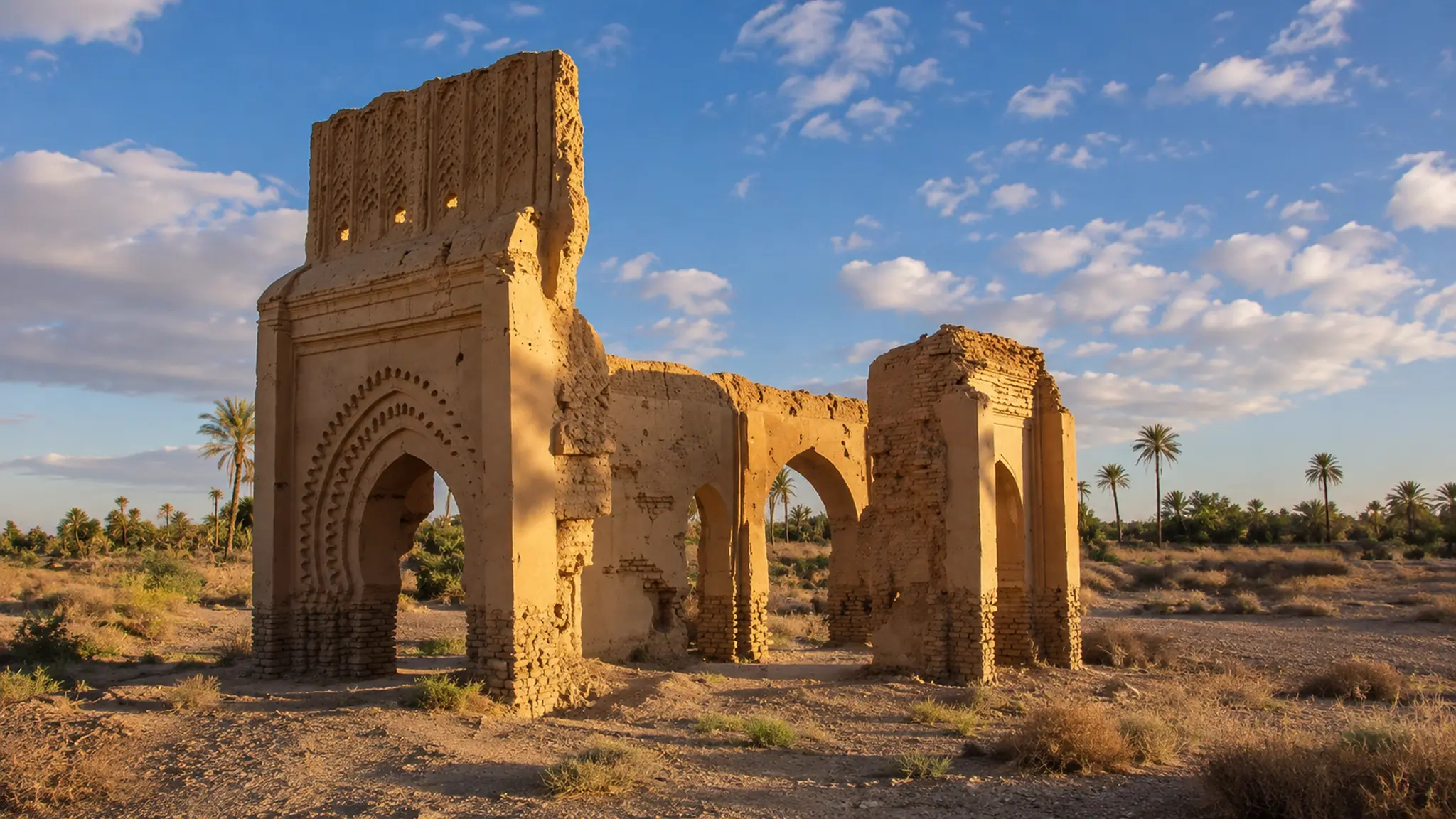
Sijilmasa is not a neatly preserved monument with a single gate, courtyard or palace to consume quickly. It is an archaeological landscape near Rissani, where the remains of a medieval oasis city must be read through fragments, mud construction, palms, water channels, open ground and memory.
The site matters because Sijilmasa once stood at a strategic northern edge of Saharan movement. Historical and archaeological writing connects it with the western trans-Saharan trade routes that linked the Maghreb to West Africa, especially through gold-route exchange, caravan travel and oasis settlement.
Its meaning is inseparable from Tafilalt. The oasis gave the city more than scenery: it gave agriculture, water logic, shade, route position and the conditions that allowed a settlement on the desert edge to become economically and politically important during the medieval period.
For visitors, the challenge is part of the value. Some remains are low, eroded or difficult to read at first glance. Sijilmasa therefore rewards slow looking: wall lines, broken arches, earth texture, palm-grove edges and the relationship between Rissani and the archaeological zone begin to explain the place.
Sijilmasa is not listed as one of Morocco's inscribed UNESCO World Heritage properties. That makes careful language important. Its value comes from documented historical importance, ongoing archaeological attention and the fragile visibility of an oasis city whose traces can easily be misunderstood.
Use the map to place the archaeological zone beside Rissani, within the Tafilalt oasis and the wider Ziz Valley edge of southern Morocco.
Editorial reading
The empty spaces are part of the evidence.
Sijilmasa does not reveal itself with the instant clarity of a restored palace. Its strongest reading comes from the gap between what remains and what once operated here: a city, an oasis, a route economy and a landscape organised around movement.
Look first for position. Rissani is not background; it is the living city context that helps visitors understand why this area still matters. The old site and the modern town sit in conversation across time, linked by oasis geography and regional memory.
Then look for material. Mud architecture can disappear into the ground that made it. Weathered wall faces, broken edges and repaired surfaces are not visual weakness; they are the basic language of the site, and they explain why preservation is difficult.
The most rewarding visit connects trade history to physical evidence without forcing the ruins to perform more than they can. A wall line may suggest enclosure; a standing fragment may hint at urban fabric; a palm edge may explain survival better than any monument.
Because Sijilmasa is fragile and partly difficult to read, the visitor's attitude matters. Move with patience, avoid touching or climbing surfaces, and treat uncertain spaces as archaeological evidence rather than empty land.
The beauty here is quieter than spectacle. It lives in the meeting of earth colour, blue sky, palms, low ruins, desert-edge silence and the knowledge that this was once a point of exchange between worlds.
Leave with the larger map in mind: Rissani, Tafilalt, the Ziz system, Saharan routes and the wider history of Morocco's south. Sijilmasa becomes memorable when those layers are held together.
Historical and heritage orientation
Read the site through trade, water and archaeological caution.
Sijilmasa is best approached as a layered urban site rather than a single visible ruin. Archaeological work places it in the Tafilalt palm oasis near modern Rissani and studies it through urban remains, hydraulic traces, mud construction, regional networks and the changing ways the site has survived in the landscape.
01Place type
Medieval urban site
The remains belong to a former oasis city, not a single landmark. Visitors should read broad ground, wall fragments, built earth and settlement traces together.
02Route position
Trans-Saharan memory
Sijilmasa is strongly associated with medieval caravan exchange between the Maghreb and West Africa, especially through the economic geography of Saharan routes.
03Oasis logic
Tafilalt and water
The city cannot be separated from Tafilalt. Palm groves, water management, agriculture and route access help explain why urban life could take root here.
04Preservation
Fragile visibility
Archaeological reports describe poor preservation in parts of the site, linked to mud construction, erosion and human pressure. What remains must be treated with restraint.
A visual bridge
Three readings between oasis, earth and route
Before Sijilmasa becomes a ruin photograph, it is a relationship between water, mud architecture and long-distance movement. These readings help visitors slow down and see why the site belongs to the whole Tafilalt landscape.
01
Oasis
Water before walls
The ruins make more sense when the oasis is read first. Palms, cultivated ground and the Ziz Valley context explain why a city could grow here and why its memory remains tied to water.
Look beyond the standing fragments.
Notice palms, fields and dry edges together.
Read the site as an oasis city, not isolated ruins.
02
Route
Caravans and exchange
Sijilmasa's historical importance comes from position. It should be understood as a meeting point of trade, movement, authority and desert-edge logistics rather than a ruin that stands alone.
Connect Rissani to the older city site.
Imagine movement north and south of the Sahara.
Let the map explain the archaeology.
03
Looking
Absence before detail
The strongest visit accepts that much of the medieval city is not immediately visible. Distance reveals landscape logic; close looking reveals texture, fragment, alignment and fragility.
Do not expect a restored monument.
Move slowly around fragile earthen surfaces.
Use fragments to think at city scale.
Quick orientation
Type of place
Archaeological remains of a medieval oasis city, best understood through trade-route history, mud construction and the wider Tafilalt landscape.
Landscape context
The site lies near Rissani in the Tafilalt oasis, where Ziz Valley water, palms, desert-edge light and earthen remains belong to the same reading.
Best for
Medieval history, Saharan route context, careful archaeology-minded walking, oasis geography, quiet photography and southern Morocco cultural orientation.
Closest city context
Rissani is the practical and cultural city context for visitors connecting Sijilmasa with Tafilalt, markets, ksour landscapes and desert-edge routes.
What visitors experience here
A place that asks you to read slowly.
Sijilmasa works differently from Morocco's more complete monuments. First comes the oasis setting: palms, open ground, Rissani close by and the dry light of Tafilalt. Then the ruins begin to separate into fragments, surfaces, alignments and questions.
Arrival
Ruins inside an oasis map
The first impression may be quieter than expected. Instead of one complete monument, visitors meet scattered earthen remains that make sense only when the palms, dry ground and Rissani context are included.
Light
Mud, shadow and open sky
Earthen surfaces change quickly with light. Warm sun reveals texture and relief; shadow flattens some forms; the blue sky and palms sharpen the contrast between ruin, oasis and desert edge.
Movement
Walking without rushing the evidence
The best rhythm is measured. Move around fragments, keep distance from weak edges and allow the site to gather meaning through repeated looks rather than one obvious viewpoint.
Material
Earth returning to earth
Mud construction gives Sijilmasa its colour and vulnerability. Some surfaces read almost as landscape, which is exactly why the visitor must look carefully and avoid treating low remains as ordinary ground.
Water
The hidden logic of Tafilalt
The archaeology cannot be separated from water. Oasis agriculture, hydraulic traces and settlement position help explain why a major medieval city could exist here on the edge of the Sahara.
Pace
History without theatrical certainty
Sijilmasa rewards visitors who accept ambiguity. The stronger experience comes from holding trade history, fragile remains and oasis geography together without forcing every fragment into a simple story.
Place details and orientation
Read Sijilmasa through six defining elements
No single fragment explains the site. Its meaning comes from the relationship between urban memory, mud construction, oasis water, Rissani, trade routes and the fragile survival of archaeological traces.
1
Earthen remains
Standing and low mud-built traces are the clearest visual language of the site, but they must be approached as fragile archaeological fabric.
2
Urban memory
Sijilmasa was a city, so the visitor should think beyond isolated walls toward settlement organisation, movement, neighbourhoods and public life.
3
Rissani context
Modern Rissani helps anchor the visit. It gives the ruins a living geographical context rather than leaving them as disconnected desert fragments.
4
Tafilalt oasis
Palms, water and cultivated land explain the environmental intelligence behind the city's location and its long regional importance.
5
Route economy
The site is tied to Saharan exchange and movement. Its history belongs to trade geography as much as to architecture.
6
Archaeological caution
Some remains are difficult to date or interpret visually. The strongest reading stays cautious, precise and open to what research continues to clarify.
Archaeology, not scenery
The place asks for patience before judgment.
Stand back before narrowing your attention. The first lesson is geographical: a former city positioned inside an oasis world, close to Rissani and connected historically to routes moving across the Sahara.
Then move closer. Wall fragments, eroded surfaces, broken profiles and changes in ground level begin to matter. The site becomes less about one dramatic image and more about reading how built earth survives, disappears and returns through research.
Keep the oasis in view throughout the visit. Sijilmasa is not only a ruin field; it is a memory of water management, settlement intelligence and exchange. The palms and dry light are part of the evidence.
Architecture and material intelligence
Mud construction is memory and vulnerability.
The earthen character of Sijilmasa is not a decorative surface. Mud construction belongs to climate, local material, repair cycles and the way oasis settlements meet heat, dust, shade and time. It gives the site its warmth, but also explains why so much has eroded.
Archaeological writing on Sijilmasa repeatedly asks for caution: visible remains do not always tell a simple story, and some standing fabric may belong to later phases. That makes the visitor's task more interesting, not weaker. The site should be read as layered evidence.
What to notice slowly
Look at the wider oasis setting before focusing on individual fragments.
Notice how mud, stone, shadow, palm shade and open ground change the reading.
Distinguish visible ruins from the broader footprint of a former city.
Connect the place to Rissani rather than treating it as an isolated stop.
Keep water in the interpretation; oasis life made the city possible.
Respect fragile surfaces and avoid climbing, touching or crossing weak edges.
Architectural reading
Three languages of the site to notice
Urban footprint
Sijilmasa should be read at city scale. Even when remains are fragmentary, the visitor can think in terms of settlement, movement, edges and the relationship between built space and oasis land.
Route and economy
The site carries the memory of caravan exchange. Its importance comes from position: between oasis resources, regional authority, Saharan routes and wider medieval networks.
Surface and erosion
Earthen surfaces record light, weathering, repair and loss. Their beauty depends on care, which is why a respectful visitor avoids touching, climbing or treating fragile fabric as scenery.
Visual atmosphere
Light, earth and quiet scale
From landscape to fragment
Start with the full Tafilalt setting: palms, open ground, Rissani and dry light. Then move closer to read individual surfaces, broken edges and the way ruin fragments emerge from the same earth that made them.
From water to desert edge
The strongest contrast is not theatrical colour, but the meeting of oasis green, mud walls, pale ground and wide sky. Sijilmasa becomes clearer when abundance and exposure are seen together.
From photograph to memory
The photograph may hold a wall or arch, but the deeper memory is spatial: quiet walking, fragile earth, palm shade, Rissani close by and the thought of a city once tied to routes across the Sahara.
Nearby places and onward links
Connect Sijilmasa to the wider southern Morocco map
Sijilmasa belongs to Tafilalt before it belongs to any quick itinerary. Rissani gives the closest city context, while the wider region opens toward oasis routes, desert-edge towns, kasbah landscapes and Saharan history.
Rissani
The closest city context for Sijilmasa. Use it to frame Tafilalt markets, oasis memory, routes toward Erfoud and the way modern life sits near older urban traces.
Sijilmasa opens a quieter reading of Moroccan heritage: mud construction, archaeology, preservation, route economy and the patience needed to understand ruins.
Treat Sijilmasa as a heritage stop that needs context. Pair it with Tafilalt, Rissani, oasis routes and respectful time rather than a rushed photo pause.
Sijilmasa is easy to under-read and easy to damage. Move carefully around low remains, avoid stepping on fragile edges, ask before photographing people nearby and remember that archaeological ground is not empty just because every trace is not dramatic.
Respect also means resisting the need to turn the site into a stage. Do not climb on walls, scratch surfaces, remove fragments, leave litter, force access into closed or private areas, or treat the surrounding oasis as background scenery. A slower visitor sees more and harms less.
Ask clearly before photographing local people, guides, market life or private spaces around Rissani.
Keep to appropriate walking areas and avoid pressure on fragile walls, low remains or eroded edges.
Do not remove pottery, stones, earth fragments or anything that may belong to the archaeological record.
Carry water, protect yourself from exposed light and avoid turning heat or dust into impatience with the place.
Check current access, local guidance and site conditions close to travel.
A strong first visit
Begin with the map and the landscape. Locate Rissani, the Tafilalt palm oasis and the Ziz Valley context before focusing on individual ruins. This first reading prevents the site from shrinking into a few isolated fragments.
On the ground, move slowly enough to notice changes in texture, alignment, colour and height. Some traces are modest, but modest does not mean meaningless. The site is strongest when read as a former urban landscape.
If you arrive with a guide, listen for the words that clarify the place: Sijilmasa, Tafilalt, oasis, caravan route, mud construction, archaeology, hydraulic remains and Rissani. These terms organise what the eye is seeing.
Afterward, reconnect the visit to southern Morocco. Sijilmasa belongs to a wider geography of oases, ksour, desert-edge towns, trade memory and cultural continuity, not to a single stop on the road.
Start with Rissani and Tafilalt, then move into the archaeological reading.
Give attention to low walls, broken edges, earth texture and palm-grove boundaries.
Use distance to understand scale, not only to photograph the standing fragments.
Leave space for local movement, guides and small businesses around the wider area.
Finish by connecting Sijilmasa back to southern Morocco's oasis routes.
Careful planning note: opening hours, prices and exact travel times can change. Verify practical arrangements locally before travelling.
Go deeper through the nearest city context
Rissani — the city gateway to Sijilmasa
Sijilmasa belongs naturally inside a wider Rissani and Tafilalt journey. The city gives visitors a stronger base for reading oasis life, market rhythm, ksour landscapes, desert-edge routes and the historical memory of southern Morocco.
Use Rissani to widen the context after the ruins themselves: palm-grove geography, routes toward Erfoud and Merzouga, local urban life and the wider Tafilalt story all make Sijilmasa easier to understand as a former city rather than an isolated ruin.
Historic and regional contextRissani city orientationTafilalt oasis routesArchitecture and heritage readingPractical travel structureNearby southern highlights
Read the ruins slowly, then connect them to Rissani, Tafilalt, oasis geography, earthen architecture, Saharan routes and the wider heritage map of Morocco.