Read the materials
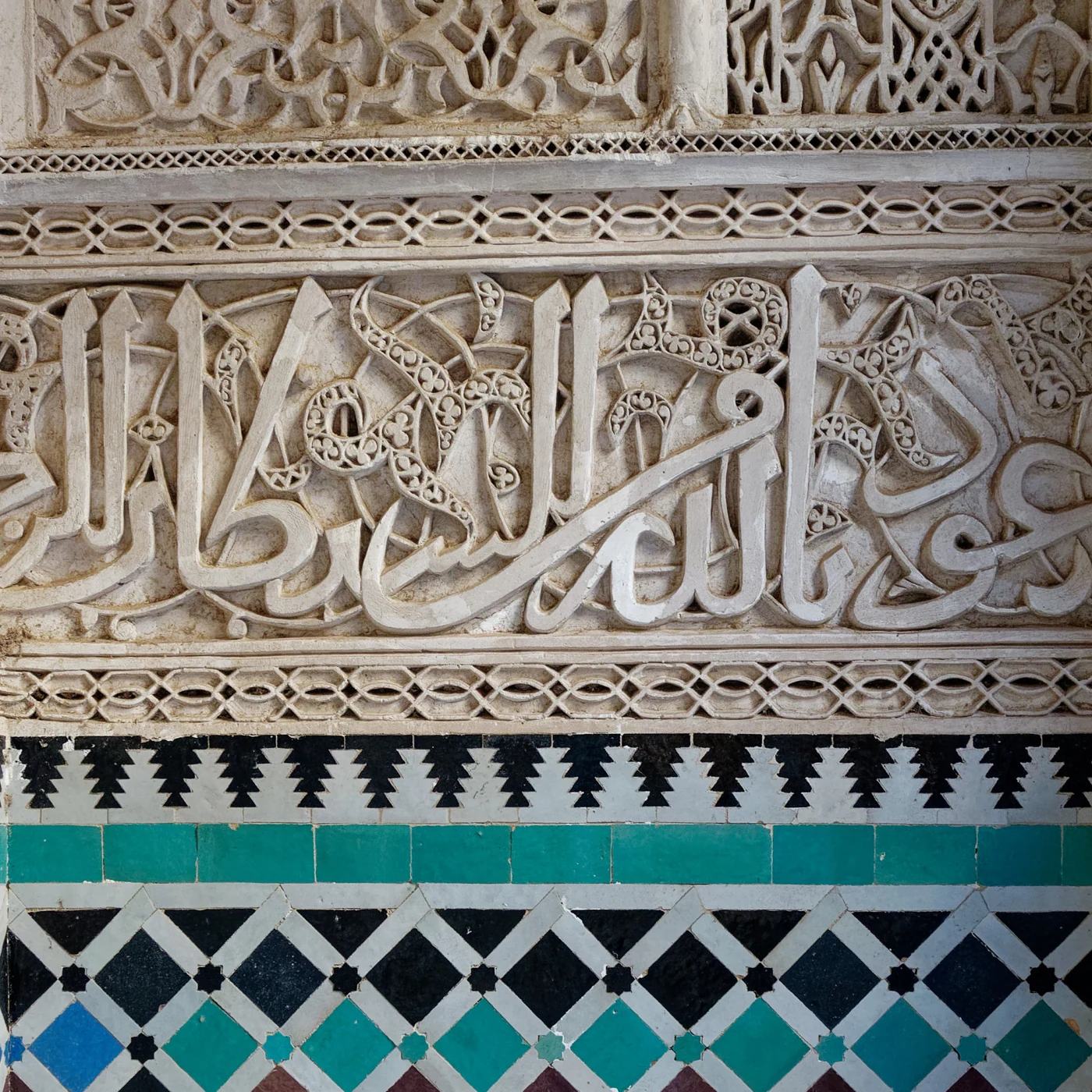
Tile, inscription and carved plaster: different materials, read together.

Exotic Morocco · Stories
A small piece of clay. An extraordinary way of seeing. Inside the craft that gives Moroccan architecture its colour, rhythm and human touch.
Enter the story ↓01 / The starting point
Stand a little back from a panel of Moroccan zellige and the eye starts making connections. A star becomes the centre of a larger star; a white line runs past one patch of blue and joins another. Move closer and that apparently continuous drawing breaks into individual pieces. The joint is suddenly as interesting as the colour. Something that looked almost effortless reveals how much has been fitted together.
That change of distance is a useful way into the craft. A photograph can make zellige look like a flat graphic, a repeat that could be printed by the metre. The surface tells another story. Look at an edge, a slight difference in the way adjacent faces catch the light, the meeting of several points. The pattern has been worked out through a material that must be prepared, fired, cut and assembled. Geometry is part of the achievement. So is judgment.
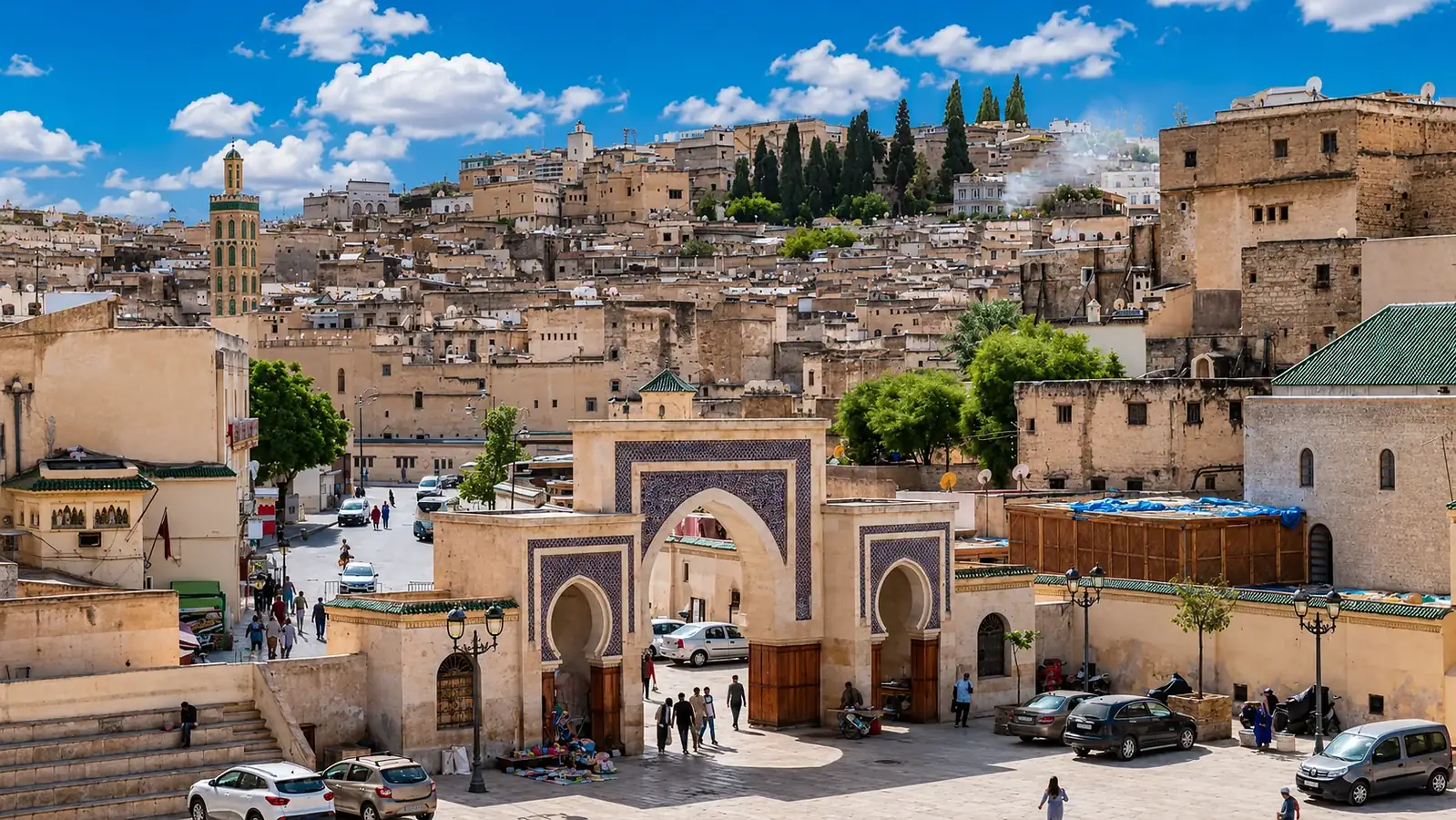
Fès gives this story a particular setting. Its decorated buildings and its working craft traditions let us consider both the finished surface and the knowledge needed to make one. But this is not a claim that every Moroccan tile comes from Fès, or that one city explains the whole country. It is a way of looking closely enough at one tradition to see beyond a familiar image of Morocco.
02 / Read the details
Three visual encounters within this story.
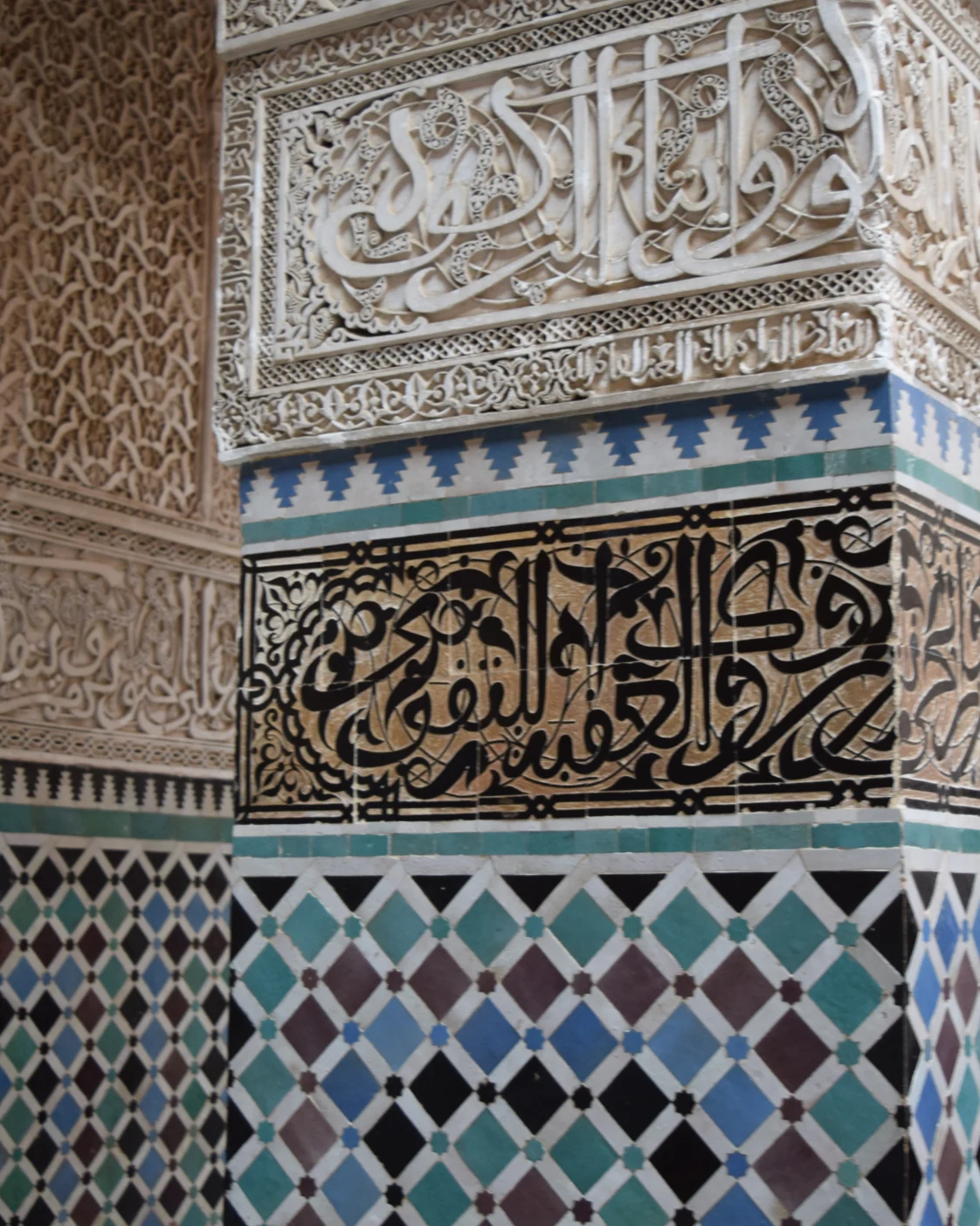
Tile, inscription and carved plaster: different materials, read together.
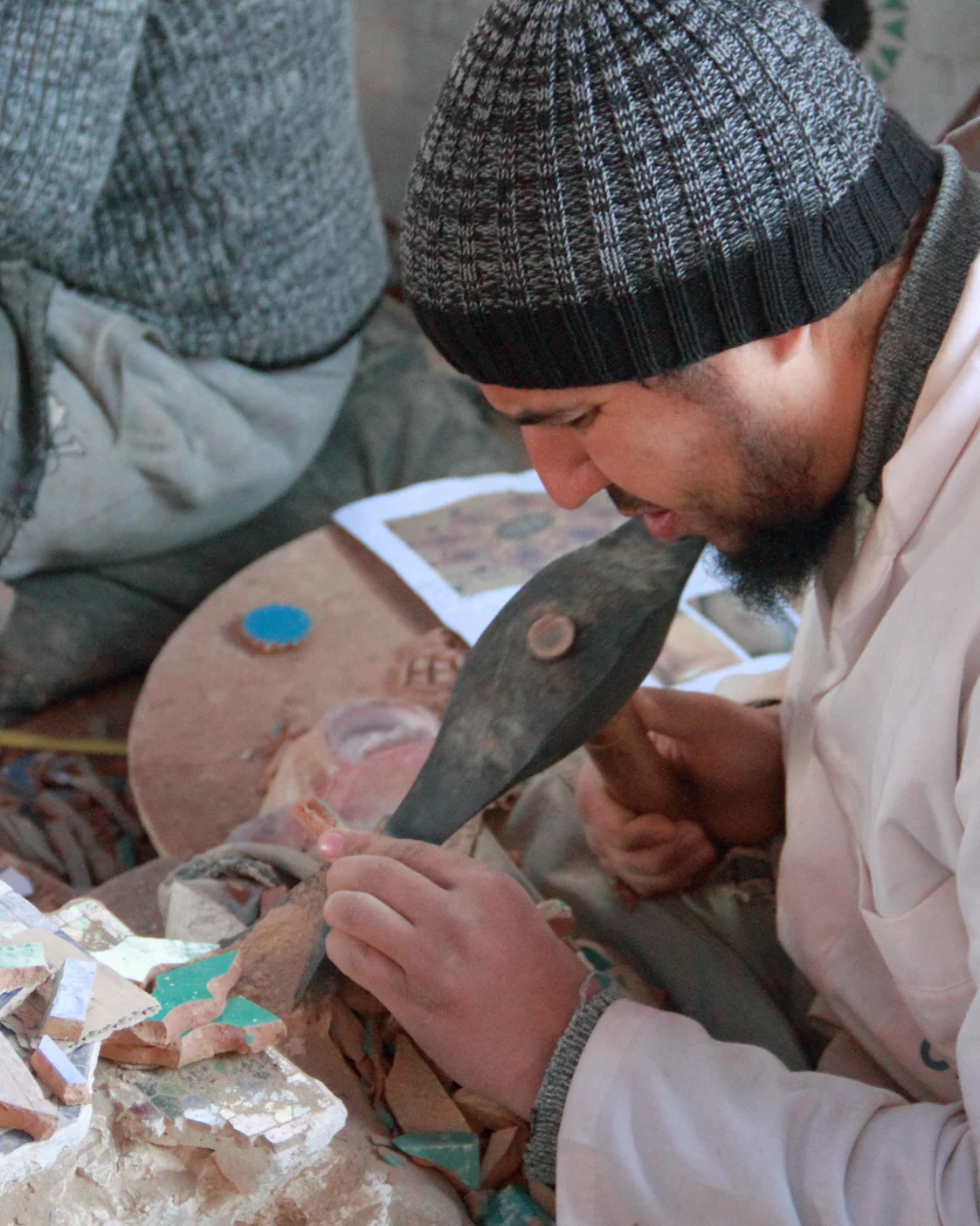
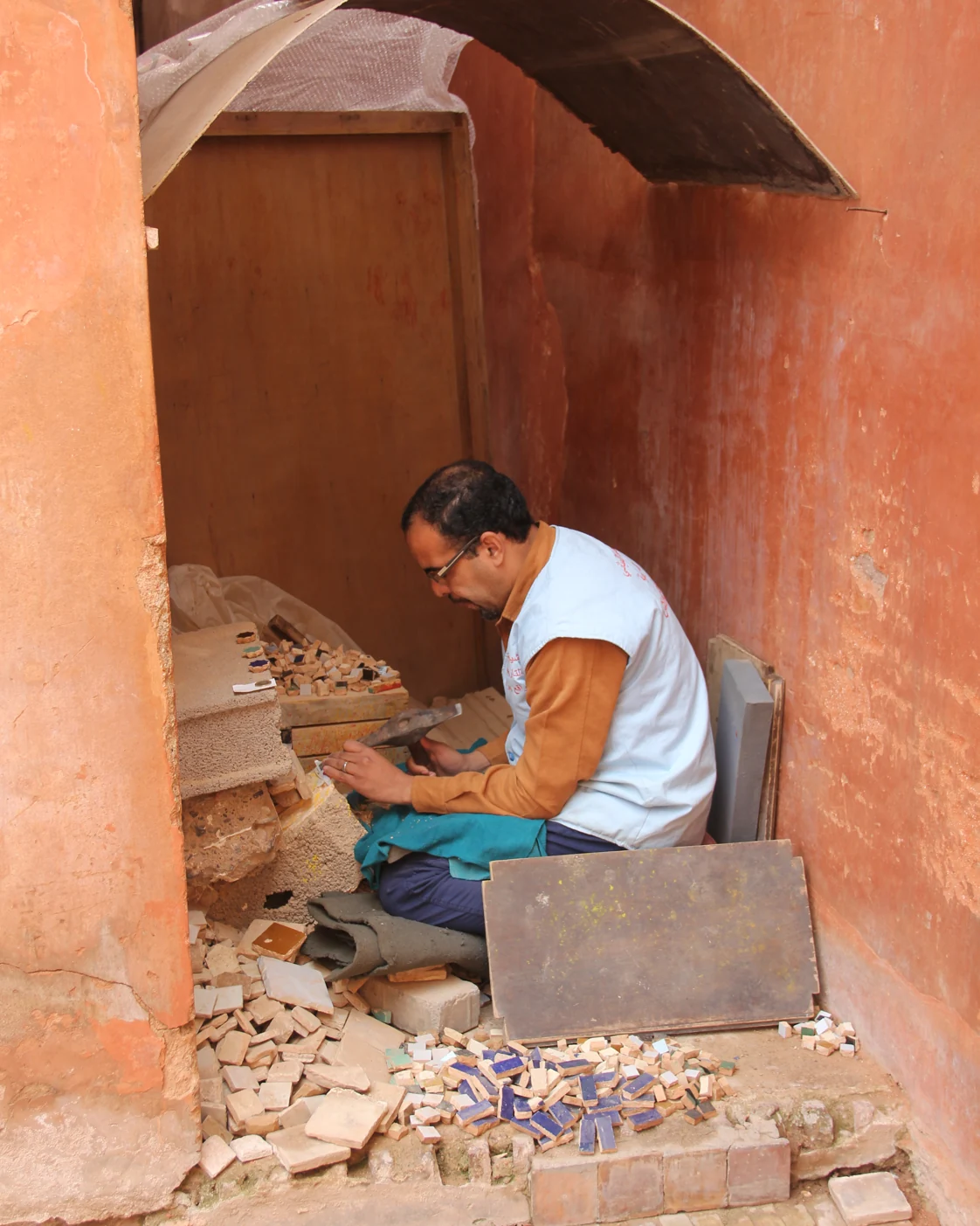
Cutting zellige in Fès. A workshop photograph by Schorle, 2016.
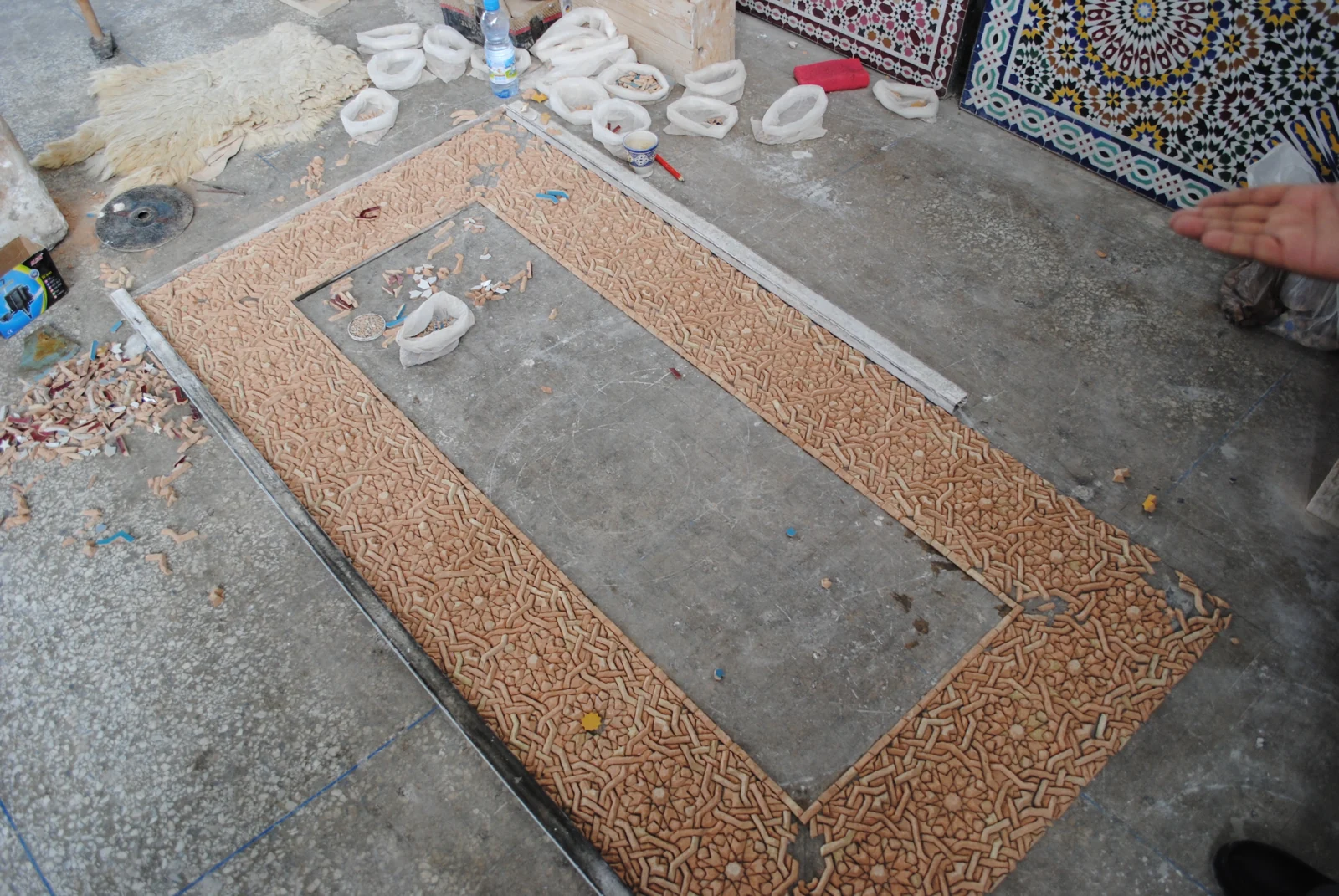
A panel assembled upside down: the unglazed backs reveal the construction. Photograph: Jadcooper.
03 / Look closer
02 / From clay to composition
First as an arrangement of shapes. Then as a surface that has to hold together.
The Hassan II Mosque Foundation describes a sequence that begins with clay mixed with water and worked into tiles. After firing and glazing, shapes are marked with templates and cut with a sharpened hammer. The pieces are then assembled face down on a smooth surface; a backing mortar holds the panel together so it can be lifted into place.
03 / Look closer
That reversal changes how we think about the finished work. The visitor encounters colour, but part of the maker’s task is to organise a composition while its coloured faces are hidden. The back of the work is not incidental. It is where separate shapes become a panel.
In the workshop photograph, the scale of the task is striking. A tool, a tile and a pair of hands occupy a small working area. Nothing about that scale predicts the breadth of an architectural wall. It takes an accumulation of precise decisions to cross the distance between them.
Notice, too, the difference between cutting a shape and placing it. One action gives the piece its edges; the other establishes its relationship with everything around it. The quality of the pattern depends on both. Calling zellige simply “handmade” is true of this process, but it leaves most of the intelligence of the work unnamed.
04 / The story in context
A finished panel conceals its making.
Turn the story over.
Clay becomes tile. Firing and glaze produce the coloured material from which the mosaic is cut.
Reading a panel at two distances reveals different information. From farther away, follow the repeat and the border. Up close, examine the meeting of cut edges and how a motif is resolved at a corner or around an opening. These are decisions of assembly; the visible glaze alone cannot explain them.
A drawing, a loose cut piece and a completed wall therefore tell different parts of the process. Ask a maker which stage an example represents before comparing prices or describing it as ‘handmade’. The useful distinction is between the preparation of the tile, the cutting of shapes and the assembly of the design. Each contributes to the surface you eventually see.
Stay with the context
Templates guide the shapes; a sharpened hammer cuts their outlines. The design needs edges that meet.
The glazed faces lie downwards. Mortar binds the arrangement into a panel ready for installation.
A different distance
The medina of Fès was inscribed on UNESCO’s World Heritage List in 1981. UNESCO identifies the thirteenth and fourteenth centuries, under the Marinid rulers, as an especially important period in the city’s history. Madrasas, mosques, palaces and residences from that era helped give the urban fabric a character that remains legible today. Zellige belongs inside this larger story of buildings, patronage and city life.
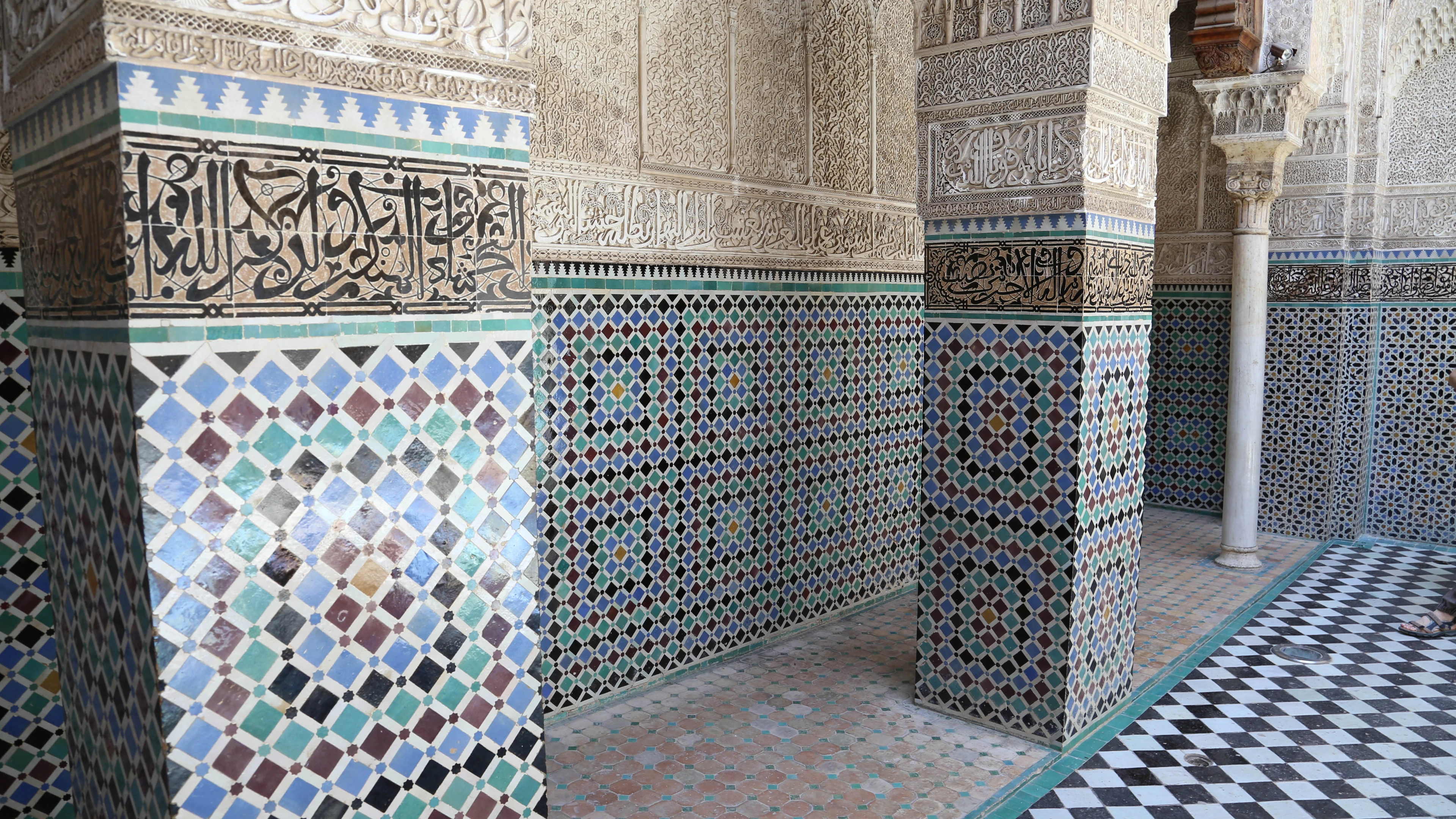
At the Al-Attarine Madrasa, built in the early fourteenth century, decoration is inseparable from the architecture. The heritage historian Mohamed Mezzine describes tiled floors and lower walls, bands of inscription, carved plaster and wood above. The eye travels through materials as it travels up the building. A mosaic panel is one voice in a more elaborate composition.
A madrasa was a place of learning, with accommodation for students; it was not built as a backdrop for visitors’ photographs. Remembering its purpose changes the encounter. A doorway marks passage between spaces. An inscription carries words, not merely a pleasing dark line. A richly treated courtyard could express the ambitions of its patron as well as the capabilities of the people who made it.
A different distance
The familiar combination of cut tile, plaster and wood also connects Moroccan architecture with the wider history of the western Islamic world, including al-Andalus. The Metropolitan Museum of Art draws precisely this connection in its account of Moroccan and Andalusian courtyard architecture. Similarities deserve attention, but a shared visual language does not make every building interchangeable. Place, period, patron and workshop still matter.
Nor does the age of a monument automatically date every visible surface. A historic building and the materials we see in it have related, but different, histories. When looking at a photograph, it is safer to name the building than to announce that every tile has survived untouched since its foundation. The pleasure of seeing does not need that exaggeration.
A different distance
04 / Learning to see the pattern
Choose a single centre in a geometric panel and trace its neighbours with your eyes. You may find that the shape you first took for the main motif is also the space between other motifs. Figure and background exchange roles. It becomes difficult to say where one unit ends and the next begins. That is part of the design’s visual energy.
The Met’s account of Islamic geometric ornament describes combinations of circles, squares, stars and other polygons, repeated and interlaced into complex arrangements. These are not recipes for one universal pattern. A change of proportion, colour or sequence can alter what the eye picks out first. A narrow border can interrupt a field without making that field appear complete.
A different distance
It is tempting to turn such effects into a ready-made explanation: this star always means one thing; that colour always means another. The evidence rarely warrants such confidence about an unidentified panel. Geometry can support religious, intellectual and aesthetic readings, but those readings need a context. The words of an inscription, the function of a room and the date of a building may tell us more than an attractive theory about a shape.
You do not need to decode a hidden message to look with care. Counting a repeat, following a line or noticing a border is already a more attentive encounter. It recognises the choices in front of you without supplying a story the object cannot confirm.
A closer encounter
Find where two colours meet. Is the line part of the pattern, or the meeting of separate pieces? Look before you decide.
Follow the outer edge. A border changes the scale of a panel and its relationship with a doorway, column or neighbouring surface.
Change your position. Reflections can make some faces brighter than others. The same panel is not the same visual experience from every angle.
A different distance
One danger of admiring ornament is to detach it from everything that gives it a place. Cropped closely, a panel becomes a pattern collection. Seen in a room, it has a height, an edge and neighbours. It can meet a floor, turn a corner or wrap a column. The difference is architectural, not merely decorative.
In the images from Al-Attarine, the surface has a clear order without being monotonous. Small pieces sit below much larger openings. Flat tile is set against the depth of carved plaster. Dark written forms run across lighter bands. These contrasts keep the wall from behaving like one uninterrupted sheet. The pattern is doing its work in relation to other things.
There is also a distinction between recognising calligraphy and reading it. A visitor may register the beauty of a line without understanding its language. That is an honest starting point. An exact translation, however, requires the actual inscription to be identified and read. Treating every band as a generic proverb, blessing or Qur’anic passage erases the specificity of the writing.
A different distance
The same care applies to spiritual explanations. The Museum With No Frontiers relates geometric decoration to religious and intellectual settings, while also emphasising its use across architecture and the applied arts. No single account should flatten that variety. A religious building, a domestic interior and a contemporary commission can share a technique without sharing every intention.
For the reader, this is a useful freedom. We can admire the precision of a piece, the movement of a design and the experience of a courtyard without pretending to know everything about them. Attention becomes more rewarding when it remains curious.
A different distance
06 / Knowledge in the present tense
A surviving wall can show us a design. It cannot, on its own, teach another person how to make one. For that, there must be practice: learning how a tool behaves, how a material responds and how to judge the result. The continuation of a craft is an active undertaking.
In an interview published by the Moroccan National Tourist Office, master zellige artisan Saïd Ben Adiba describes joining his uncle’s work in Fès while still at school and later entering his workshop. He also speaks about training others and studying and reinterpreting Moroccan designs. This is his account of his own route into the profession, not a single biography that can stand for every maker.
A different distance
Formal training provides another setting for transmission. Casablanca’s Académie des Arts Traditionnels describes separate areas for cutting and assembling zellige in its workshop programme. Students work with experienced master artisans; the teaching also includes clay preparation, drawing and opportunities for design. Preservation, in that context, involves education as well as completed objects.
The craft also travels. In 2011, the Naji family and their company, Arabesque, from Fès, created the Met’s Moroccan Court in New York. Its tilework, carved plaster and wood were made for a new museum installation drawing on historic courtyard traditions. The example is useful precisely because it is a contemporary commission: traditional expertise can produce something new.
None of this makes the maker’s work automatic. “Tradition” is a convenient word, but it can make skill sound as though it arrives fully formed from the past. The workshop images suggest a better emphasis. Someone is concentrating on a piece in front of them. That present-tense act deserves as much attention as the age of the pattern.
A different distance
On a next encounter with zellige, give the surface two distances. First the room: its openings, proportions and the place of the panel within it. Then the piece: its edge, colour and connection to the next. Neither view replaces the other.
If a workshop welcomes visitors, ask before photographing the people at work. Let a demonstration remain someone’s working time, not simply part of your itinerary. A useful question is not only how long a panel takes, but which part of making it demands the most experience.
The wall may be what draws you in. The small piece is what teaches you to stay.
Story pathways
Cities, cultural context and a connected essay, chosen for this subject.
Explore Fès ↗
Explore the city ↗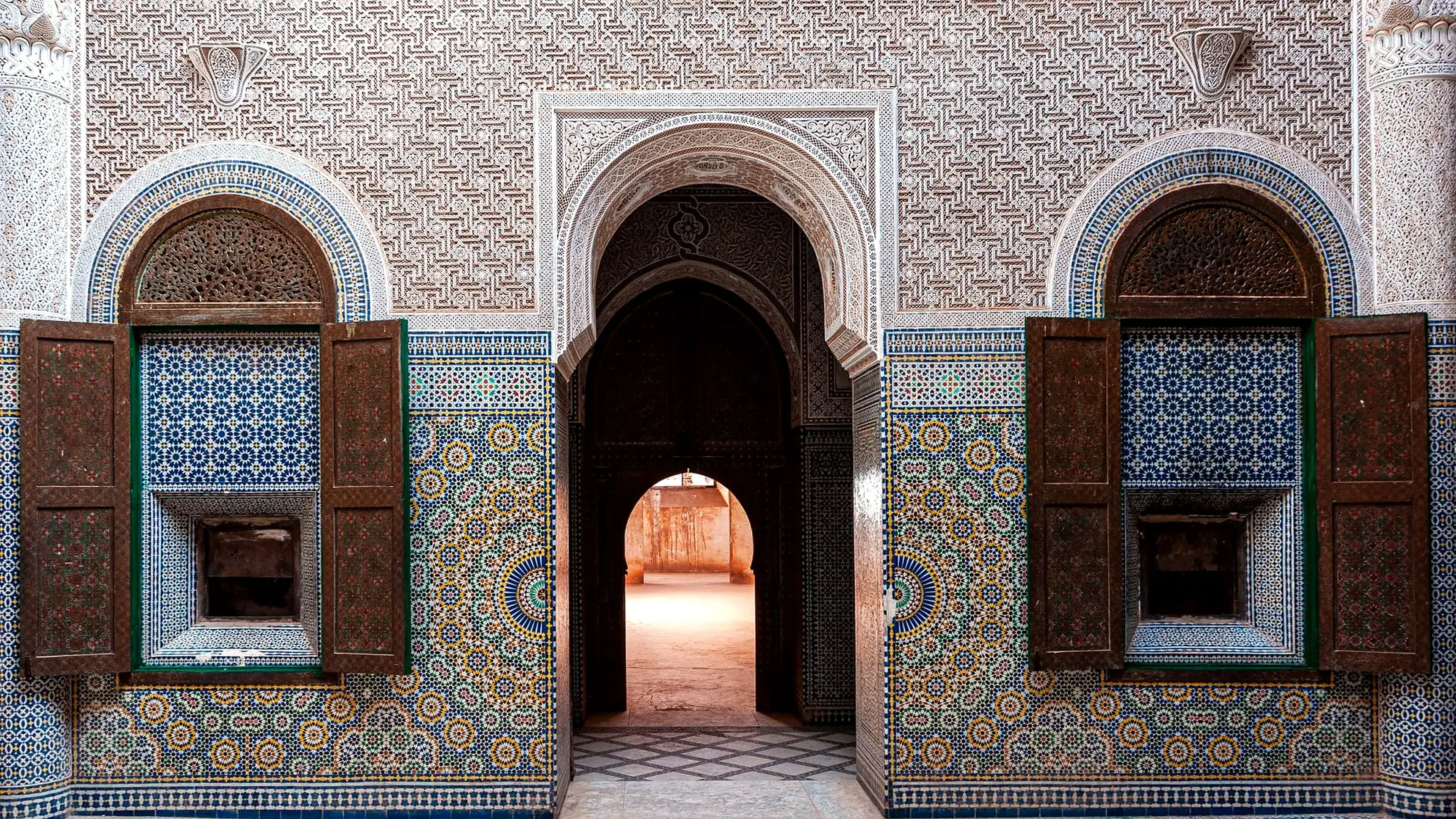
Zellige & ornament ↗
Explore the context ↗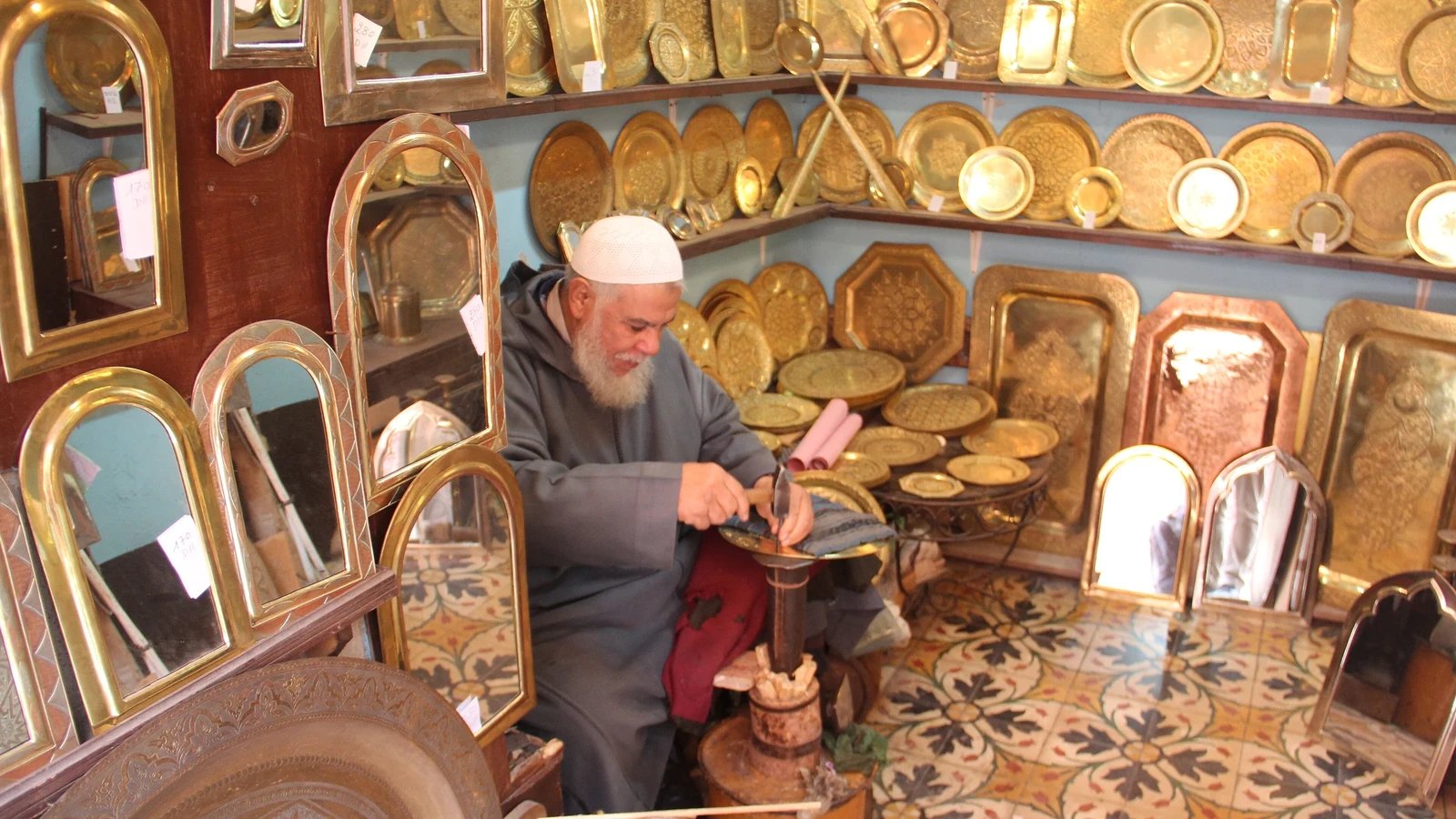
A worked surface can hold a long sequence of decisions. Looking closely begins to return the finished object to the people and processes behind it.
Explore the story ↗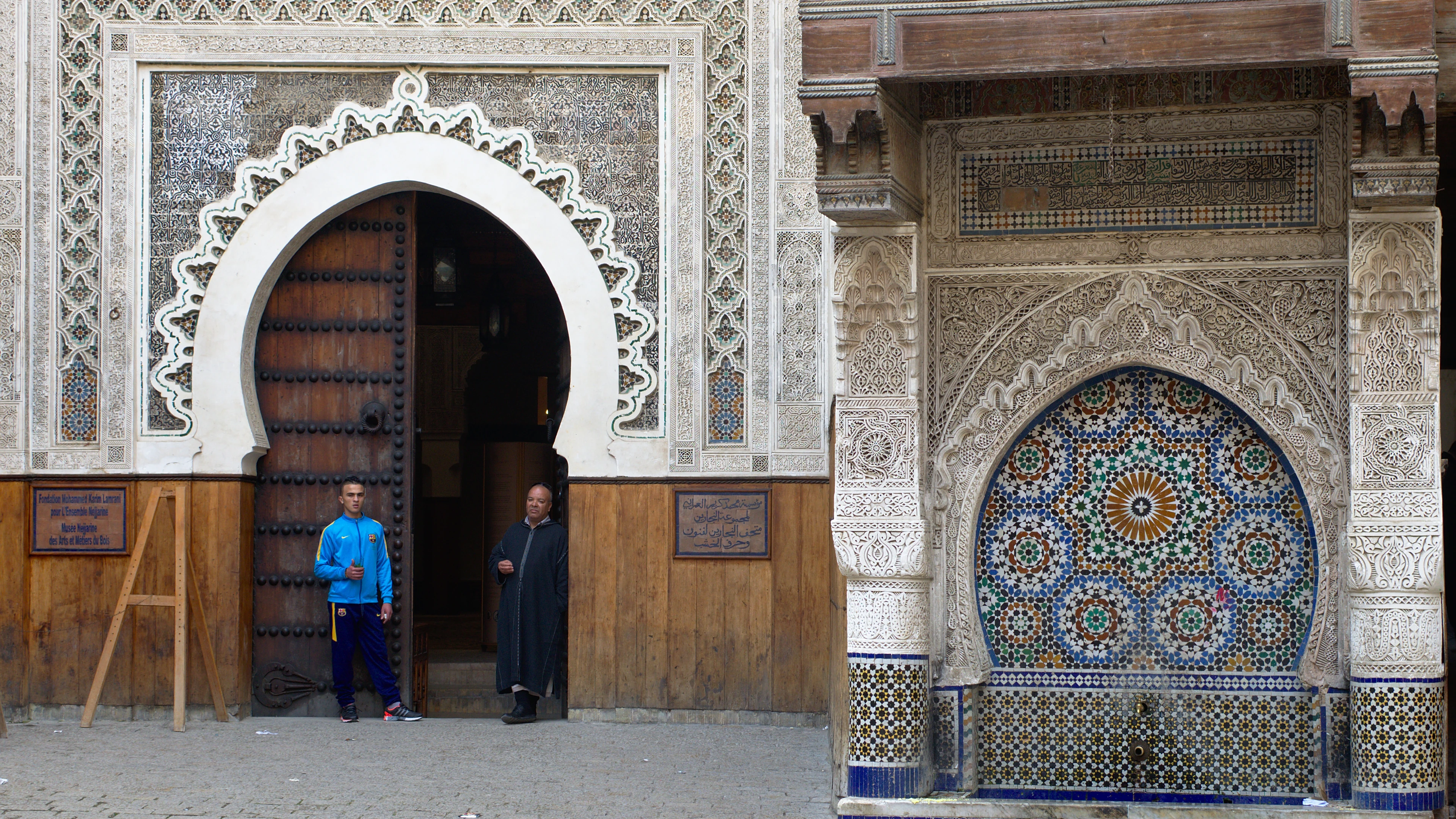
A city’s records can be held in walls, objects and practiced skills. Reading Fès means leaving room for the people who keep it alive.
Explore the story ↗Continue reading
Keep the subject in view as you choose your next chapter.
A worked surface can hold a long sequence of decisions. Looking closely begins to return the finished object to the people and processes behind it.
Read the story ↗A city’s records can be held in walls, objects and practiced skills. Reading Fès means leaving room for the people who keep it alive.
Read the story ↗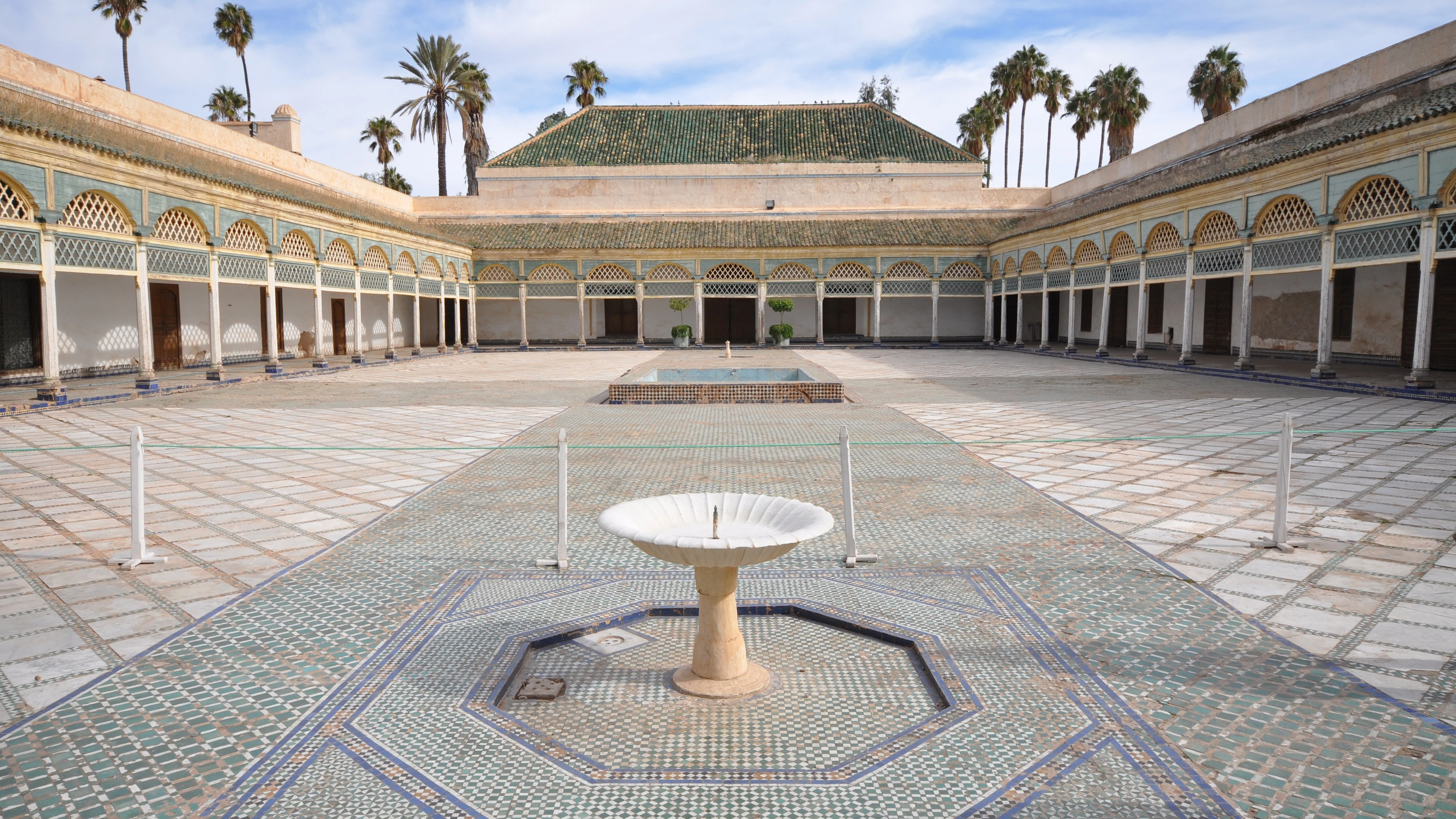
Gates, courtyards, streets and the materials that shape how a place is used.
Read the story ↗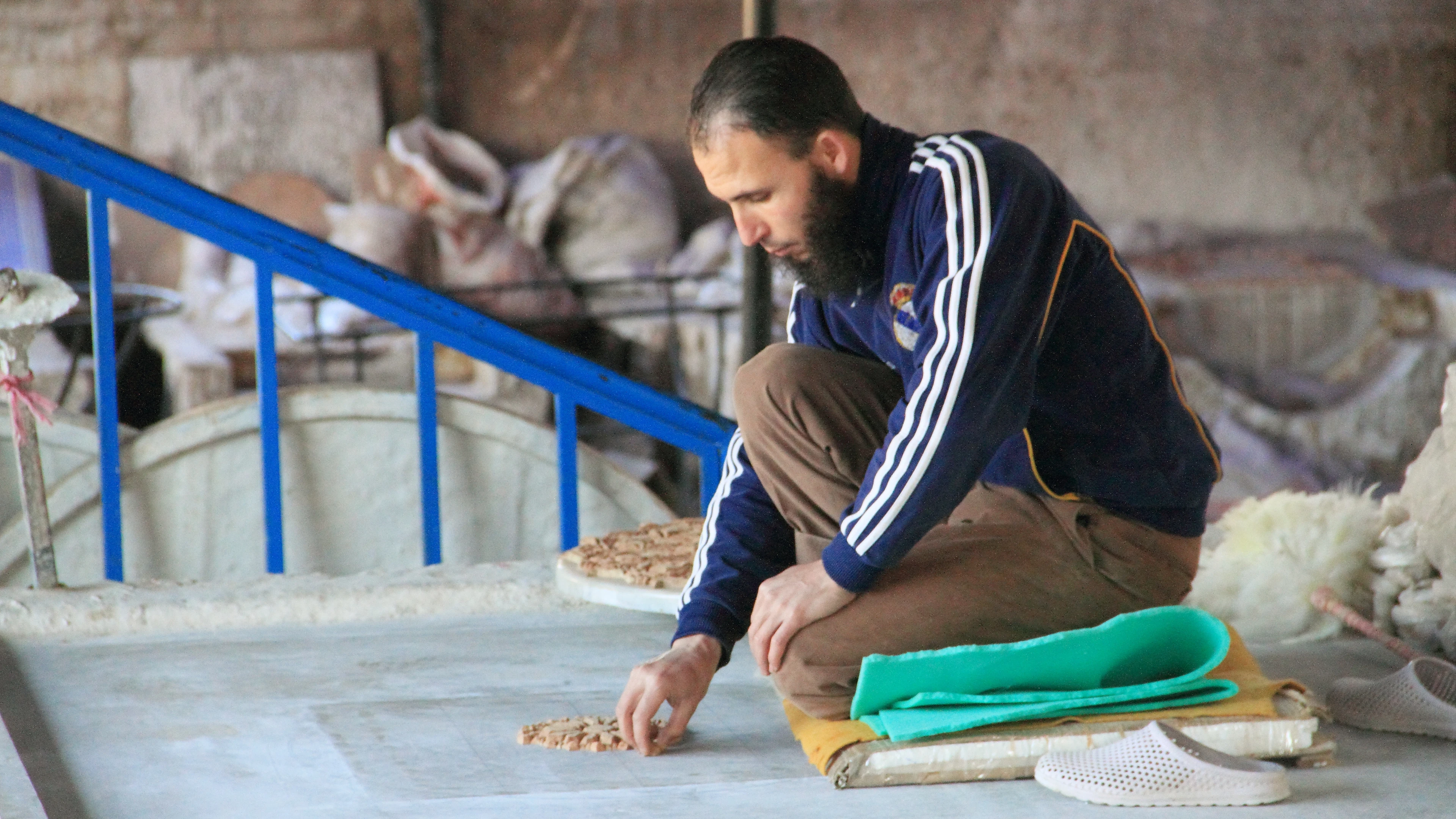
Clay, colour, wood and the decisions that turn material into a useful, beautiful thing.
Read the story ↗This is a researched visual essay. Descriptions of what to notice are editorial readings, not claims about a maker’s private intentions. The workshop photographs document their stated places and dates; they are not portraits of the named artisans discussed in the text.
The article photographs are real photographs. Images have been cropped and resized for this layout; no image generation or synthetic reconstruction was used.
Research checked 27 September 2026.
.jpg)


.jpg)
.jpg)
