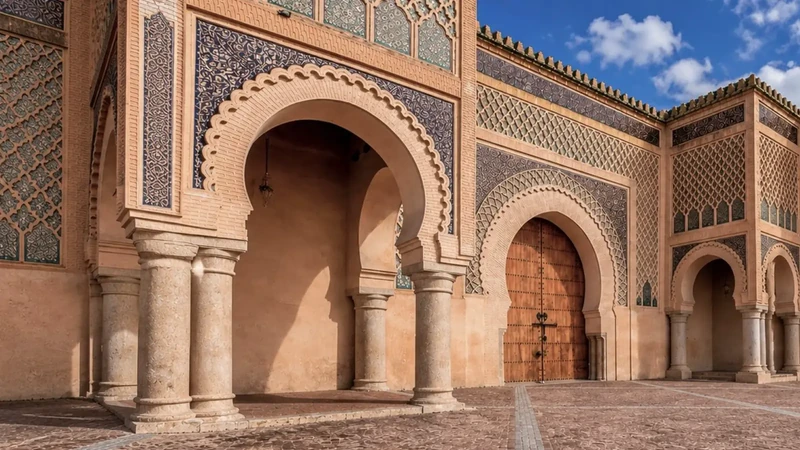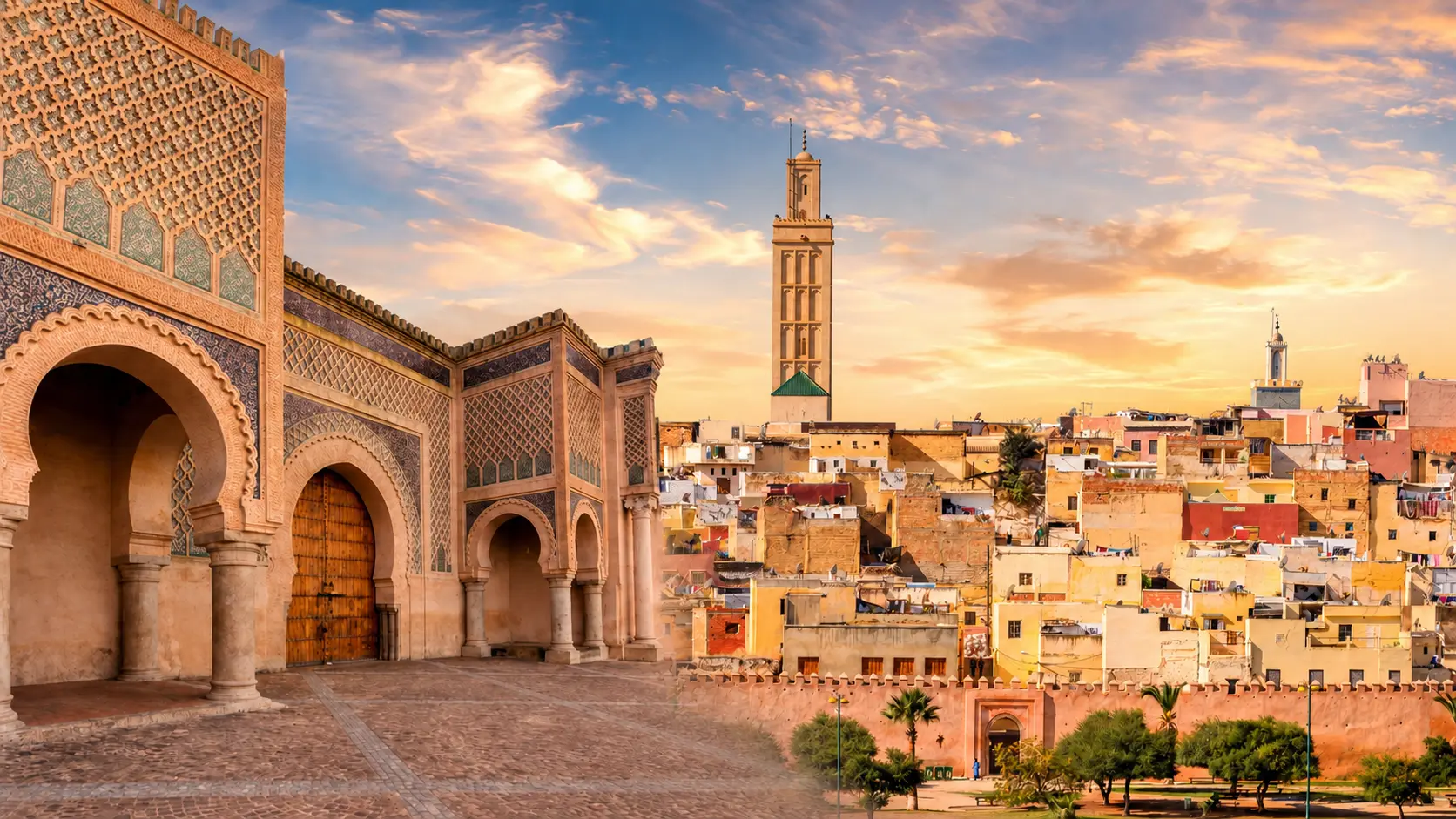
Bab Mansour and the historic cityscape of Meknes in warm Moroccan light

Visit / Place · Meknes medina · Imperial Morocco

Bab Mansour A monumental gateway where Meknes turns power, craft and urban memory into one facade

Bab Mansour is the great ceremonial face of imperial Meknes: a gate beside Place el-Hedim where zellij, carved relief, wall mass and city planning meet.

Begin from the square before moving close. The gate is strongest when the whole composition is visible first: the arch, the flanking walls, the tiled surface, the public space in front and the imperial city behind it.

Why Bab Mansour matters

A gate before it is a photograph.

Bab Mansour is not only an ornate doorway in Meknes. It is a ceremonial threshold between the public life of Place el-Hedim and the royal-city vision associated with Sultan Moulay Ismail. Its meaning comes from that position: square, wall, imperial enclosure and visitor approach all meet at the same architectural moment.

UNESCO frames Meknes as a historic city founded in the 11th century and transformed under Moulay Ismail into a walled capital with monumental gates, palaces, granaries and kasbah architecture. Bab Mansour should be read inside that wider structure, not as an isolated decorative facade.

The Prefectural Council of Tourism of Meknes identifies Bab Mansour Laalej as standing in front of El Hedim square, built by Moulay Ismail and completed by his son Moulay Abdellah in 1732. It also notes the broken-arch opening, polychrome mosaic work, relief lattice and white marble columns that give the gate its force at close range.

The place matters because it condenses several languages at once: royal authority, urban planning, skilled surface craft, public square life and the visual grammar of Moroccan monumental gates. The facade impresses first, but its deeper value is structural. It teaches visitors how scale and detail can work together.

For visitors, Bab Mansour is a lesson in disciplined looking. The best experience starts with the full facade from the square, then moves closer to the zellij, carved relief, arch rhythm and wall thickness. The gate rewards attention because every layer changes with distance.

Core heritage facts are grounded in the UNESCO World Heritage Centre listing for the Historic City of Meknes and the Prefectural Council of Tourism of Meknes note on Bab Mansour Laalej. Practical details such as access, restoration conditions and local arrangements should be checked close to travel.
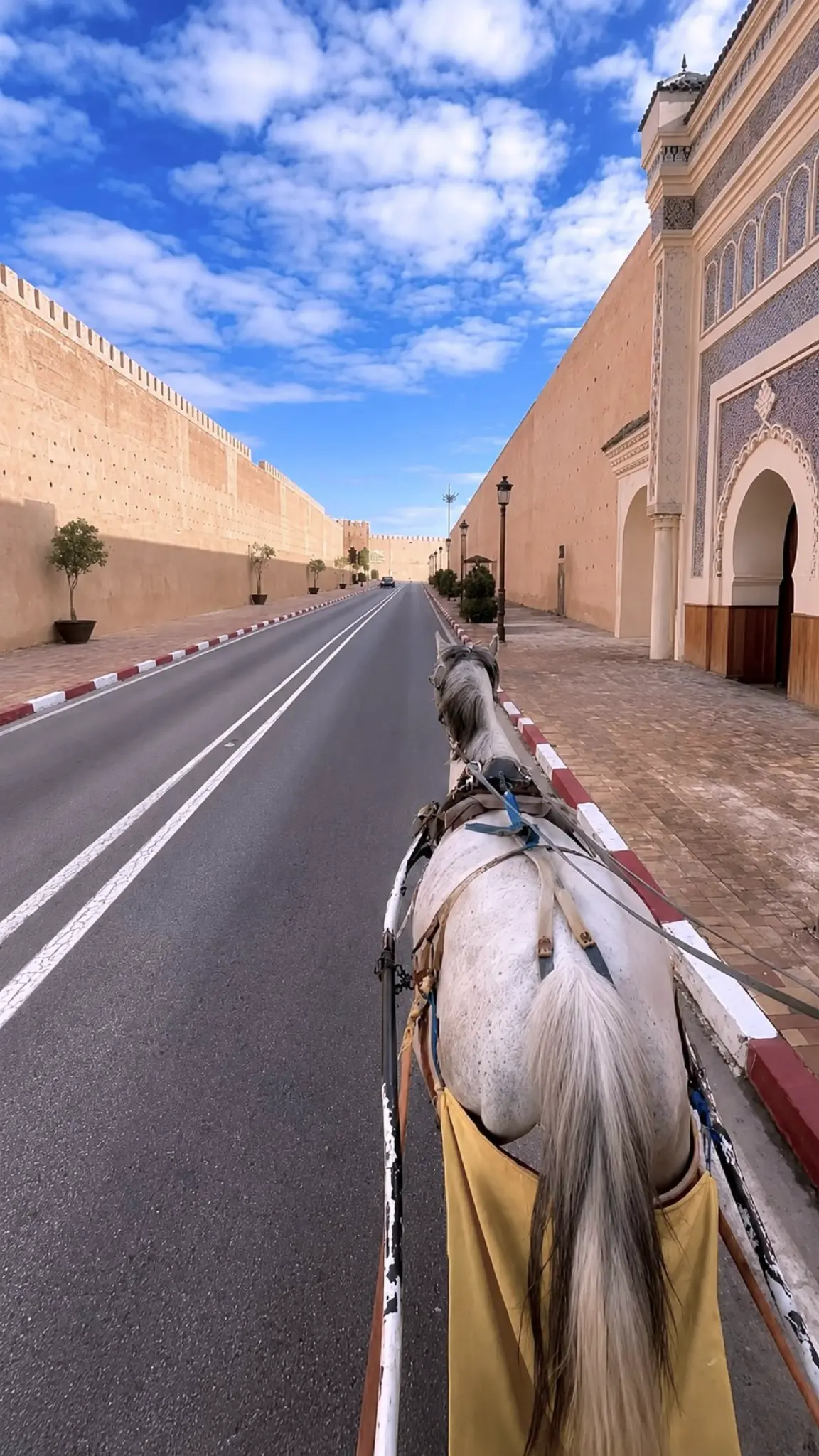
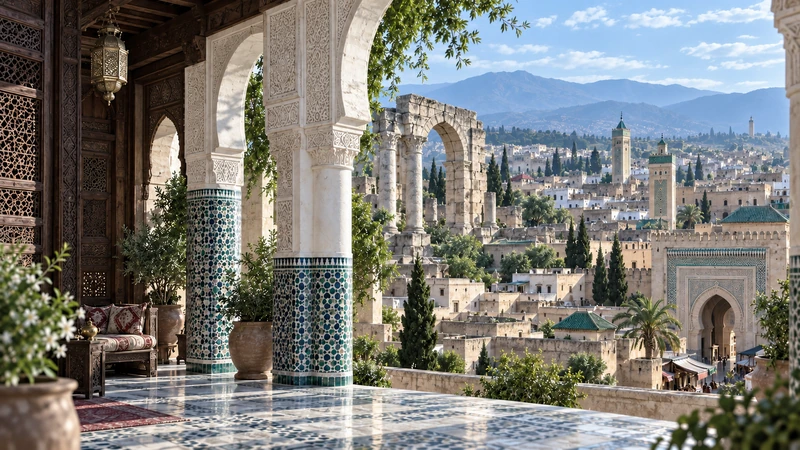
Horse-drawn carriage along the ramparts of Meknes near Bab Mansour

Map orientation

Use the map to place the gate beside Place el-Hedim, at the meeting point between the historic medina edge and the imperial-city enclosure of Meknes.

Editorial reading

Its beauty is disciplined, not loud.

The first impression is scale: a broad facade, a powerful arch and a wall line that makes the gate feel less like an object than a formal announcement. That scale is deliberate. Bab Mansour was made to mark entrance, authority and ceremonial presence.

Then the surface takes over. The eye starts to read zellij, relief work, framed panels, upper bands and the contrast between geometry and wall mass. The decoration is not scattered; it is arranged so the facade holds together from far away and becomes intricate only when approached slowly.

This is why Bab Mansour rewards more than a quick photograph. It asks the visitor to compare square and gate, distance and detail, public life and royal enclosure. The architecture becomes clearer when the surrounding city is allowed to remain in the frame.

The best reading also includes restraint. The gate is a landmark, but it belongs to a living city with traffic, residents, guides, shops and daily movement around it. Good looking leaves space for that rhythm instead of treating the facade as a private stage.

Stand back, move close, then step back again. From afar the gate is urban theatre; from near it is craft; from the side it becomes part of a larger system of walls. That sequence is the real visit.

Bab Mansour is memorable because it makes Meknes legible. It shows how an imperial city could use architecture to organise arrival, frame prestige, and still leave a surface full of hand-scale detail for the attentive eye.

Historical and heritage orientation

Read the gate through empire, square and craft.

Bab Mansour belongs to the historical fabric of Meknes, one of Morocco's imperial cities. The gate is best understood as part of a broader urban project: ramparts, monumental entrances, royal-city spaces and a medina whose heritage value is recognised through the UNESCO listing for the Historic City of Meknes.

01Urban context

Historic Meknes

UNESCO describes Meknes as a city founded in the 11th century and reshaped under Moulay Ismail into a fortified capital with high walls and monumental gates.

02Imperial patronage

Moulay Ismail's city

The gate is tied to the royal-city project of Moulay Ismail. Local tourism material states that it was built by the sultan and completed by his son Moulay Abdellah in 1732.

03Place el-Hedim

A public threshold

Its position beside El Hedim square matters. The visitor does not meet the gate in isolation, but across a civic space that frames the facade before the details begin.

04World Heritage context

Part of a listed city

The Historic City of Meknes was inscribed on the UNESCO World Heritage List in 1996. Bab Mansour belongs to that wider protected urban and architectural context.

A visual bridge

Three readings between square, surface and threshold

Before Bab Mansour becomes a photograph, it is an urban relationship. These three readings help visitors move from the broad square to the facade, then from ornament to the larger wall system of imperial Meknes.

01

Surface

Zellij as structure

The tilework is beautiful, but it is also organisational. Colour, geometry and framed panels help the facade stay readable from the square while giving the close visitor a much finer layer of craft.

  • Start with the full facade before isolating details.
  • Notice how geometry frames the arch and upper bands.
  • Read ornament as part of order, not surface noise.
02

Threshold

Square and imperial city

The gate works because it has a public foreground. Place el-Hedim lets the architecture breathe, while the wall behind it reminds visitors that this was a formal entrance into a larger royal-city system.

  • Keep the square in the first reading.
  • Connect the gate to Meknes ramparts and royal spaces.
  • See the facade as an entrance, not a detached monument.
03

Looking

Distance before detail

The strongest visit begins across the square. Distance reveals the gate's whole command; walking closer reveals tile, relief and shadow; stepping aside reconnects the facade to the long wall line.

  • Begin with the entire gate in view.
  • Move close only after the proportions are clear.
  • Use side angles to understand depth and wall mass.

Quick orientation

Type of place

A monumental imperial gateway in Meknes, best understood as a ceremonial threshold rather than a standalone photo stop.

Urban context

The gate stands by Place el-Hedim in the historic city of Meknes, where public square, medina edge and royal-city walls meet.

Best for

Architecture, zellij, imperial urbanism, careful photography, craft detail, medina orientation and a strong first reading of Meknes.

Closest city context

Meknes is the essential city context. The gate belongs to its larger network of ramparts, monumental doors, squares and royal heritage.

What visitors experience here

A facade that changes as you cross the square.

Bab Mansour works in stages. First comes the full gate, held by the open space of Place el-Hedim. Then come the proportions: arch, side volumes, tile fields and upper bands. Only after that do the smaller details begin to speak.

Arrival

The square as foreground

The approach is part of the architecture. The open square gives visitors enough distance to read the entire gate before the facade becomes a collection of details.

Scale

The arch and the wall

The broken arch opening, wall thickness and flanking volumes create a sense of ceremony. The gate feels powerful because it controls both view and passage.

Detail

Zellij at close range

Move closer and the surface becomes sharper: tiled geometry, carved relief, framed panels and small shifts in colour. The facade changes from monument to craft.

Light

Warm stone and tile

Light changes the gate dramatically. Soft light clarifies colour and relief, while stronger sun emphasises shadow, depth and the contrast between smooth wall and patterned surface.

Rhythm

A living city around it

Bab Mansour is not silent museum scenery. Movement around the square, nearby streets and city walls keeps the monument connected to the everyday life of Meknes.

Threshold

Beyond the facade

The richer visit connects the front view to the wider imperial city: ramparts, royal enclosures, nearby heritage sites and the planned authority behind the ornament.

Place details and orientation

Read Bab Mansour through six defining elements

No single detail explains the gate. Its meaning comes from the relationship between square, arch, tilework, carved surface, column rhythm and the wider wall system of Meknes.

1
Place el-Hedim foreground

The square gives the gate its first frame. Without that open foreground, the facade would lose much of its ceremonial force.

2
Broken arch opening

The central opening anchors the composition. Local tourism material identifies its broken-arch form as one of the gate's defining features.

3
Polychrome zellij

Green-dominant mosaic work gives the facade colour and precision, turning the surface into a disciplined field rather than simple decoration.

4
Relief lattice

Carved and raised patterns create depth across the face of the gate, especially where shadow makes the geometry easier to read.

5
Marble columns

The white marble columns and antique-style capitals noted by local tourism sources add vertical weight to the entrance.

6
Rampart relationship

The gate belongs to Meknes's larger wall system. Its power depends on the surrounding fortifications, not only on the front surface.

Gate, not backdrop

The place asks for a careful eye.

Stand across the square before moving close. The first lesson is compositional: a monumental entrance held by wall mass, public space and a facade that announces the imperial city beyond it.

Then move nearer. Zellij, relief lattice, column rhythm and shadowed depth make the gate human again. This is where the visit becomes more than a frontal image: the eye starts to understand how craft and authority have been designed into the same surface.

Finally, step to the side and reconnect the monument to Meknes. The wall line, the square and nearby streets show that Bab Mansour is part of an urban system, not just a single celebrated gate.

Architecture and material intelligence

Monumental craft is not surface decoration.

Bab Mansour works because scale and craft do not compete. The gate has the authority of a wall, the ceremony of a framed entrance and the intimacy of tile, relief and column detail. The facade is grand, but it is never visually empty.

UNESCO's description of Meknes emphasises monumental gates, high walls and a historic urban fabric shaped under Moulay Ismail. Bab Mansour makes that idea visible in one place: it is both a public landmark and a key to understanding the planned power of imperial Meknes.

What to notice slowly

  • Look at the whole facade before focusing on individual tile panels or carved bands.
  • Notice how the arch, columns and upper ornament hold the composition together.
  • Compare the patterned surface with the plain wall mass around it.
  • Read the square as part of the monument's power, not as empty space.
  • Keep the larger Meknes ramparts in mind; the gate belongs to a wall system.
  • Respect barriers, restoration zones and local movement around the square.

Architectural reading

Three architectural languages to notice

Proportion and threshold

The gate speaks first through proportion: a central arch, flanking mass and the controlled drama of entrance. It is architecture designed to slow the eye before passage.

Surface and depth

Zellij and relief work give the facade its precision, but shadow gives it depth. The best reading compares the flat pattern with the carved and recessed elements around it.

City and power

Bab Mansour makes little sense without Meknes around it. The square, walls and royal-city context turn the gate into a statement of urban order, not only ornament.

Visual atmosphere

Light, tile and public space

From square to arch

Start with the whole gate across Place el-Hedim, then move closer to read the arch, wall thickness, tile fields and the way the facade balances mass with detail.

From tile to shadow

The strongest visual contrast is not artificial colour, but the meeting of patterned zellij, carved relief, warm wall surface and shadowed depth. Small angle changes can make the same detail read differently.

From image to memory

The photograph is powerful, but the deeper memory comes from understanding how the gate holds the city together: square, entrance, wall, craft and the everyday rhythm of Meknes.

Nearby places and onward links

Connect the gate to the wider imperial Morocco map

Bab Mansour belongs to a larger Meknes itinerary. Use it as the starting point for reading the city's ramparts, squares, royal heritage, medina edges and the wider architecture of imperial Morocco.

Meknes

The essential city context for Bab Mansour. Use it to connect the gate with ramparts, medina streets, imperial monuments and everyday urban rhythm.

Open Meknes city guide

Imperial Morocco

The regional and historical lens for royal capitals, monumental gates, ceremonial spaces and the architecture of Moroccan authority.

Explore the region

Architecture & Heritage

Bab Mansour is a strong gateway into Moroccan architecture: zellij, carved relief, monumental walls, urban planning and heritage protection.

Read the theme

Visit Morocco places

Continue through monuments, kasbahs, heritage sites, caves, lagoons, valleys and major landscapes beyond the city guides.

Browse Visit places

Plan your journey

Treat Bab Mansour as a Meknes anchor, then build a route around imperial architecture, nearby heritage and calm city walking.

Plan your journey

Stories from Morocco

Use the Stories section for deeper cultural reading around city memory, craftsmanship, public space and the human rhythm behind visual heritage.

Read stories

How to visit respectfully

Good behaviour protects the experience.

Bab Mansour is famous enough to attract fast stops. That makes respectful behaviour more important, not less. Keep space for pedestrians, guides, local movement and street life around Place el-Hedim instead of blocking the square for photographs.

Respect also means caring for material heritage. Do not touch tilework, scratch surfaces, climb on walls, cross barriers, lean into fragile edges or treat restoration areas as photo sets. A slower visitor sees more and adds less pressure to the place.

  • Ask clearly before photographing local people, guides, shopkeepers or working street scenes.
  • Keep the facade clear for others and avoid standing in traffic or busy crossing points.
  • Do not touch zellij, relief work, columns or any fragile surface around the gate.
  • Support nearby local services with courtesy and fair-minded interaction.
  • Check current access, restoration conditions and local guidance close to travel.

A strong first visit

Begin across Place el-Hedim, where the gate has enough air around it. This first view gives the visit its structure: facade, arch, walls, square and urban threshold can be understood together before the detail begins to compete for attention.

Move closer slowly enough to notice tile rhythm, carved relief, column weight and the shift from public monument to hand-scale craft. Then step aside and look back along the wall line, because the gate belongs to a larger fortified city.

If you arrive with a guide, listen for the terms that clarify the place: Bab Mansour Laalej, Moulay Ismail, Moulay Abdellah, zellij, Place el-Hedim, ramparts and imperial Meknes. These words help organise what the eye is seeing.

Afterward, connect the visit to the wider city. Meknes becomes stronger when Bab Mansour leads into its medina, royal-city remains, nearby squares and quieter architectural details rather than being treated as a single postcard stop.

  • Start from the square, where the full facade is easiest to understand.
  • Move closer only after the gate's proportions are clear.
  • Look for the relationship between tile, relief, arch and wall mass.
  • Leave space for local movement, guides and businesses around the square.
  • Finish by connecting the gate back to Meknes, its ramparts and imperial city context.

Careful planning note: opening hours, prices and exact travel times can change. Verify practical arrangements locally before travelling.

Meknes ramparts and street approach near Bab Mansour

Go deeper through the nearest city context

Meknes — the city gateway to Bab Mansour

Bab Mansour belongs naturally inside a wider Meknes journey. The city gives visitors a stronger base for reading imperial Morocco: ramparts, monumental gates, medina edges, royal-city remains, public squares and careful architecture.

Use Meknes to widen the context after the gate itself. The facade becomes more meaningful when it leads into nearby streets, walls, heritage sites and the calmer rhythm that distinguishes Meknes from Morocco's busier imperial cities.

Historic city contextMeknes orientation Ramparts and gatesArchitecture and heritage reading Public square rhythmImperial Morocco links

Continue the journey

Continue from Bab Mansour into imperial Meknes.

Read the gate slowly, then connect it to Meknes, Place el-Hedim, zellij craft, ramparts, royal-city memory and the wider heritage map of Morocco.