
01 · Toasted, ground & gathered
A spoonful
built from roasting.
Sellou is not baked into a cake. Its character is assembled ingredient by ingredient.
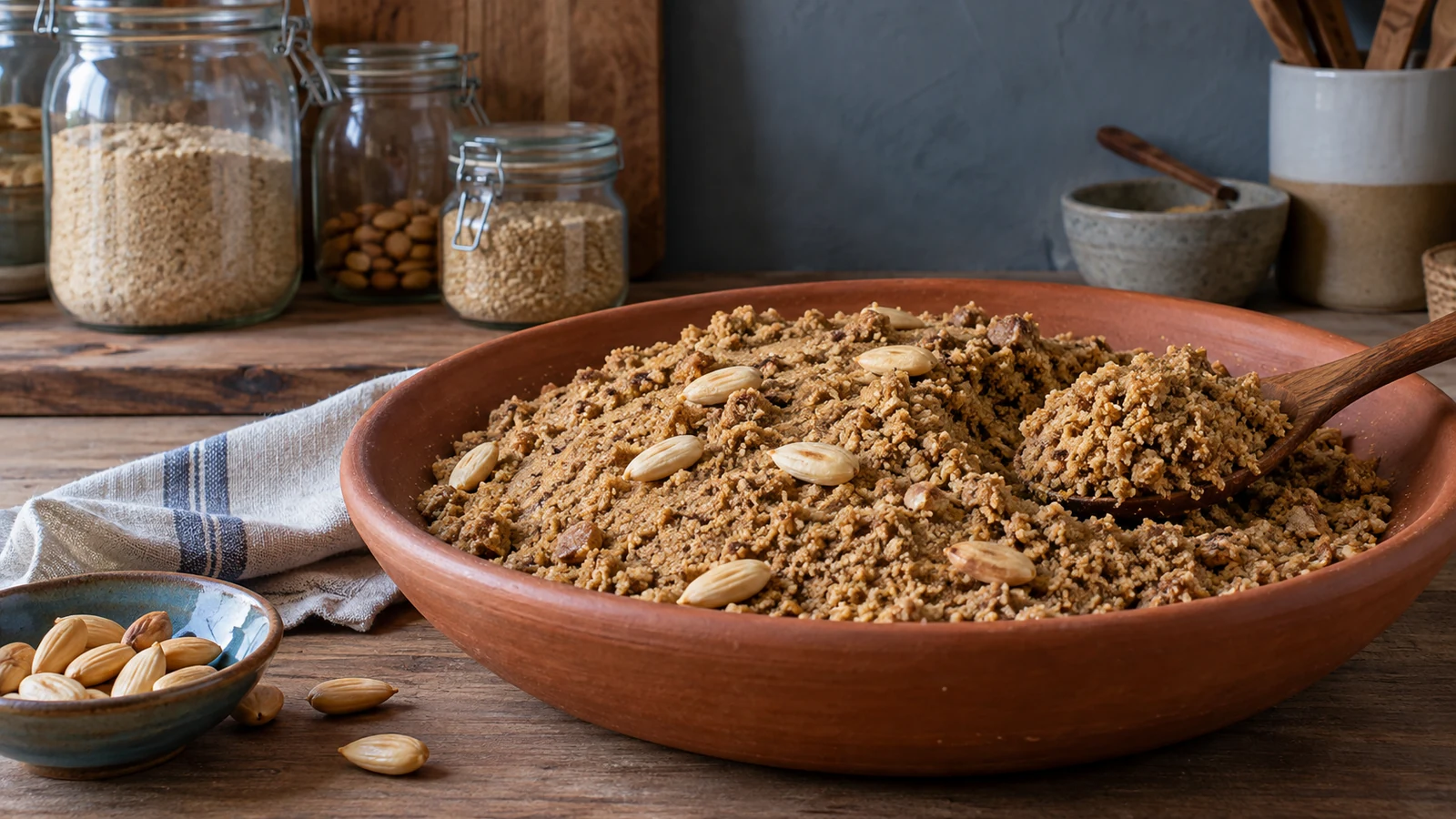
At its core are browned flour, toasted sesame and almonds, ground and blended with warm spice, then sweetened and bound until the mixture reaches the texture a household prefers. It can remain dry and sandy, or become moist enough to press into a mound or shape into small pieces. [1]
Sellou is also widely called sfouf. The name zmita is sometimes used around related mixtures, but it is not a perfectly interchangeable term everywhere; ingredient bases and local usage vary. [1]
The pleasure comes from what roasting does: flour loses its raw taste, sesame becomes nutty, almonds deepen, and the final mixture carries those roasted notes before sugar, honey, butter or spice add their own character.
Enter Moroccan food culture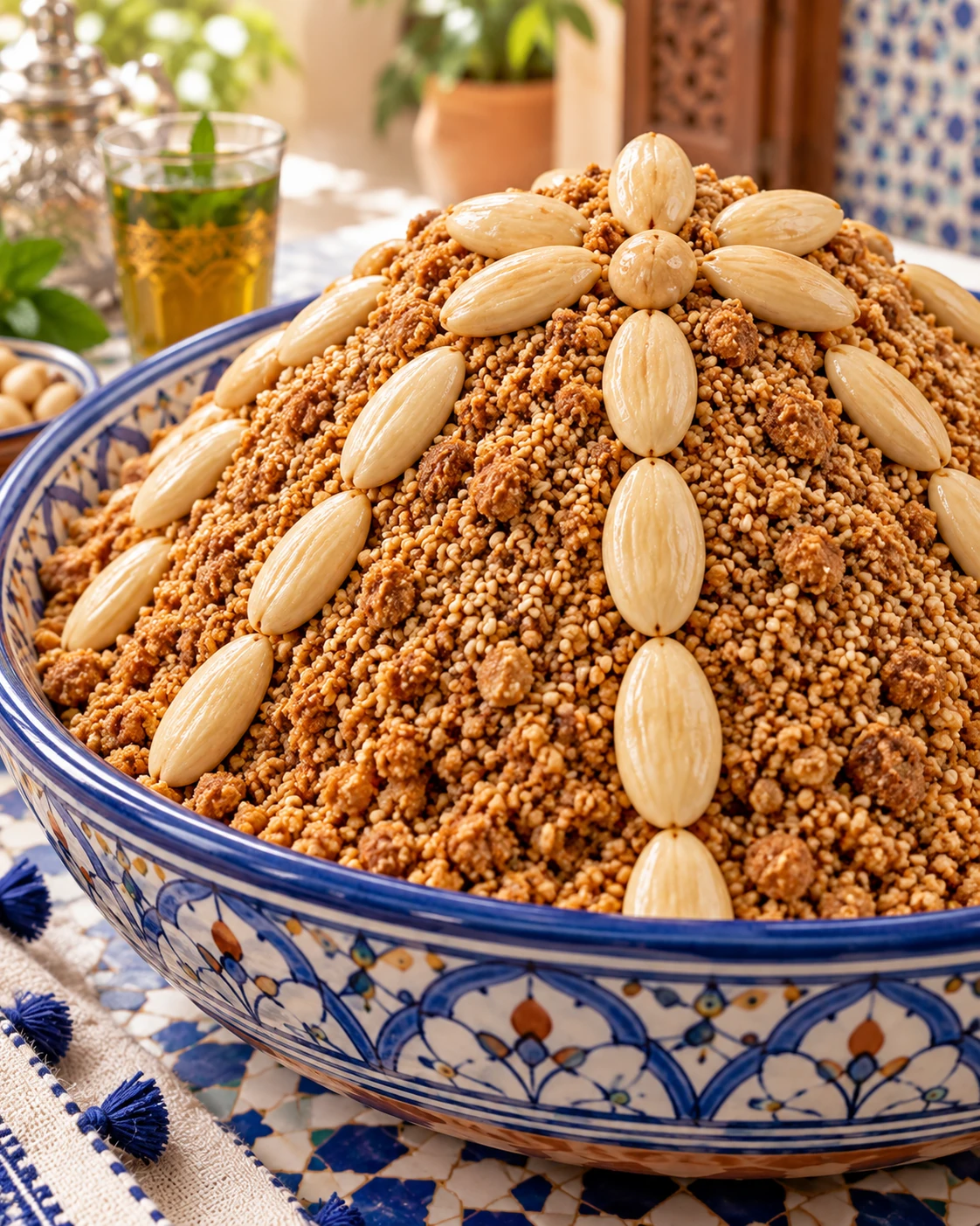
Common names; regional vocabulary is not perfectly uniform.
Roasted separately before the final mixture is built.
Family preference changes how much the mixture binds.
02 · Roots & living practice
Roasted flavours, shared occasions.
Sellou is deeply embedded in Moroccan Ramadan practice, yet its exact historical beginning is harder to pin down responsibly.
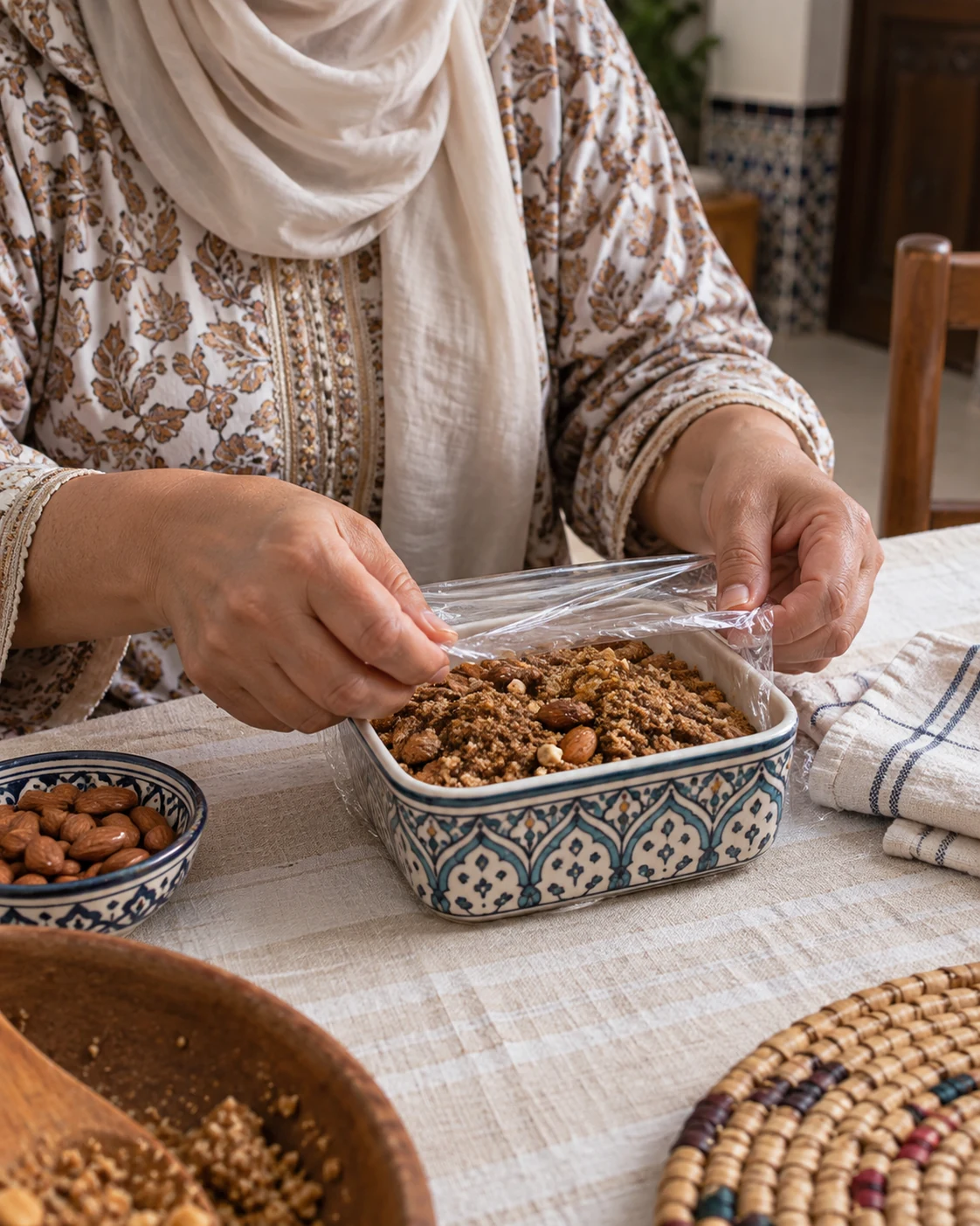
Contemporary Moroccan food sources consistently connect Sellou with Ramadan, when many households prepare a large batch before or during the month. Chebakia may be made in the same pre-Ramadan burst of kitchen work, sometimes with several relatives sharing the labour. [1] [2]
Sellou is also served for other special occasions. One well-documented household tradition is offering it around the birth of a baby; that should be understood as a widespread custom in some families, not a rule every Moroccan household follows. [1]
The preparation carries its history through skilled work: browning the flour, toasting sesame, grinding nuts and judging how much fat the mixture will absorb. Families pass on their preferred texture alongside the occasions when they serve it.
Explore Taste Morocco03 · The method behind the flavour
Toast.
Grind. Bind.
Sellou’s technique is less about one dramatic cooking moment than a sequence of controlled preparations.
The flour, sesame and almonds are handled separately because each develops flavour at a different rate. Only after cooling and grinding are they brought together. [1]
Roast each foundation properly
Flour is browned until its raw taste is gone; sesame is toasted until nutty; almonds are commonly fried or toasted before grinding. Under-roasting leaves the mixture flat, while burning adds bitterness.
Grinding controls the mouthfeel
Fine grinding releases oil from sesame and almonds and helps the mixture bind. Some cooks reserve a portion more coarsely ground or whole for crunch. A fully smooth paste is not the only desirable result.
Binding is gradual
Clarified butter or other fats, honey and/or powdered sugar are worked in according to the household formula. The target may be sandy and spoonable or moist enough to hold a shape. [1]
Exact weights, roasting times, grind sizes and troubleshooting stay with the recipe guide.
04 · Family preference in the bowl
One idea.
Different textures.
Sellou varies most visibly in texture, sweetness, nut treatment and presentation. These are family choices, not authenticity tests.
The photographs below show two ends of a broad spectrum rather than two official categories.
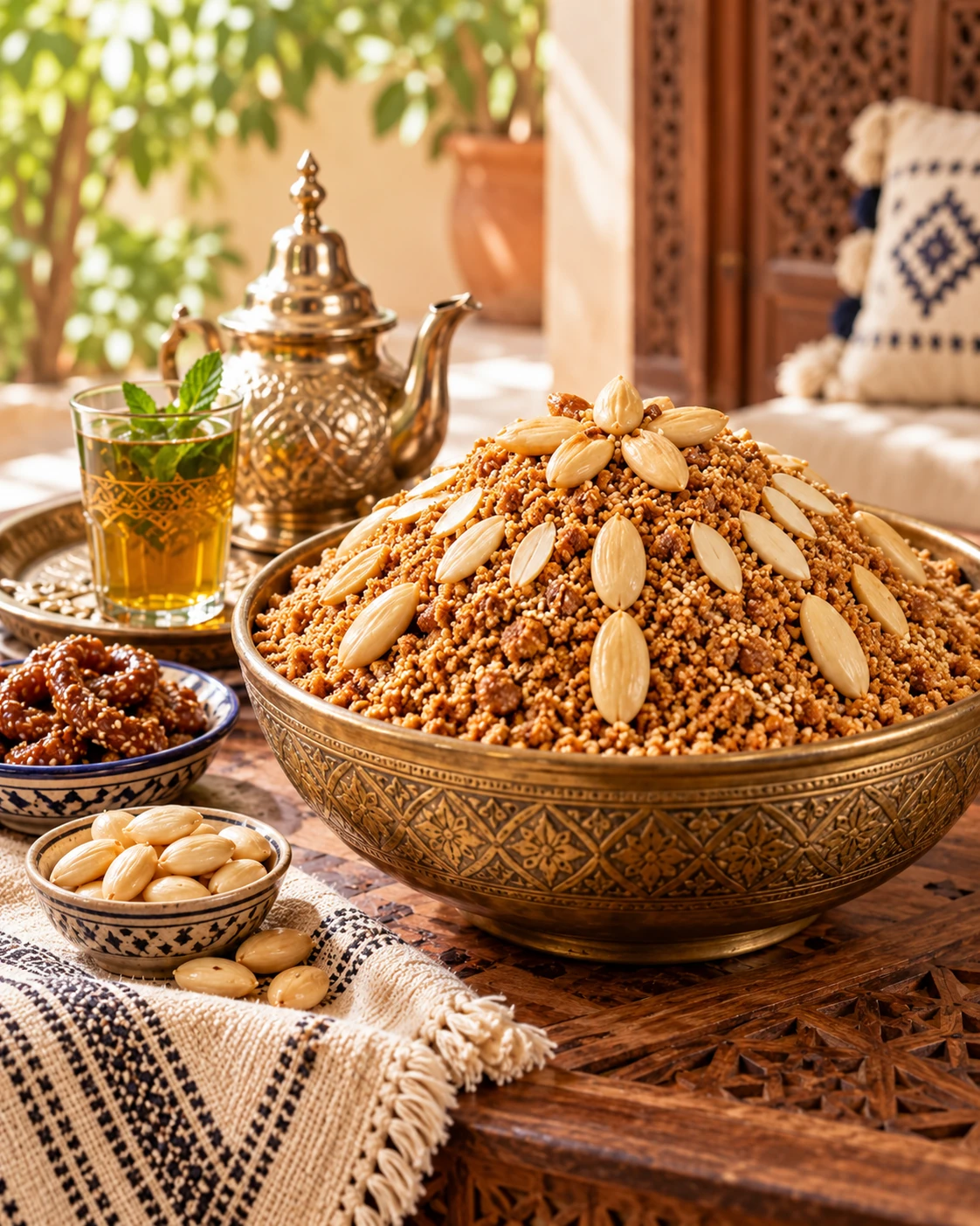
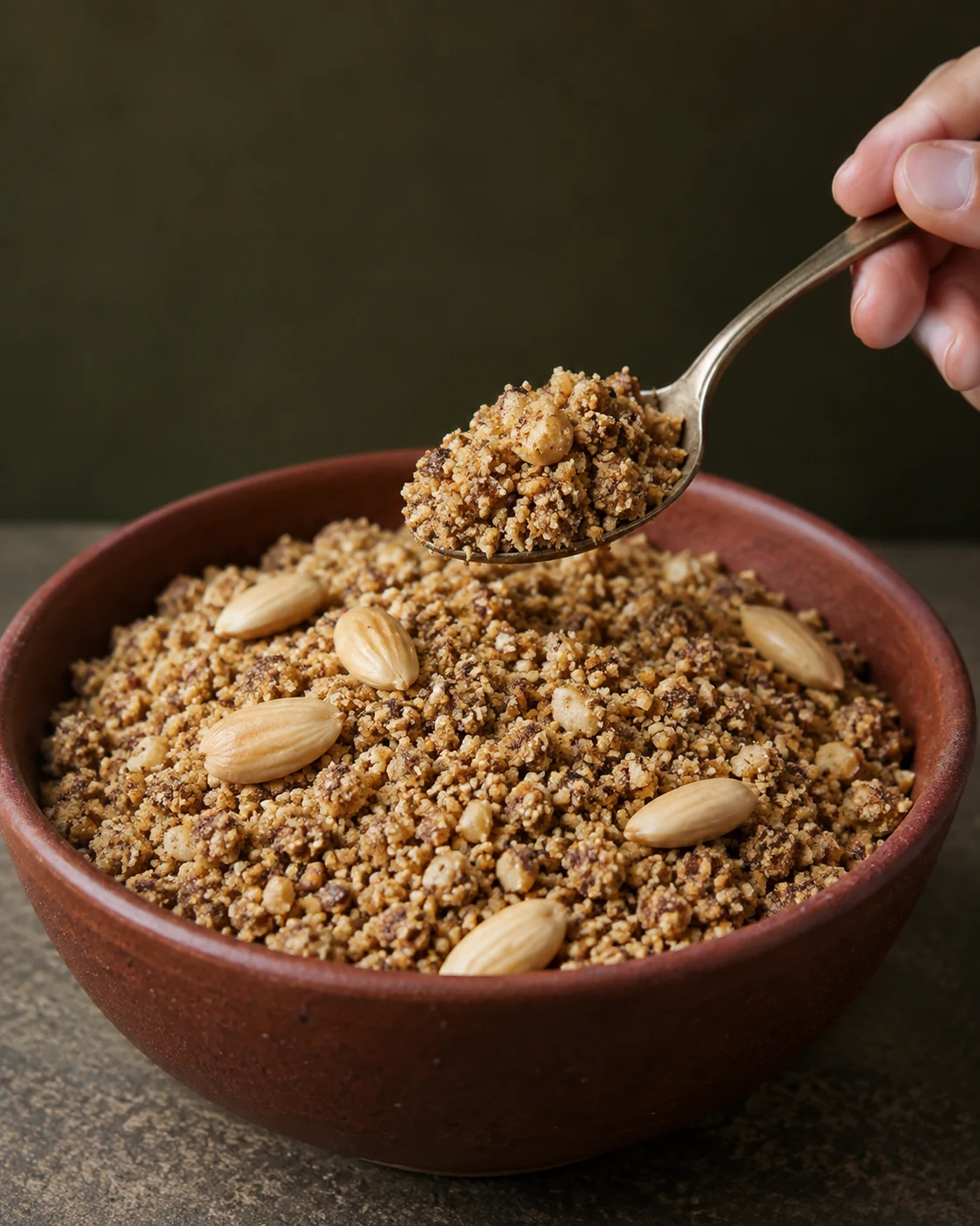
A sandy spoonful
Using less binder leaves the grains and nut crumbs more distinct. The mixture can be heaped rather than moulded, with a dry, friable texture that breaks apart easily on the spoon.
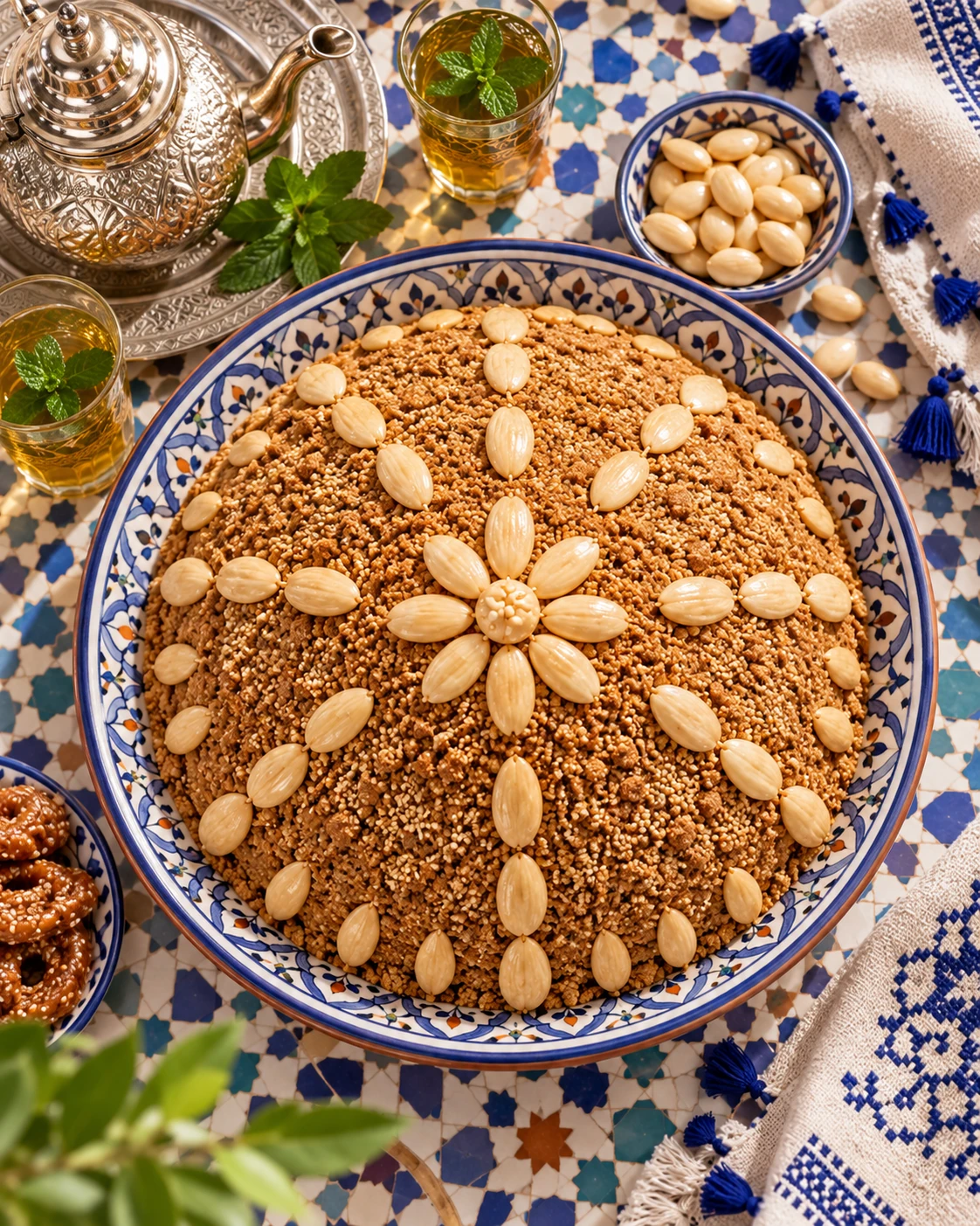
Ready to shape
A little more fat or honey can make Sellou pliable enough to press into a mound, mould or bite-size shape. Texture still matters: it should remain recognisably granular rather than becoming a smooth paste. [1]
Sweetening is not one fixed formula.
Powdered sugar, honey or a combination appear in published and family recipes. Honey also adds moisture, so changing the sweetener can alter texture as well as flavour. [1]
Grinding can leave a little crunch.
Some cooks grind almost everything finely; others reserve sesame or almonds for a more obvious bite. Contemporary family formulas also vary the spice mix, including anise, cinnamon and sometimes fennel or mastic. [4]
05 · The flavour architecture
Roasting first.
Then balance.
Sellou’s ingredients are familiar. What makes them distinctive is the way they are browned, toasted, ground and combined.
The mixture should taste nutty before it tastes merely sweet.
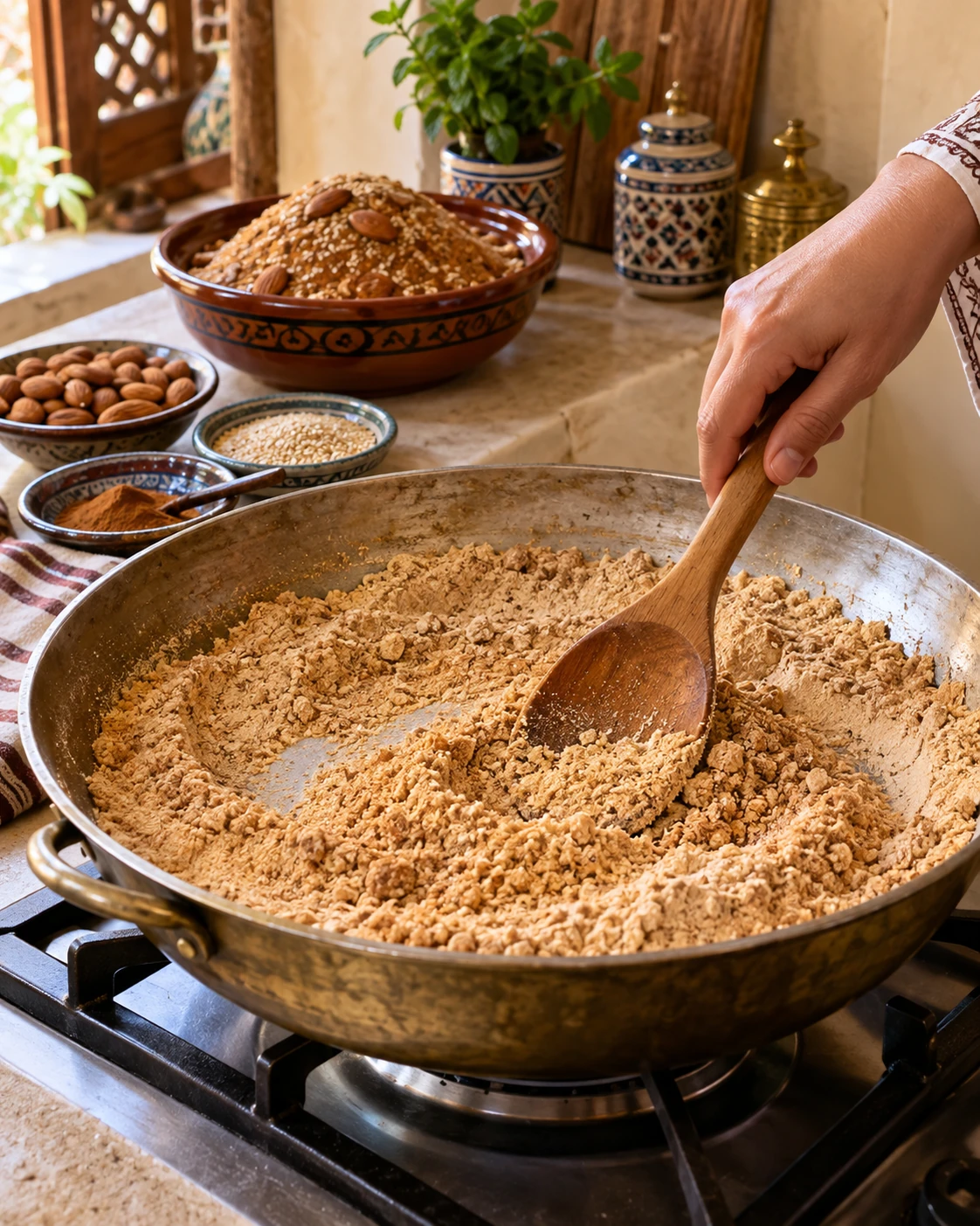
Browned flour
The roasted backbone.
Flour is cooked until its raw character disappears and a warm toasted aroma develops. Even colour matters more than pushing it dark.
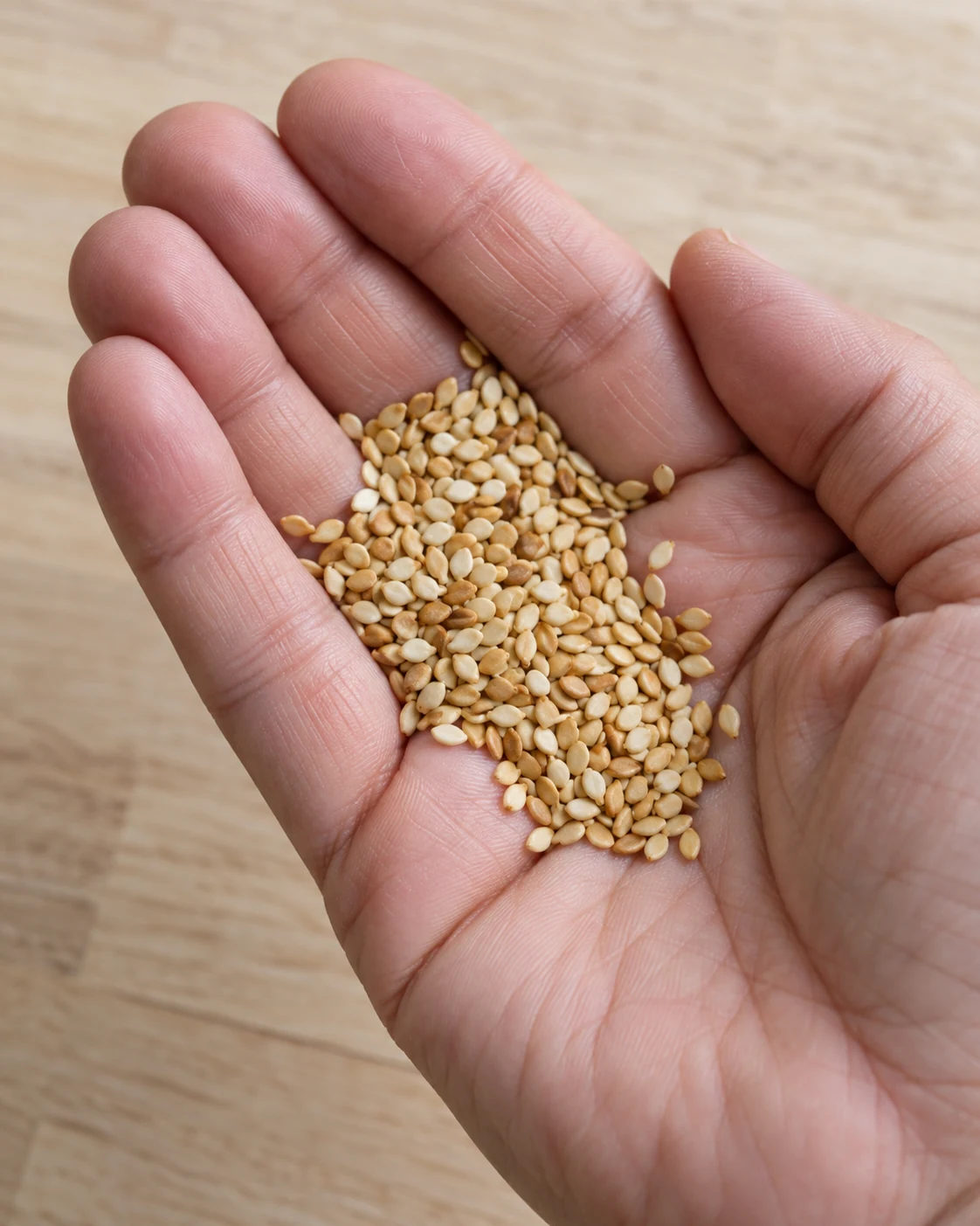
Toasted sesame
Nutty, fragrant, structural.
Toasting deepens the seed’s flavour. Grinding part of the sesame releases oils that help the mixture feel rich without needing to become greasy.
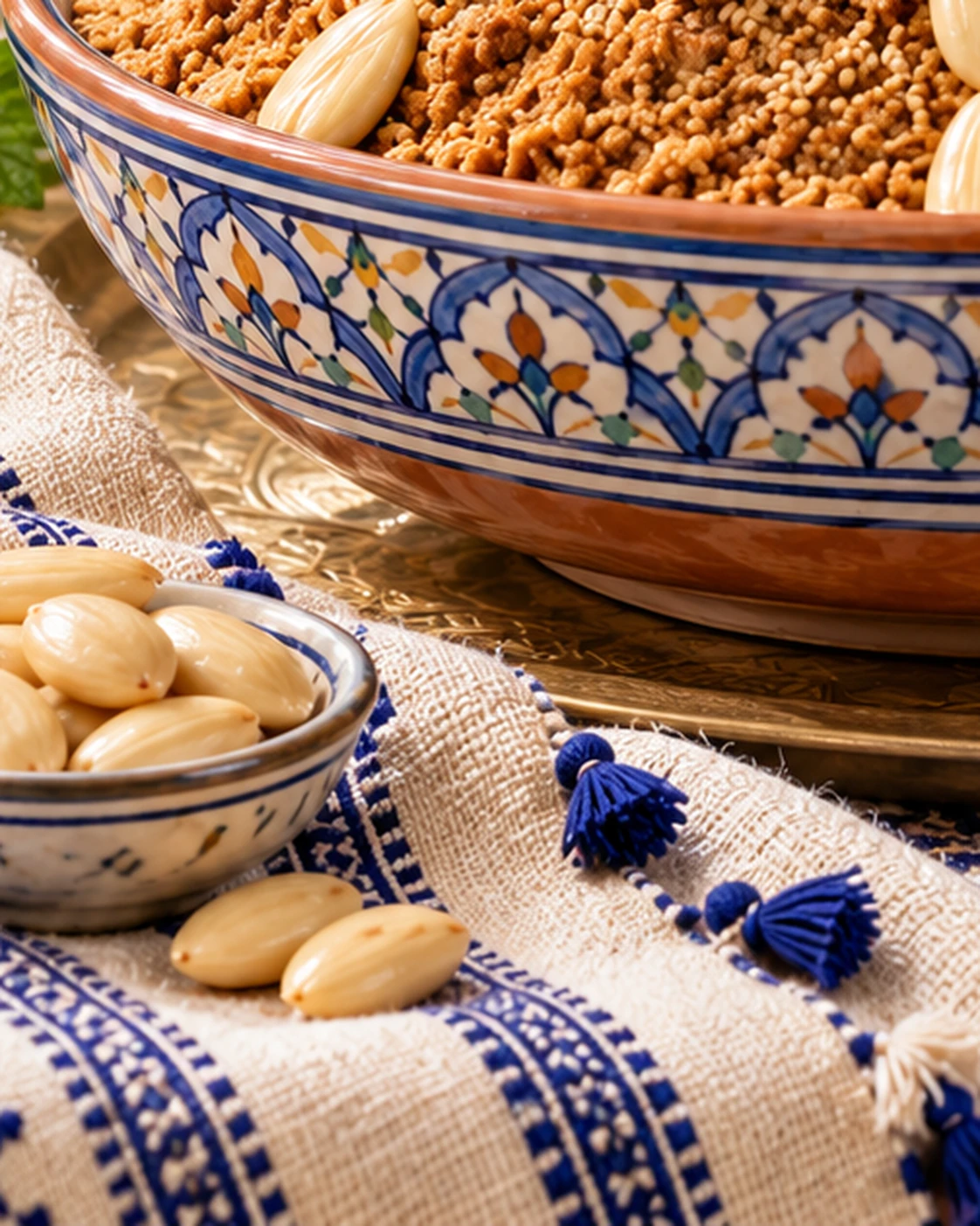
Almonds
Body, richness & crunch.
Fried or toasted almonds are commonly ground into the mixture, with whole or coarser pieces sometimes reserved for texture and decoration.
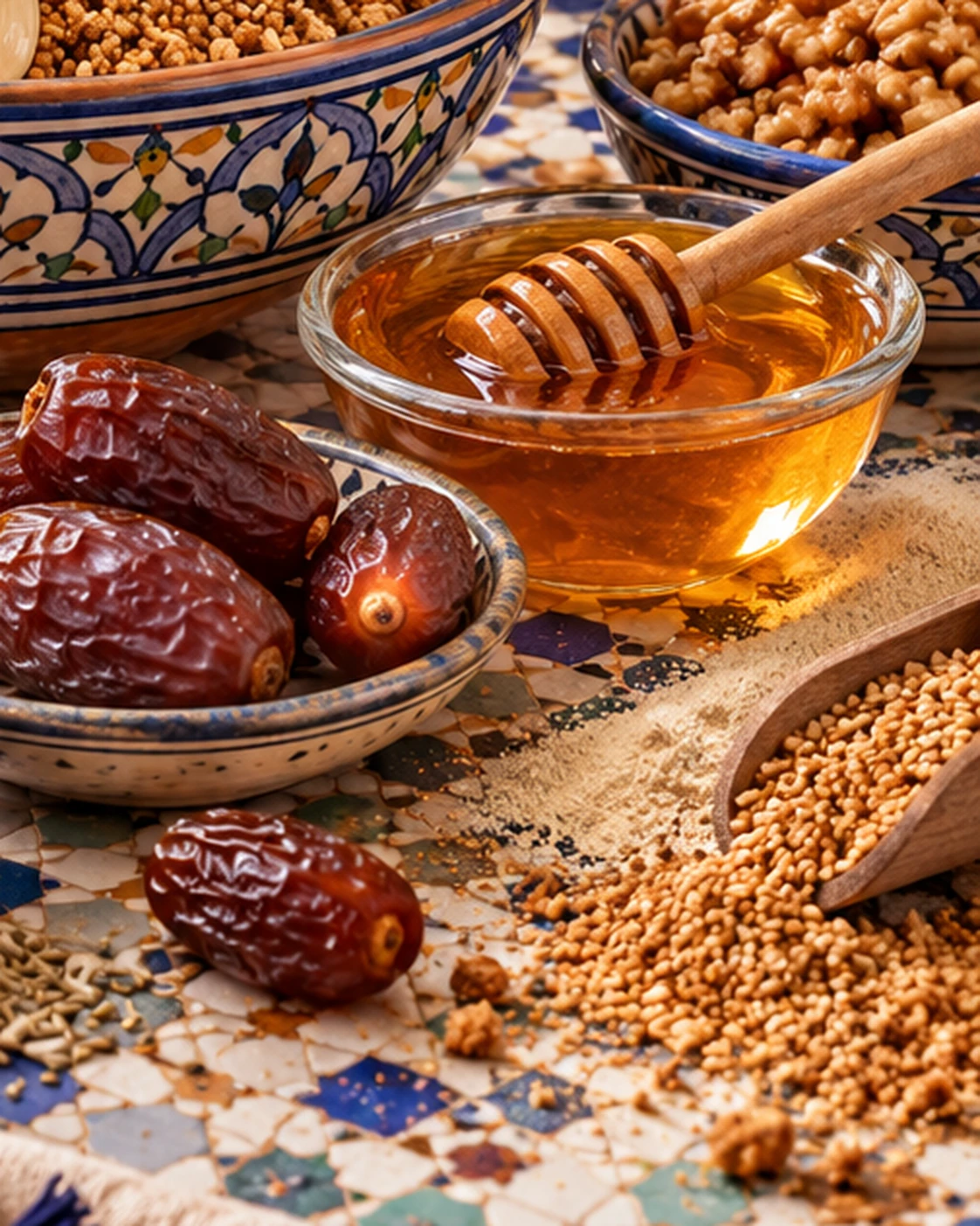
Sweetness & binding
Honey, sugar, butter — in balance.
Recipes differ in how sweetness and fat are supplied. Their proportions change not just sweetness but how loose, moist or packable the final mixture becomes. [1]
Explore the four foundations
CINNAMON · ANISE · OPTIONAL AROMATICS
Warmth without
spice overload.
Sellou is fragrant, but it is not a generic “Moroccan spice mix”.
Cinnamon and anise are recurring flavourings in established recipes. Other family formulas may add fennel, mastic or other aromatics. The useful rule is restraint: spice should frame the roasted sesame and almonds, not erase them. [1] [4]
Roasting creates the depth. Spice gives it direction.
Cinnamon rounds the roasted notes.
It contributes warmth rather than heat, particularly when the flour and sesame have been evenly toasted.
Anise brings a distinct aromatic lift.
Its presence varies in strength; it should be noticeable without making every bite taste only of anise.
Optional additions stay optional.
Fennel or mastic appear in some formulas. They are family choices, not compulsory evidence of authenticity.

06 · Occasion, household & time
A recipe shaped
by the people making it.
Ramadan gives Sellou its strongest public moment. Family memory gives it many forms.
Because the components can be prepared in stages and the final mixture is often made in quantity, Sellou suits a month in which households plan ahead for evening tables and visitors. That does not make it exclusively a Ramadan food.
Special-occasion uses overlap rather than obey hard regional borders. Published household accounts also connect Sellou with celebrations around a new baby, while other families reserve their own formula for guests, holidays or simply the season. [1]
Ramadan kitchens
Large-batch preparation reflects planning as much as celebration.
Explore Moroccan food culture ↗A new baby
Some families serve Sellou as part of the food offered around childbirth and visiting.
Explore Moroccan stories ↗Family formula
Texture, sweetness and the balance of sesame to almonds often tell you more about a household than a city label does.
Continue through Taste ↗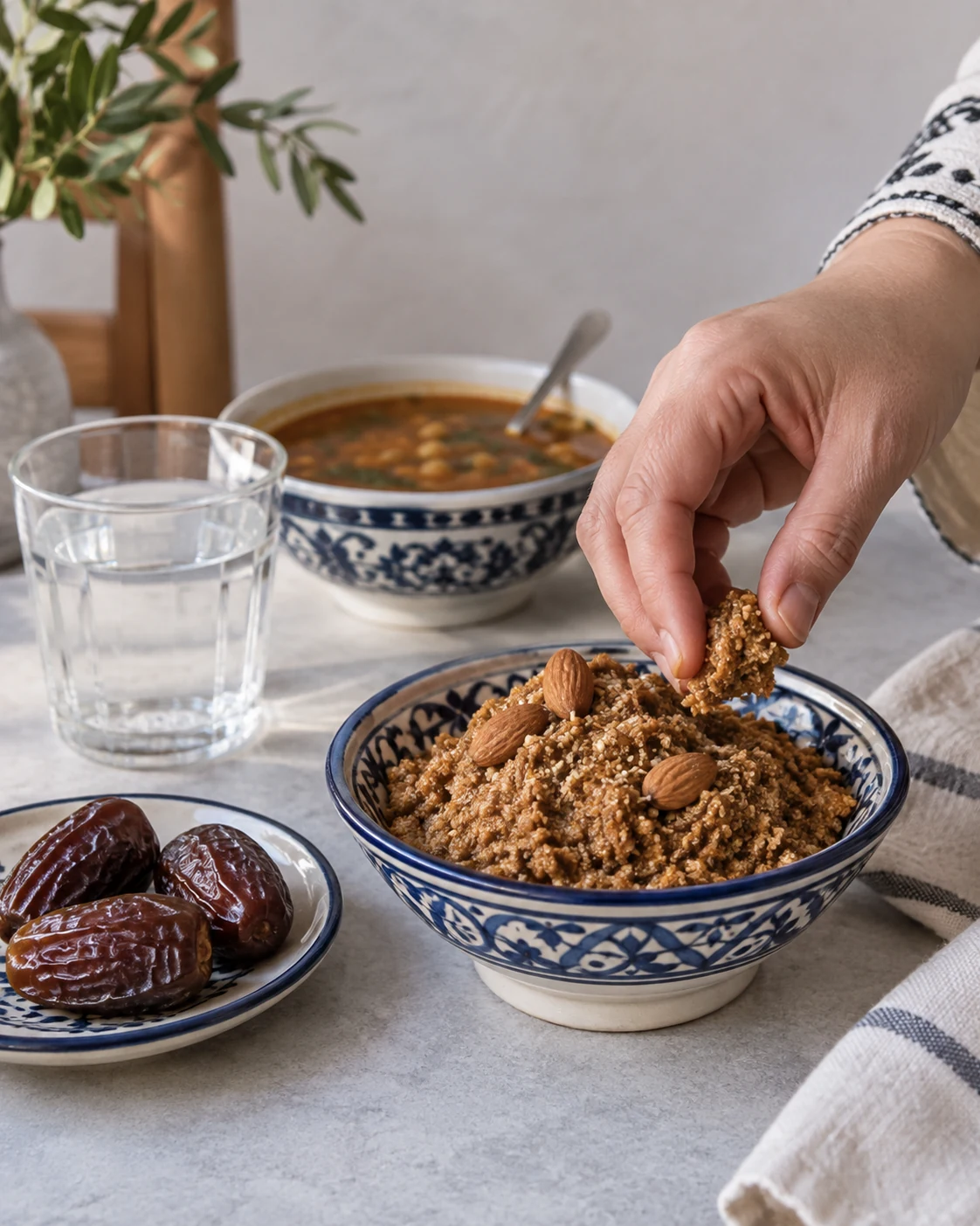
07 · Serving & sharing
Small portions.
Deep flavour.
Sellou is concentrated: roasted grain, seeds, nuts, sweetness and fat in one spoonful.
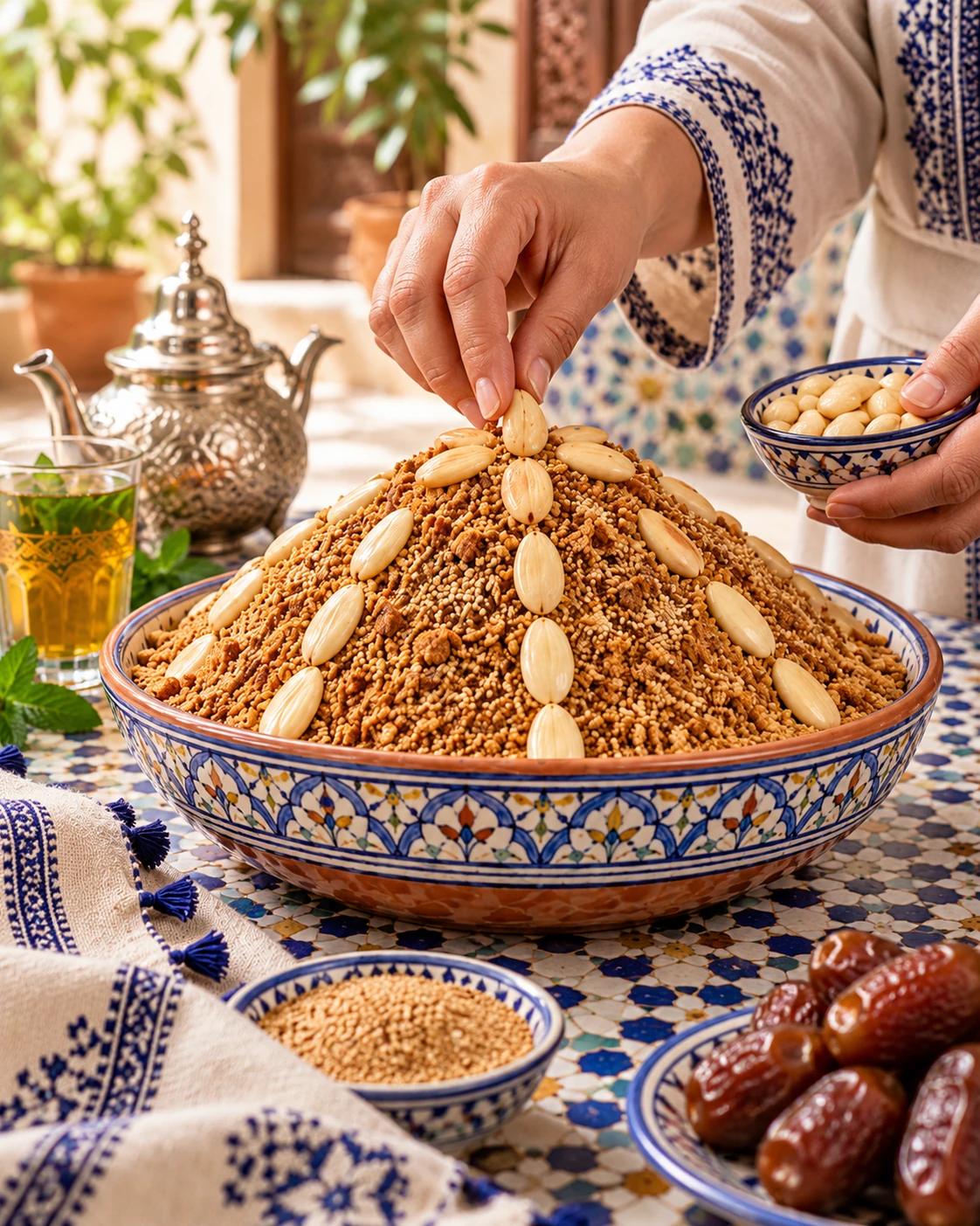
It is commonly served from a mound or bowl, decorated with almonds or sesame, and eaten in modest portions. A glass of mint tea can make a natural companion, particularly when Sellou appears as part of a larger hospitality spread.
The useful distinction is simple: Sellou belongs on the Ramadan table; it is not mixed into harira, and it is not the same preparation as chebakia. Each contributes a different texture and rhythm to the meal.
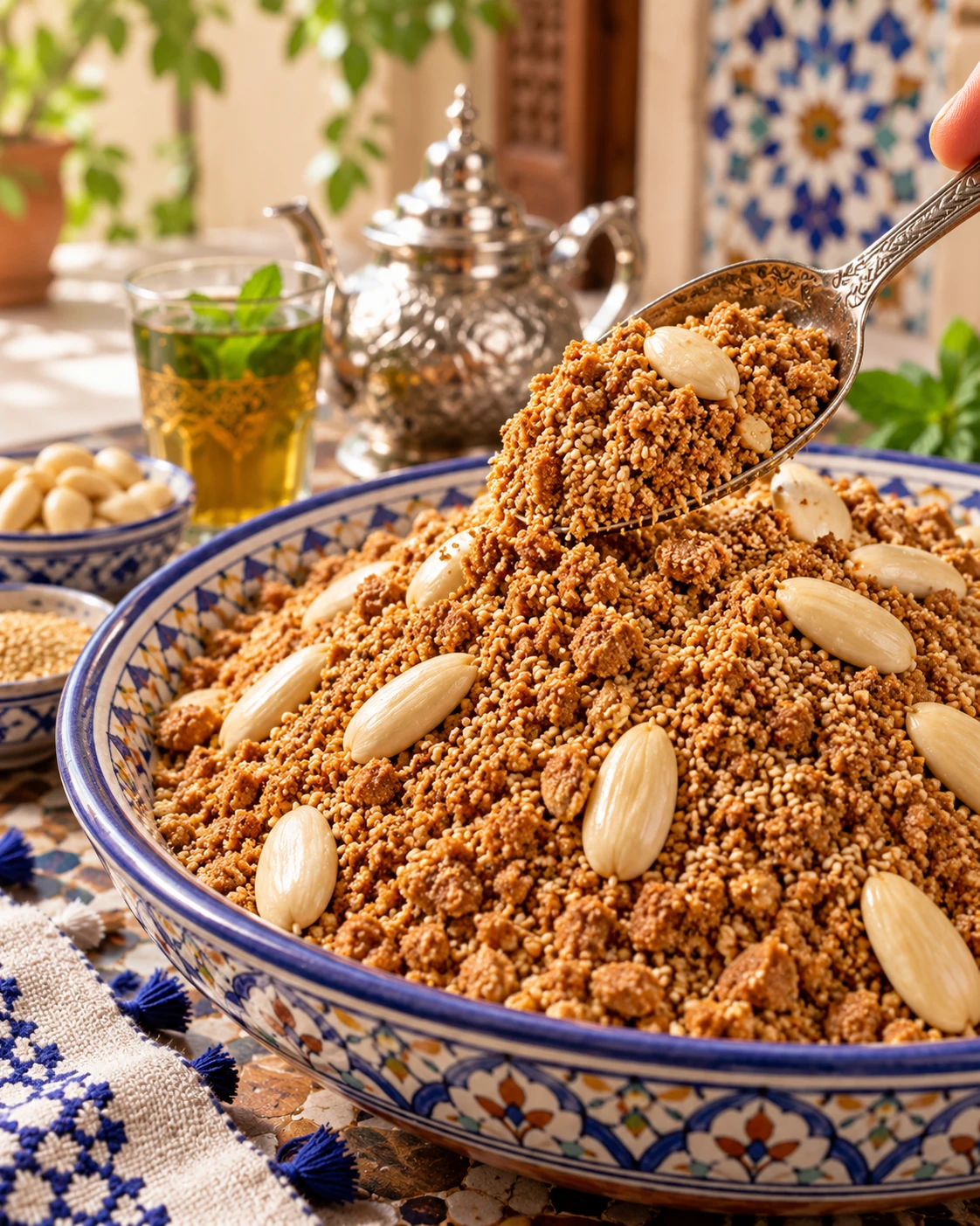
Mint tea, not a rule.
Tea works well beside Sellou because its freshness and warmth contrast with the dense nut-and-seed mixture. It is a familiar hospitality pairing, not a compulsory serving instruction.
On a generous table, water, coffee or other drinks may be present as well. The page describes a common pairing without turning it into a national rule.
A mound, a mould, a small bite.
Loose Sellou can be heaped into a cone or rounded mound and decorated with almonds. A more cohesive mixture can be pressed or shaped. Presentation changes the look, but the roasted flavour structure remains the point. [1]
Why the crumbs matter.
Sellou should not eat like cake, halva or nut butter. Even a moist version keeps a crumbly, granular identity. The best texture lets roasted flour and seeds remain perceptible while the binder quietly holds the mixture together.
Prepared ahead, offered with care.
Large batches make sense when a household expects repeated evening meals and visitors.
08 · Batch work & hand judgement
The decoration is easy.
The roast is the craft.
Sellou rewards repetition, cooling, sifting and careful grinding more than showy finishing.
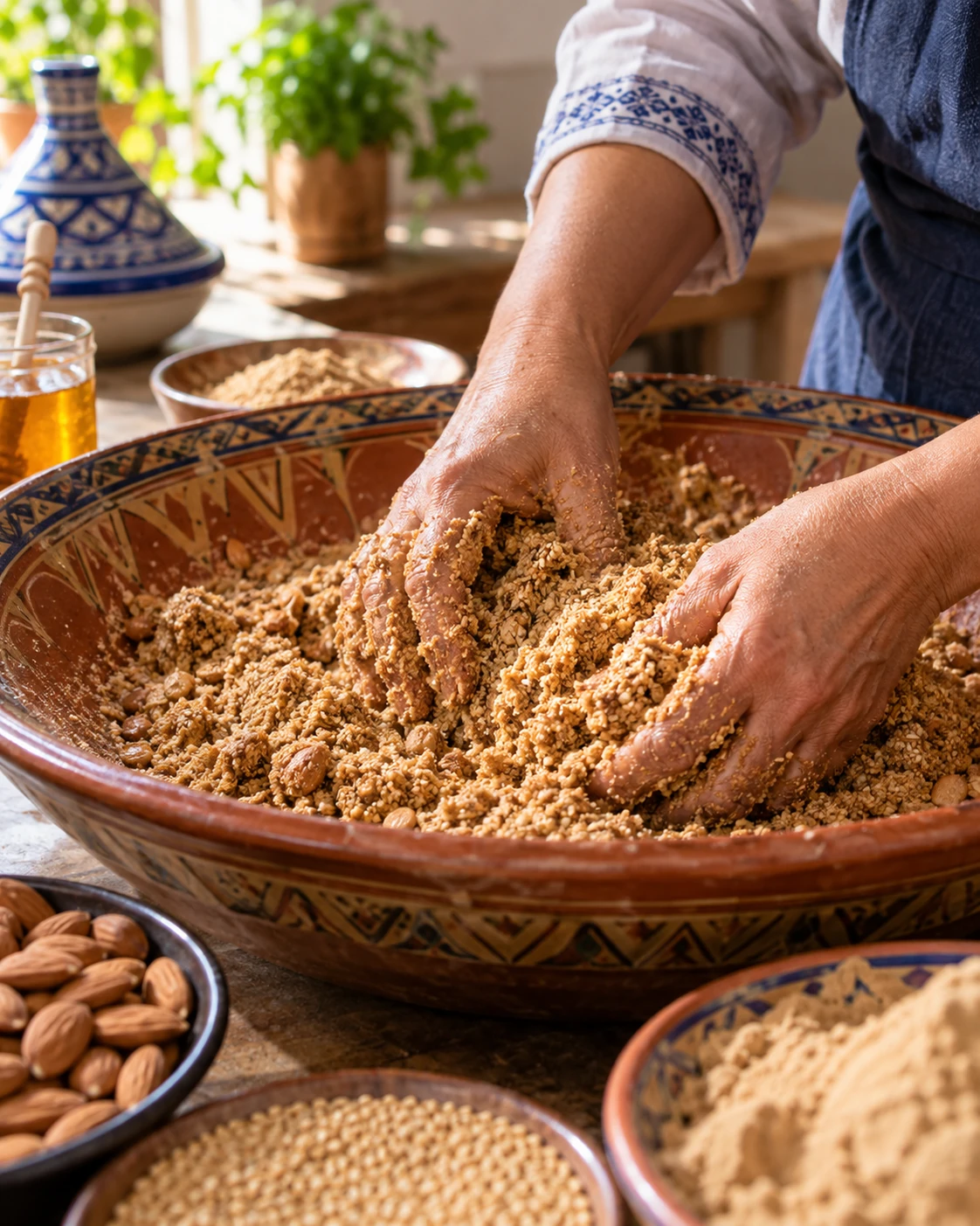
A large batch means several separate jobs: browning flour evenly, cleaning and toasting sesame, preparing almonds, cooling everything thoroughly, grinding to the intended texture and finally mixing a quantity large enough to test the arms as well as the recipe.
That is why family collaboration appears so naturally around pre-Ramadan preparation. Several hands can divide work without changing the final aim: an even mixture in which no single ingredient tastes raw, burnt or disproportionately sweet. [2]
The almond decoration comes last. It can be simple or elaborate; it is presentation, not the definition of Sellou.
Explore the guide collection09 · Useful questions
Good questions.
Clear answers.
Names, texture and technique are where most confusion begins.
Are Sellou and sfouf the same thing?
They are widely used as alternate names for this Moroccan confection. The term zmita can overlap in everyday usage but may also refer to related grain-and-seed mixtures with a different ingredient base. [1]
Why is the flour browned first?
Browning removes the raw flour taste and creates a toasted flavour that is foundational to Sellou. The aim is even roasting, not maximum darkness.
Is Sellou supposed to be dry?
It can be. Some households prefer a loose, sandy texture; others add enough binder to make it moist and packable. Published Moroccan recipes explicitly acknowledge that range. [1]
Is Sellou only for Ramadan?
No. Ramadan is its strongest contemporary association, but Sellou is also prepared for other special occasions, including in some families around the birth of a baby. [1]
Does authentic Sellou have to use honey?
No. Honey, powdered sugar or combinations appear in established recipes. The choice affects both sweetness and moisture. [1]
 EXOTIC MOROCCOTASTE · THE GUIDE COLLECTIONSellouIngredients, technique
and the Moroccan table
From the story to your kitchen
Keep the flavour.
Go a little deeper.
Toasted flour, sesame and almonds in a distinctive sweet mixture.
Explore the Exotic Morocco guide collection for a closer look at ingredients, kitchen knowledge and the culture around the table.
- Understand the ingredients and their roles
- Recognise the techniques and textures that matter
- Bring context and confidence to the way you cook and serve
Continue tasting Morocco
Follow the
table outward.
Another dish, another technique, another way into the Moroccan kitchen.
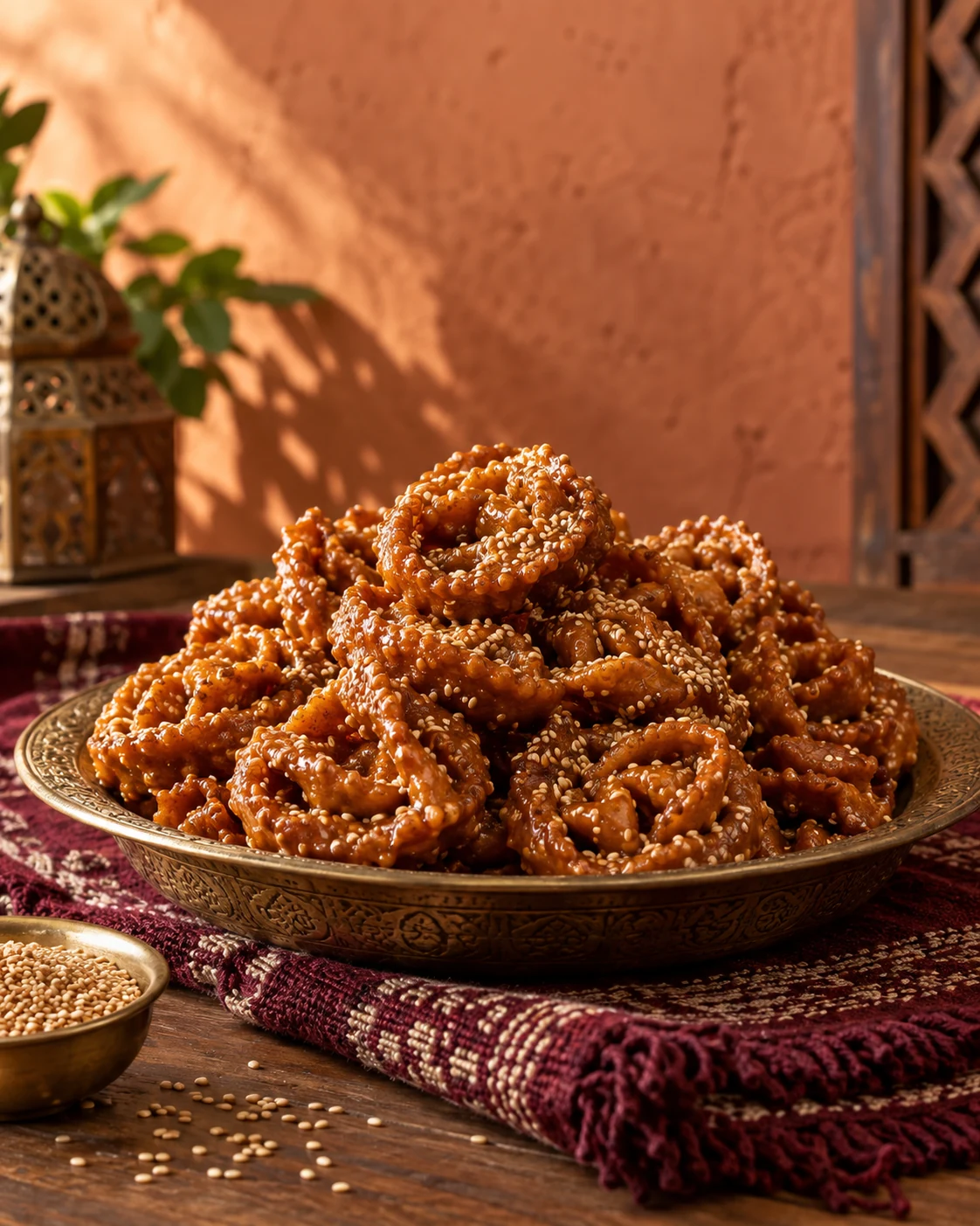
Chebakia
Folded sesame pastry finished with honey.
Explore the story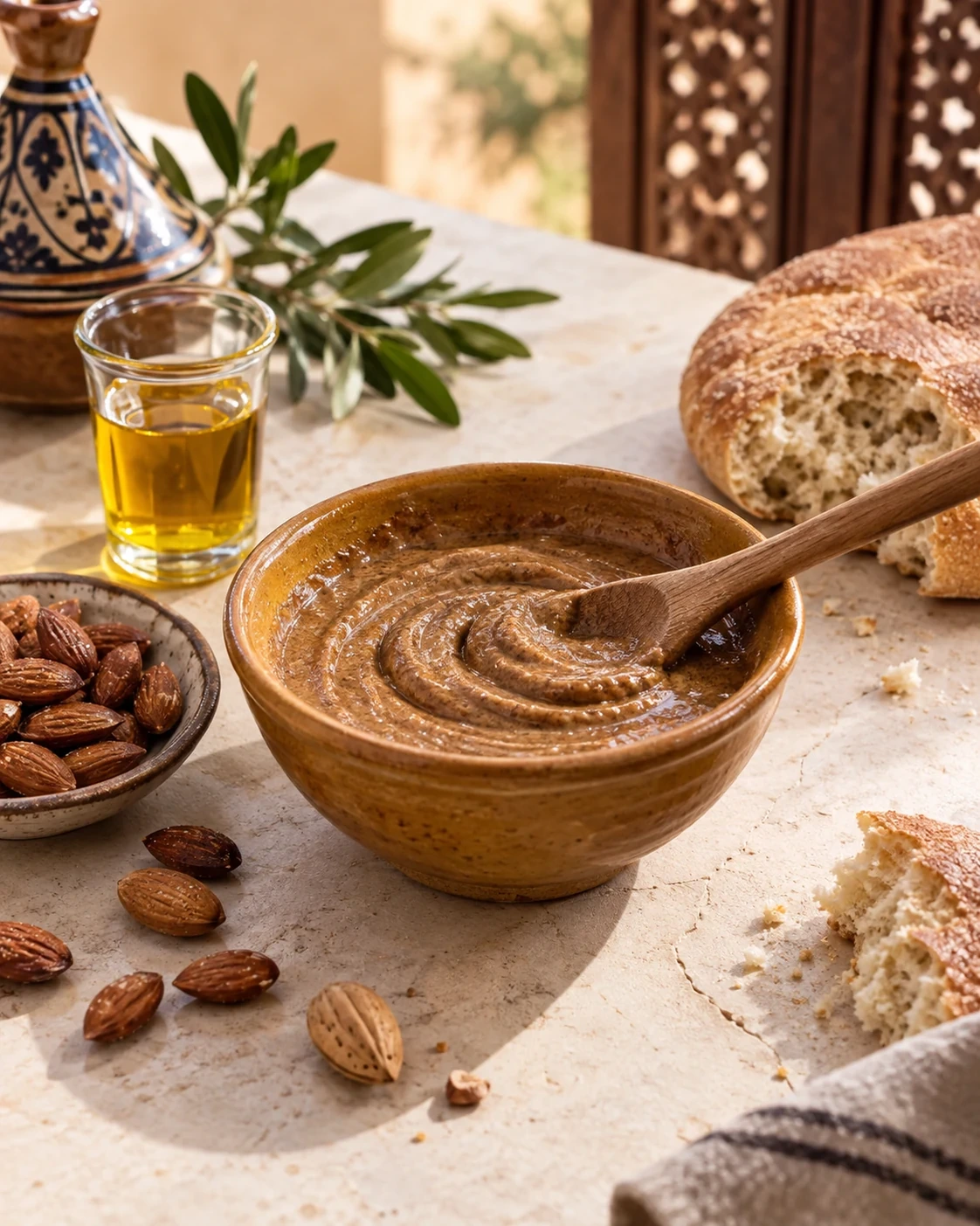
Amlou
Roasted almonds, culinary argan oil and honey from the southwest.
Explore the story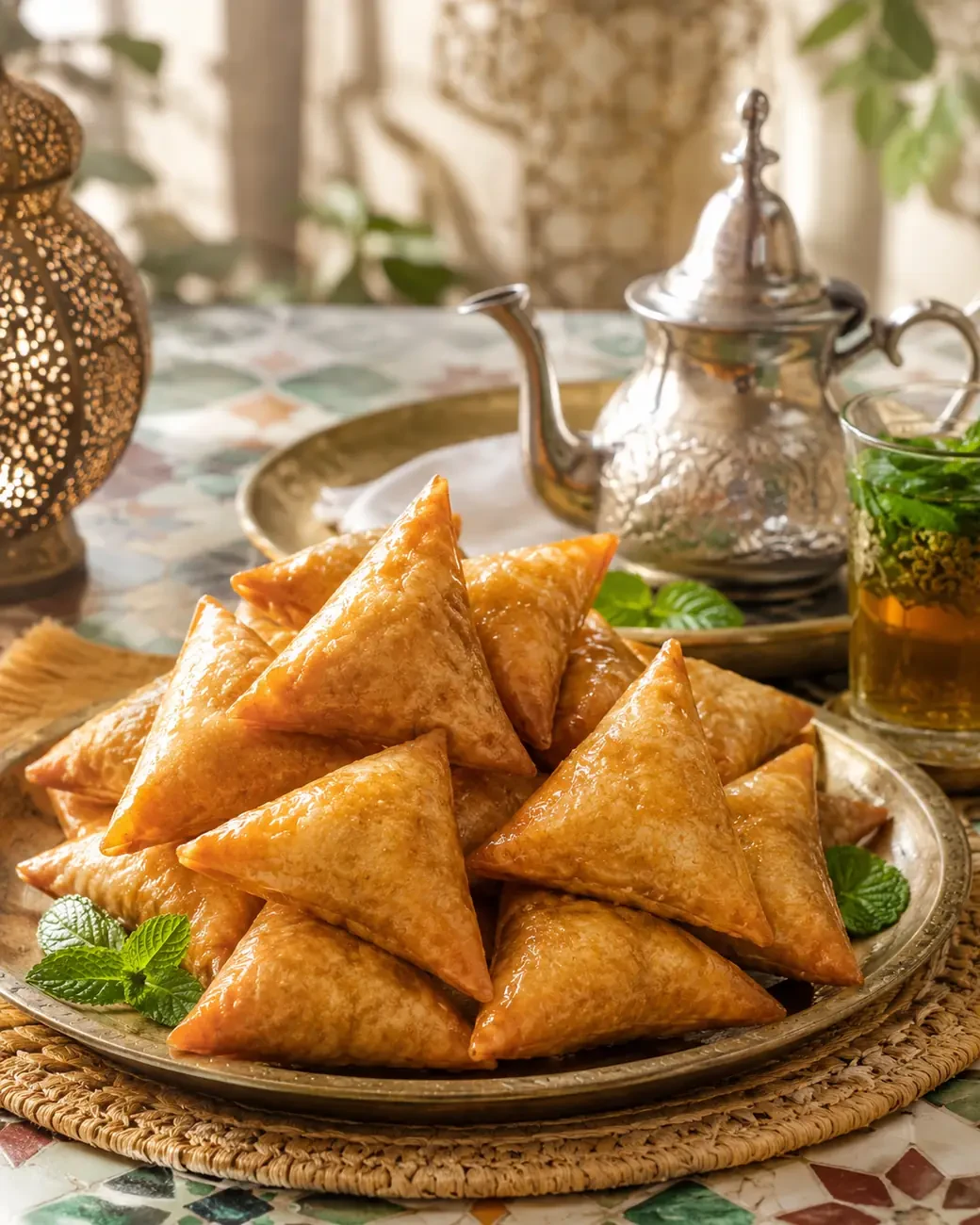
Briouats
Small folded pastries, with both savoury and sweet possibilities.
Explore the story
Moroccan Mint Tea
Green tea, fresh herbs and the time given to a guest.
Explore the story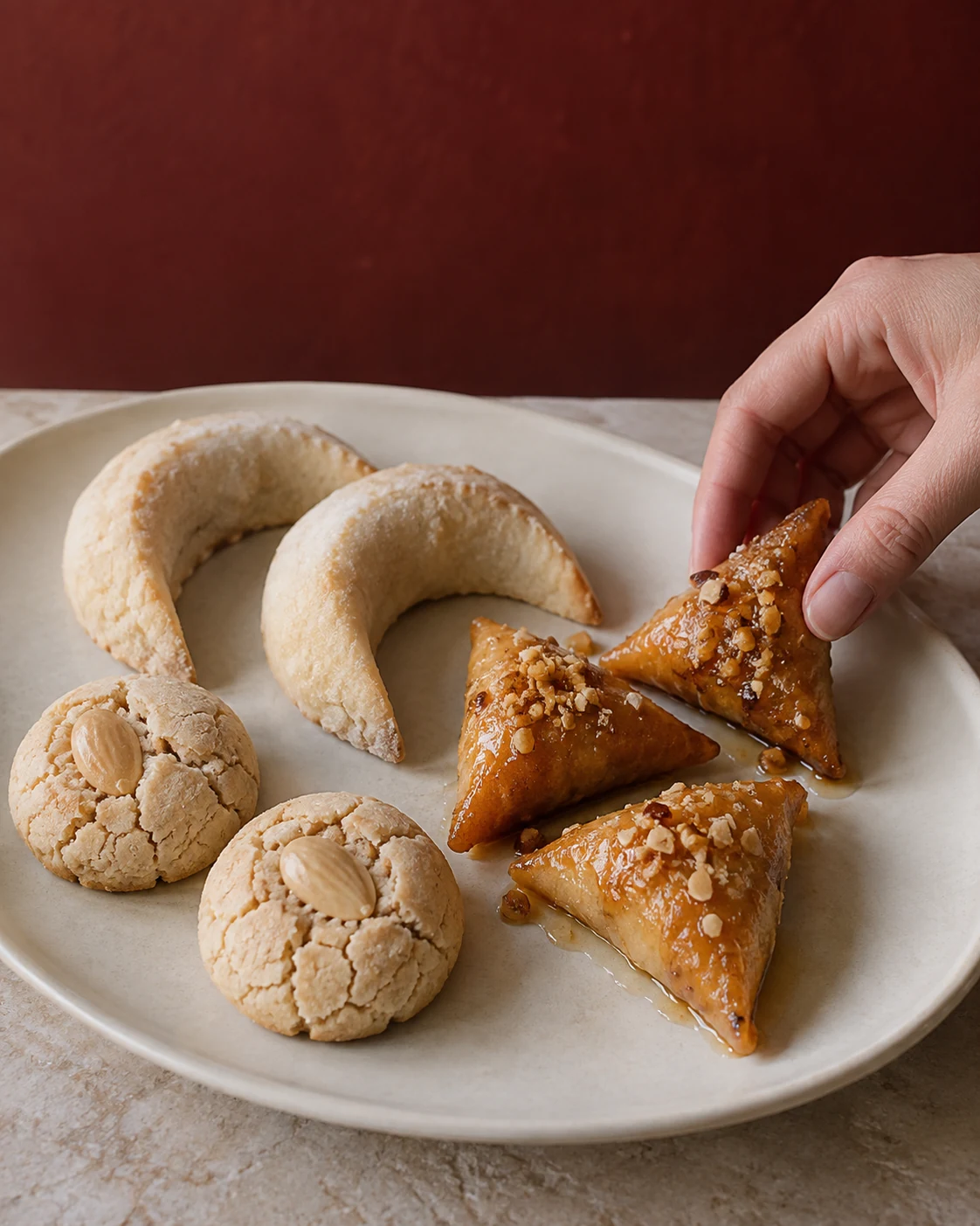
Sweets & Pastries
Almonds, sesame, pastry and the work of the sweet kitchen.
Explore the story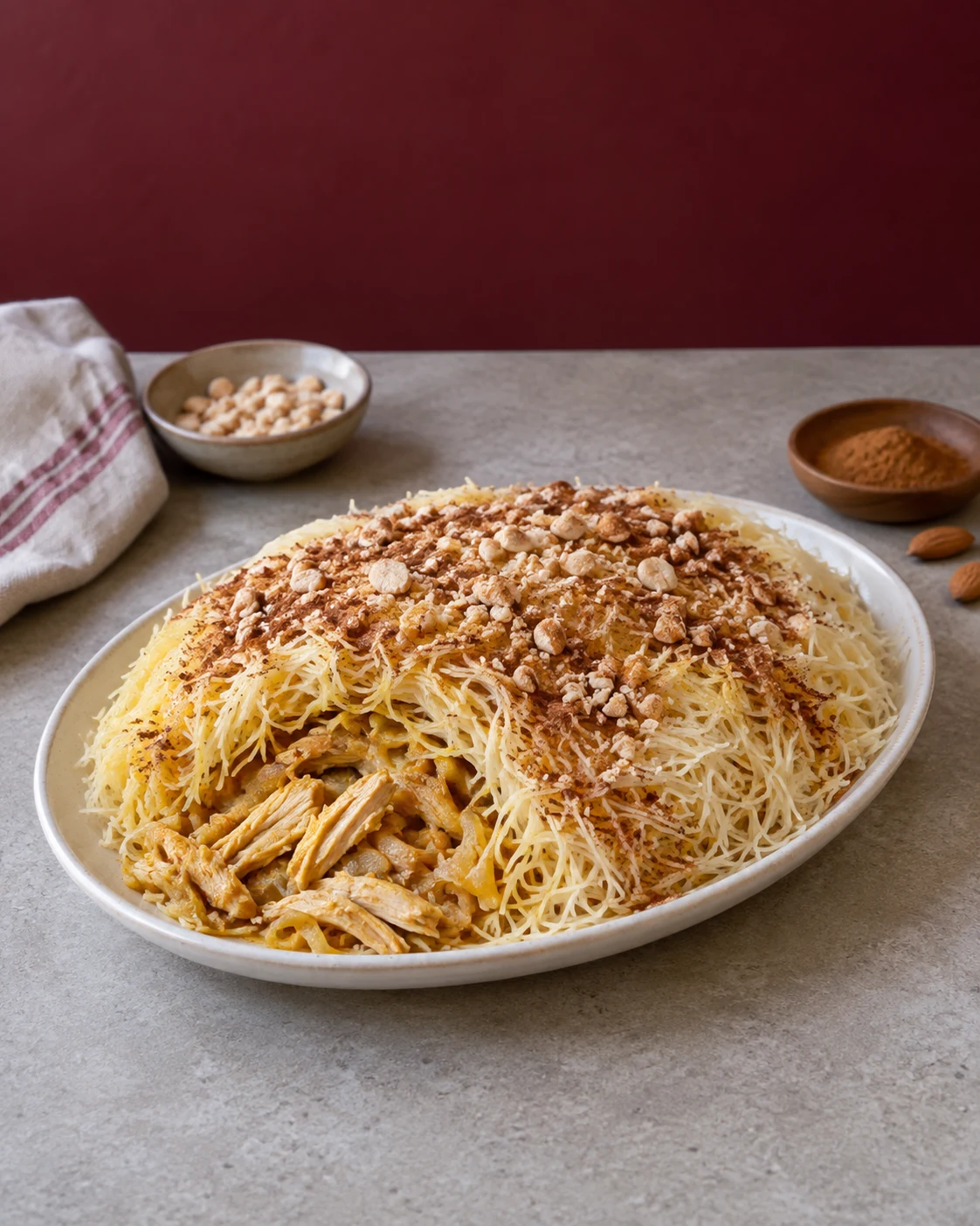
Seffa
Steamed vermicelli or couscous, almonds and sweet aromatics.
Explore the storySources & editorial notes
Photography combines existing Exotic Morocco assets and generated editorial illustrations. These images do not document a named person, household or historical event.
- Christine Benlafquih · Taste of Maroc — Sellou Recipe: Sfouf or Zmita — core ingredients, browned flour, toasted sesame, almond preparation, texture spectrum, Ramadan association, birth celebrations and family variation.
- Christine Benlafquih · Taste of Maroc — Chebakia — household pre-Ramadan batch preparation in which relatives may make chebakia and Sellou together.
- Morocco World News · Sellou and Ramadan — contemporary Ramadan prominence and examples of regional naming. Its precise medieval-origin narrative is not adopted here as settled history.
- Siham Daily · Sfouf / Sellou — a contemporary family-style formula illustrating fennel, anise and household variation; used as an example, not a national standard.
EXOTIC MOROCCO Places. People. The pleasure of knowing more.Back to top ↑