Visit / Place · Rabat · Bou Regreg and Atlantic edge
Kasbah of the Udayas A historic Rabat citadel of stone, river light, blue-white lanes and Atlantic air
The Kasbah of the Udayas is one of Rabat's clearest thresholds: fortified wall, ceremonial gate, residential quarter, garden calm and river view gathered above the Bou Regreg.
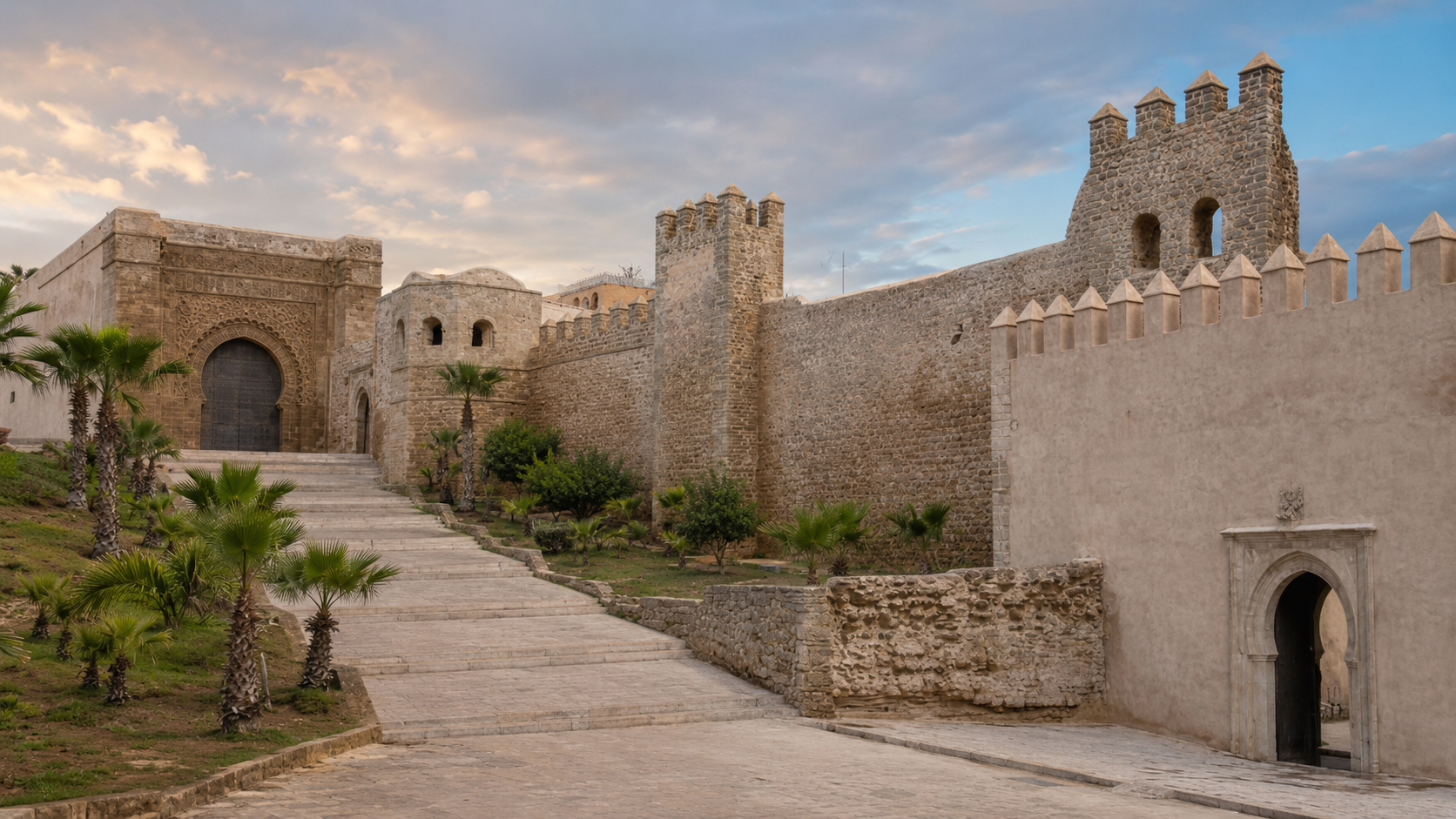
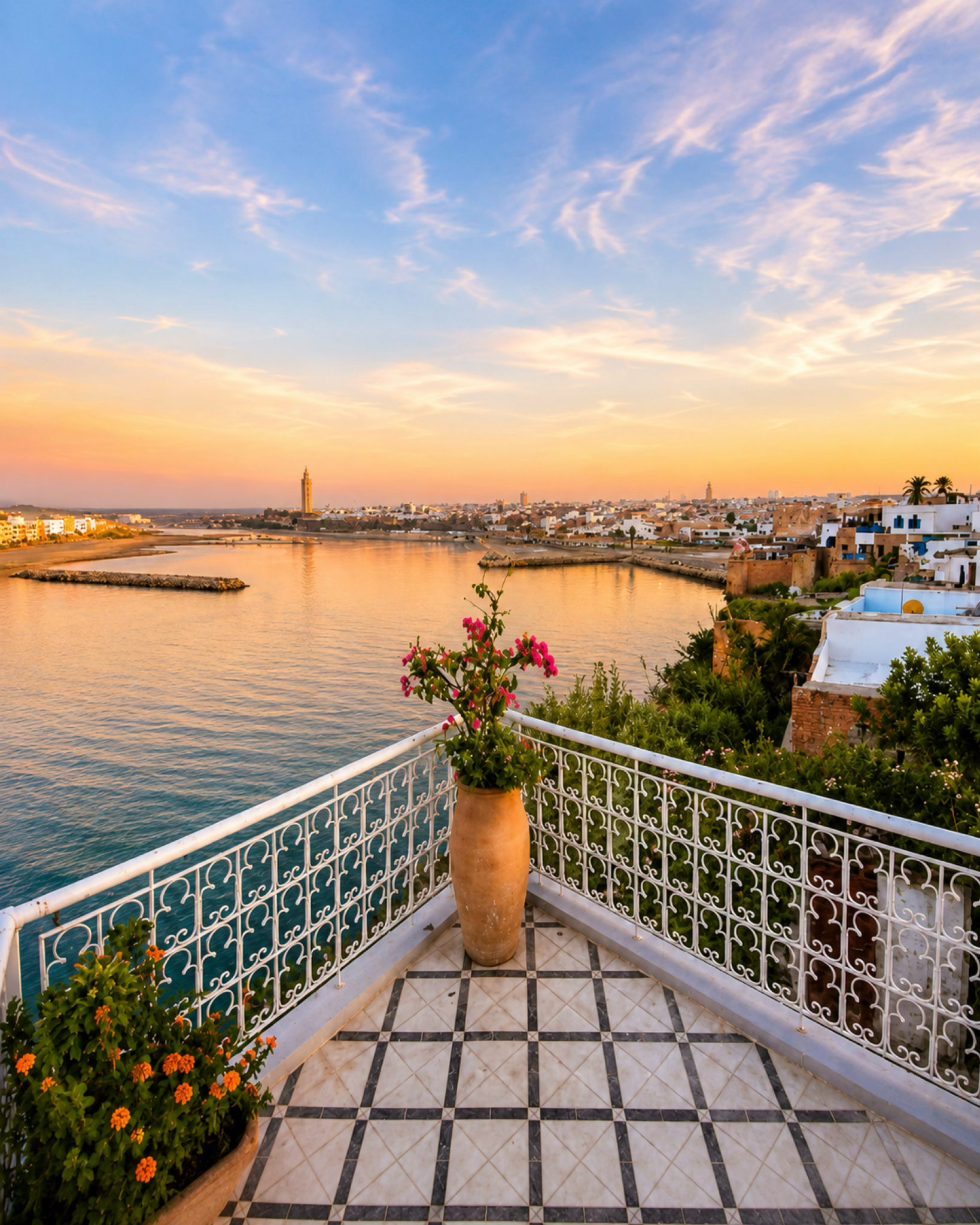
Read it as a sequence. The gate gives the first weight, the lanes reduce the scale, the garden softens the pace, and the terrace opens Rabat toward Sale, the river mouth and the Atlantic horizon.
The Kasbah of the Udayas is often remembered for its blue-white lanes and terrace view, but its deeper meaning begins with position. It stands at Rabat's old northern edge, above the Bou Regreg river mouth, where city, estuary, Sale and Atlantic horizon can be read together.
UNESCO's World Heritage description of Rabat places the capital on the Atlantic coast and recognises the dialogue between older Arabo-Muslim layers and twentieth-century urban modernism. The Kasbah is part of that older urban identity: a fortified quarter whose wall, gate and high ground explain how Rabat's historic city faces water, movement and defence.
The place matters because it makes Rabat's layered character legible in a small area. Monumental stone architecture sits beside domestic lanes. A formal garden sits behind defensive edges. The river view turns geography into orientation. Nothing needs to be exaggerated; the strength is already in the urban structure.
It also matters because the Kasbah remains a lived quarter. Visitors move through a place where heritage, homes, public movement and photography all overlap. That makes respect part of the experience, not an extra rule added at the end.
For a first-time visitor, the best reading is not only beautiful but exact: gate, wall, lane, garden, terrace, river, coast. Each element adds a layer, and together they show why the Kasbah is one of Rabat's most intelligent places to begin understanding the city.
Use the map first to place the Kasbah above the river mouth, beside Rabat medina and facing Sale across the Bou Regreg.
Editorial reading
Its beauty is civic, not only scenic.
The view is strong, but the Kasbah is not just a balcony over the river. It is a compact urban lesson: defensive architecture, ceremonial entrance, residential texture and landscape orientation compressed into one walkable quarter.
Look at how the stone gate changes the mood before the lanes begin. The approach is public and monumental; the interior becomes quieter, narrower and more domestic. That shift from authority to intimacy is one of the site's finest qualities.
The river matters just as much as the walls. From above, Rabat and Sale are no longer separate names on a map; they become a visual relationship shaped by water, bridges, estuary light and Atlantic wind.
The garden adds another register. It is not there simply as decoration, but as a pause in the sequence: after stone and before the terrace, shade and planting reset the visitor's pace.
The strongest photographs usually come after the strongest reading. Notice which spaces are public, which doorways are private, where residents pass, where visitors gather, and how quickly a beautiful lane can become intrusive if treated carelessly.
A good visit keeps the place whole. Bab Oudaya, the ramparts, the residential streets, the Andalusian garden and the river view should not be consumed as separate checklist items. They are one urban composition.
Return mentally to the entrance after reaching the terrace. The first wall, the narrowing lanes and the final horizon begin to explain each other. That is when the Kasbah becomes more than a pretty corner of Rabat.
Historical and heritage orientation
Read the Kasbah through Rabat's older city layers.
The Kasbah of the Udayas belongs to the historic side of Rabat's World Heritage identity. UNESCO describes Rabat as a city where older parts dating back to the twelfth century stand in dialogue with the planned modern capital. Within that wider story, the Kasbah gives visitors a concentrated reading of fortification, gateway architecture, residential continuity and river-facing urban form.
01Place type
A fortified quarter
The site is not a single monument. It is a historic kasbah quarter where walls, gate, lanes, gardens, viewpoints and homes form one urban fabric.
02Architecture
Almohad gate language
Bab Oudaya gives the approach its force through stone mass, horseshoe-arch form and carved surface. It should be read as a ceremonial threshold as much as a defensive marker.
03UNESCO 2012
Rabat World Heritage context
Rabat was inscribed on the UNESCO World Heritage List in 2012. The Kasbah appears within that wider property, linking the old city layers to the capital's protected urban ensemble.
04Continuity
Residential heritage
The blue-white lanes are visually memorable, but they are also lived spaces. Visitors should treat the quarter as a home environment as well as a heritage place.
A visual bridge
Three readings between gate, river and city
Before the Kasbah becomes a photograph, it is a relationship between built edge, water and daily urban life. These three readings help visitors slow down and understand why the place feels monumental from outside, then intimate at human scale.
01
Material
Stone as threshold
The Kasbah first speaks through wall and gate. Stone gives the entrance weight, but the carved surface prevents the architecture from becoming mute. The visitor is asked to pause before passing inside.
Read the gate before rushing through it.
Notice wall thickness, shadow and carved relief.
Understand beauty as structure and entrance ritual.
02
Water
River and Atlantic orientation
The Kasbah makes most sense when connected to the Bou Regreg and the Atlantic edge. Its high position turns geography into a visual guide: Rabat behind, Sale across the water, ocean light beyond.
Keep the river in mind before the terrace.
Connect the site to Rabat medina and Sale.
See the viewpoint as orientation, not only scenery.
03
Looking
Public edge before private lane
The strongest visit understands the change in scale. Outside, the Kasbah is civic and fortified. Inside, the lanes narrow, doors become personal, and the visitor has to move with more care.
Start with the wall and gate sequence.
Move slowly through turns and doorways.
Use restraint where residential life is visible.
Quick orientation
Type of place
A historic fortified kasbah quarter in Rabat, best understood through its gate, walls, residential lanes, garden sequence and river-facing viewpoint.
Urban context
The site sits between Rabat medina, the Bou Regreg river mouth, Sale and the Atlantic edge. Its force depends on both architecture and geography.
Best for
Almohad architecture, blue-white lanes, careful photography, city orientation, garden calm, river views and a deeper reading of Rabat's old city layers.
Closest city context
Rabat is the natural frame: the Kasbah belongs with the medina, Hassan Tower, Chellah, the riverfront and the capital's wider heritage route.
What visitors experience here
A place that changes as you pass through it.
The Kasbah works in stages. First comes the approach to the wall and Bab Oudaya. Then the scale tightens into lanes, thresholds and residential quiet. The garden slows the body, and the terrace releases the whole visit into water, sky and city.
Arrival
The gate as a pause
The approach is deliberately formal. Steps, wall mass and carved stone slow the visitor before the quarter begins. Give this entrance time; it is the first act of the visit.
Light
Stone warming at the edge
The ramparts shift from pale mineral tones to warmer browns as the light changes. Late afternoon is especially clear for reading surface, depth and shadow without making the place feel staged.
Movement
Blue-white lanes
Inside, the walk becomes smaller and quieter. Painted walls, turns, steps and doorways create a domestic rhythm that contrasts sharply with the monumentality of the gate.
Garden
Shade after stone
The Andalusian garden offers a needed change of pace. Planting, paths and enclosure make the visitor feel how Rabat's heritage is not only monumental, but also ordered and restful.
Terrace
The river explains the site
From the upper view, the Kasbah's position becomes obvious: Rabat medina behind, Sale across the river, the Bou Regreg below and the Atlantic opening the horizon.
Pace
A quieter kind of looking
The site loses meaning when treated only as a backdrop. The better visit gives time to public movement, private thresholds, the garden pause and the way the river holds the city together.
Place details and orientation
Read the Kasbah through six defining elements
No single detail explains the place. Its meaning comes from the relationship between gate, fortification, residential lanes, garden, river viewpoint and Rabat's old-city edge.
1
Bab Oudaya
The monumental gate gives the Kasbah its ceremonial face and turns arrival into an architectural event.
2
Ramparts and towers
The defensive walls make the quarter read as a protected edge before the visitor discovers its smaller residential scale.
3
Residential lanes
Blue-white passages, doors and turns keep the Kasbah human. They also remind visitors that privacy matters here.
4
Andalusian garden
The garden brings order, shade and stillness into the sequence between stone entrance and river viewpoint.
5
Bou Regreg terrace
The viewpoint is not only scenic. It explains the site's command of river mouth, city edge, Sale and Atlantic horizon.
6
Rabat medina threshold
The Kasbah sits close to the old medina, making it a natural bridge between fortified heritage and daily city movement.
Citadel, not scenery
The place asks for an urban eye.
Stand with the gate before entering. The first lesson is architectural: a fortified quarter announcing itself through stone mass, ornament, height and controlled passage. The entrance is not simply picturesque; it explains authority and threshold.
Then move closer. Lanes, steps, painted walls, private doorways and small turns make the place human again. This is where the visit becomes more than a view: the eye starts to understand how monumental heritage and daily life occupy the same space.
Keep the river in the reading. The terrace is meaningful because it turns the quarter back toward geography, connecting Rabat to Sale, estuary to ocean, and old city to modern capital.
Architecture and material intelligence
Fortress architecture is not only defence.
The Kasbah's fortified character is not just a military shell. Wall, gate, slope and river position organise the whole experience. The architecture controls arrival, protects edges, frames views and then releases visitors into a smaller residential world.
UNESCO's Rabat listing is useful because it treats the city as a layered ensemble. The Kasbah should be read the same way: not as one isolated sight, but as a historic quarter where older fortifications, urban housing, public gardens and twentieth-century capital planning all belong to the wider city story.
What to notice slowly
Look at Bab Oudaya as a threshold before treating it as a photo stop.
Notice where stone, plaster, whitewash and shadow change the mood of the walk.
Distinguish the public approach from the quieter residential lanes inside.
Read the terrace as geography: river mouth, Sale, Rabat and Atlantic edge.
Keep the garden in the sequence; it is a pause, not a filler space.
Respect closed doors, private thresholds and residents moving through the quarter.
Architectural reading
Three urban languages to notice
Gate and authority
The first language is public and monumental: carved stone, heavy walls and an entrance that makes the visitor feel the seriousness of the fortified edge.
Lane and privacy
The second language is domestic. Painted walls, doorways and tight turns make the Kasbah feel inhabited, so the visitor's movement should become quieter and more observant.
Terrace and horizon
The third language is geographic. The upper view connects the quarter to the Bou Regreg, Sale and the Atlantic, turning a local walk into a reading of Rabat itself.
Visual atmosphere
Stone, whitewash and river light
From gate to detail
Start with the wall and monumental entrance, then move closer to read carved stone, shadowed openings, painted surfaces and the way narrow lanes change the visitor's posture.
From whitewash to water
The strongest visual contrast is not artificial colour, but the meeting of pale walls, warm stone, river blue and Atlantic sky. Rabat's light keeps the place bright without flattening it.
From photo to memory
The image is powerful, but the deeper memory comes from connecting architecture with movement: entrance, quiet lane, garden pause, terrace wind and the river opening toward the ocean.
Nearby places and onward links
Connect the Kasbah to the wider Rabat map
The Kasbah belongs to a broader capital-city route. Rabat gives the clearest context, while nearby heritage, riverfront and Atlantic-coast pages help visitors understand the site beyond one viewpoint.
Rabat
The host city context for the Kasbah. Use it to connect medina, riverfront, monuments, museums and the calm rhythm of Morocco's capital.
The Kasbah is famous enough to attract fast visits, but it is still a lived environment. Move quietly through narrow areas, avoid blocking paths, ask before photographing people, and remember that not every doorway is public because the lane is beautiful.
Respect also means caring for the built fabric. Do not climb on walls, scratch surfaces, lean into fragile edges, leave litter, shout through residential lanes or treat interiors as props. A slower visitor sees more and harms less.
Ask clearly before photographing residents, guides, shopkeepers or private interiors.
Keep to appropriate walking routes and avoid pressure on walls, edges or planted areas.
Support local services with courtesy and fair-minded interaction.
Leave space in narrow lanes for residents and local movement.
Check current access, local guidance and practical conditions close to travel.
A strong first visit
Begin at the approach to Bab Oudaya so the gate, wall and slope can be read together. This first view gives the visit its structure: fortified edge, ceremonial entrance and city threshold before the smaller details begin to compete for attention.
Inside, move slowly enough to notice thresholds, painted walls, shade and domestic scale. Pause in the garden, then continue toward the terrace so the river view arrives as the final explanation of the site, not merely as a photo stop.
If you arrive with a guide, listen for the words that clarify the place: kasbah, Almohad gate, rampart, medina edge, Bou Regreg, Sale and Atlantic coast. These terms help organise what the eye is seeing and prevent the visit from becoming only a sequence of images.
Afterward, connect the visit to Rabat's wider route. The medina, Hassan Tower, Chellah and riverfront help the Kasbah feel less like an isolated attraction and more like part of the capital's layered heritage map.
Start outside, where the gate and ramparts are easiest to understand.
Enter slowly, giving attention to thresholds, shaded turns and residential quiet.
Use the terrace to read river geography, not only to photograph the panorama.
Leave space for local movement, guides and small businesses around the site.
Finish by connecting the Kasbah back to Rabat, Chellah and the Bou Regreg.
Careful planning note: opening hours, prices and exact travel times can change. Verify practical arrangements locally before travelling.
Go deeper through the nearest city context
Rabat — the city frame for the Kasbah of the Udayas
The Kasbah belongs naturally inside a wider Rabat journey. The city gives visitors a stronger base for reading Morocco's capital: medina life, Atlantic light, riverfront movement, royal and civic avenues, museums, gardens and protected historic layers.
Use Rabat to widen the context after the Kasbah itself. Chellah, Hassan Tower, the Bou Regreg waterfront and the medina all help explain how the fortified quarter belongs to a larger urban story rather than a single scenic stop.
Historic capital contextRabat city orientationMedina and river routesArchitecture and heritage readingPractical travel structureNearby Rabat highlights